
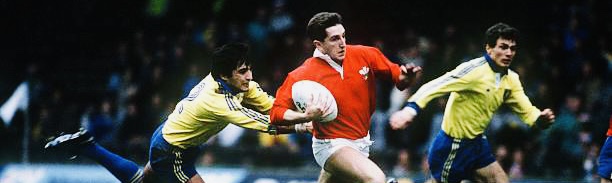
On December 10 1988, Wales faced Romania at Cardiff Arms Park, in what appeared, on the face of it, to be an ordinary run of the mill international rugby union match.
But on a bright winter’s day in the Welsh capital, events unfolded that triggered the onset of the biggest Welsh exodus to rugby league of all time.
A young and highly talented Wales team was about to be ripped apart, and a generation that had given us glimpses of some wonderful rugby, and more importantly, hope for the days ahead, were about to be lost to our friends in the North.
The band played the wrong Romanian national anthem before kick off, which was perhaps an omen, and things were about to get a whole lot worse.
The Wales team that day had a few new faces, but on paper looked a side strong enough to see off a Romanian team that could be best described as solid and workmanlike.
15 Tony Clement (Swansea)
14 Glen Webbe (Bridgend)
13 Mike Hall (Bridgend & Cambridge University)
12 John Devereux (Bridgend)
11 Richard Diplock (Bridgend)
10 Jonathan Davies (Llanelli) Captain
9 Robert Jones (Swansea)
1 Mike Griffiths (Bridgend)
2 Ian Watkins (Ebbw Vale)
3 Dai Young (Cardiff)
4 John Wakeford (South Wales Police)
5 Kevin Moseley (Pontypool)
6 Richie Collins (Cardiff)
8 Phil Davies (Llanelli)
7 David Bryant (Bridgend)
16 Paul Thorburn (Neath)
17 Bleddyn Bowen
18 Jonathan Griffiths (Llanelli)
19 Hugh Williams-Jones
20 Kevin Phillips (Neath)
21 Rowland Phillips (Neath)
Wales lost 15-9 to Romania, in front of 19,000 fans at Cardiff Arms Park, and apart from a classy John Devereux try, and five points from the boot of Paul Thorburn, who came off the bench as a replacement winger, there was very little to shout about.
As is often the case in Wales, it was one of the nation’s greatest players who was chosen to be the sacrificial lamb, to bear the brunt of the criticism and rancour in the aftermath of the defeat.
Trimsaran is a Carmarthenshire village that grew up around the coal industry, these days the magnificent Ffos Las racecourse has transformed the place, and although horse racing is relatively new to the area, Trimsaran knows a thing or two about producing thoroughbreds, it is the birthplace of Jonathan Davies one of the greatest talents Welsh rugby has ever produced.
Jiffy wanted a debrief with the Welsh Rugby Union, following the disastrous summer tour to New Zealand, where they lost two tests to New Zealand 52-3 and 54-9, however he was given short shrift, and his desire to get this talented team back on track was sneered at by many.
Jonathan was captain against Romania, and he took the defeat hard and personally. It seems unbelievable, but he actually feared for his place in the team.
With a young family to support, along with the uncertainty surrounding his union international future, he signed for Widnes Rugby League team a few weeks after the defeat.
The same critics that had castigated him days earlier, were now mourning his passing, and beginning to realise what a massive loss he would be to the Welsh team.
Jiffy’s wonderful career in league would be a constant sobering reminder to those that did very little to encourage him to stay.
I don’t think anyone, at the time, had an idea of what was to follow, and the large casualty count of players that would be lost to the 13 man game.
That Wales rugby Union team of 1998 had only months earlier won a Triple Crown, for the first time for nine years, and shared the Five Nations Championship title with France.
They played a scintillating attacking brand of rugby, and Jiffy at fly half was the orchestrator.
Against England at Twickenham Wales had four fly halves in the back line, Tony Clement, Bleddyn Bowen, Mark Ring and Jonathan himself. Adrian Hadley, who was to sign for Widnes, scored two tries that day as Wales ran England ragged.
On a bright sunny day at HQ Wales were irrepressible, Jonathan Davies, despite a heavily strapped ankle, tormented England flanker Mickey Skinner like a matador wielding his cape around an aged bull.
Victory at home to Scotland included Ieuan Evans “Merlin the magician” try, Wales clawed back a 20-10 deficit to seal the game with two Jonathan Davies drop goals, and won a scintillating contest 25-20.
A gutsy away win in gusty Dublin, 12-9, in a tough narrow contest, included a Paul Moriarty try, and was sealed with Jiffy’s signature finale, a drop goal.
The win gave Wales their first Triple Crown since 1979, and set them up for Grand Slam showdown in rain drenched Cardiff, a match that ended in the narrowest of defeats for the men in red, by a single point 10-9.
There was disappointment in the loss, but also for the first time since the magnificent 1970’s, there was a realisation that Wales had a team with the potential, and the talent, to set the rugby world alight.
A ridiculously scheduled tour to New Zealand, described by former Wales captain Dai Young as “the tour of death”, was the beginning of the end for this talented group of players.
It was absolutely brutal, young Wales flanker David Bryant was the victim of such ferocious rucking the scars on his back didn’t heal for a year.
Bryant made his Wales debut in the opening Test, in which Wales were crushed 52-3.
“Painful would be the word I would use to describe it. My lasting memory of the tour was I would come off at the end of the game, and they would take out the stitches I’d had the week before and put stitches in new wounds. I had 28 stitches in the head during the course of that tour.
The team suffered badly from injuries and had to call up six extra players during the course of the tour. Original tour captain Bleddyn Bowen broke his wrist in the second game and was replaced as skipper by Bob Norster, until he suffered a badly gashed knee, whereupon Jonathan Davies took over the captaincy.
Even All Blacks coach, Alex “Grizz” Wylie was horrified at the schedule the Welsh Rugby Union had agreed to. He went on record as saying he would never have excepted such a fixture for his team.
The stuffing was well and truly knocked out of a young Welsh side, but that should have been just one of the up’s and down’s that occur in the development of every great side.
The Welsh Rugby Union’s decision to sack Tony Grey and Derek Quinnell, the coaches, was a massive over reaction, and it lit the blue touch paper for the decline that was about to follow.
John Devereux, in an interview with Wales Online said: “We lost a generation, the 1988 tour did the damage. We were building something but that tour tore down all the good work that had been done by Tony Gray and forwards coach Derek Quinnell.
“It was absolutely ridiculous decision, the worst ever, to sack Tony and Derek after it, because they had learned so much from being in New Zealand and knew what they had to do, who knows what would have happened had they stayed as coaches? Maybe players wouldn’t have gone to rugby league.”
There is no doubt in my mind that the boys of 98 were something very special, it still rankles with me to this very day that the Welsh Rugby Union robbed us all of the pleasure of watching this team progress, to have them taken away from us piece by piece, player by player, was heartbreaking.
The relationship between league and union had always been a fractious one, to the extent that it was questionable whether there was a relationship at all.
Cheque books and Rolls Royce’s would glide southwards into the valley towns and the West Wales countryside in the dead of night, to entice their prey away from the amateur game, (as union was pre 1995), and for rugby men with families to support, the offers from the northern men in suits were often just too good to turn down.
Union viewed league with great suspicion, anyone associated with the professional game was persona non grata at every rugby union clubhouse and playing field. Union players suffered life long bans for simply attending a rugby league trial.
In 1947 George Parsons was picked to play for Wales against France in Paris. He got on the train at Newport but was thrown off due to an allegation of him speaking to a rugby league scout.
Widnes coach Doug Laughton, the man who signed Jiffy, turned up at the Gnoll on a scouting mission to watch the then Wales wing Elgan Rees play.
An enraged Neath committee man stormed over to Laughton and told him, “You can get out of here and you can take the big thug you’ve brought with you”.
That big thug was none other than Big Jim Mills. Laughton replied “I’ll go but only after you’ve told him (Mills) to leave”.
I would hazard a guess that the committee man found discretion to be the better part of valor, but the story is an example of how things were between the two codes.
Every Welsh rugby union generation was resigned to losing a player or two to league, it was the way of the world back then.
Terry Price and David Watkins the architects of Wales 1965 Triple Crown went North
The 1969 Triple Crown and championship winning team lost Maurice Richards and Keith Jarrett.
Even the golden generation of 1970’s were not spared, John Bevan, Roy Mathias, Stuart Gallagher and Clive Griffiths followed that well trodden path up country
The list of those great Welsh players who headed to Lancashire and Yorkshire is a who’s who of outstanding talent. Lewis Jones, Billy Boston, John Mantle, John Warlow, Colin Dixon, Clive Sullivan, Terry Holmes, Kel Coslett, Jim Mills, the list seems endless.
Jiffy’s success in league gave us all a Jekyll and Hyde sensation, there was huge delight at watching him reach his sporting peak as his genius matured and flourished, but also a hollow empty feeling of what could have been with Wales and the Lions, and when you read the list of those who followed in Jonathan Davies footsteps, you truly realise the extent of Wales’ loss.
He was presented as a Widnes player on 7 January 1989 after signing for a reported fee of £230,000.
Contrary to popular belief it was Adrian Hadley, and not Jonathan Davies who was the first of the Wales 1988 stars to switch to league, signing with Salford for a £100,000 fee, which was a record at the time .
Widnes and Warrington took the lions share of the union emigrees as 13 players left Wales for pastures new.
It was September 1988 when Adrian Hadley left Cardiff and his job with the Inland Revenue in Llanishen for the much more taxing role with Salford. Four months later Jiffy’s move to Widnes opened the flood gates.
In April 1989 Moriarty followed the path trodden by Holmes. Paul Moriarty signed for Widnes.
The following month Llanelli scrum half and fireman, Jonathan Griffiths joined St Helens.
John Devereux the wonderfully talented Wales and British Lions centre increased the ever growing Welsh contingent at Widnes when he arrived at the club in October 1989.
If the Union game in Wales was hoping for a respite when 1990 dawned they couldn’t have been more wrong.
As Valentine’s Day approached prop and cornerstone of the Welsh pack Dai Young moved from Cardiff to Leeds.
Late summer saw a further drain of union talent when Rowland Phillips and Allan Bateman both signed for Warrington in the September of 1990, Mark Jones joined them from Neath at the Wilderspool a month later.
There was a bit of lull in the exodus before Swansea, Wales and British Lions flanker Richard Webster signed for Salford in September 1993.
The effect on the union team was there for all to see, Wales were bottom of the 5 Nations Championship five times out of the next seven years.
When Wales recovered in 1993/94 and won the 5 Nations championship under the captaincy of Ieuan Evans, two further massive body blows scuppered any opportunity to build on that success when two of the stars of that team in time honoured tradition headed north.
Scott Gibbs joined St Helens in April 1994 and five months later Scott Quinnell who was proving to be a revelation for Llanelli and Wales joined Wigan in a deal worth £400,000 over four years. Quinnell’s loss was the hardest to come to terms with as he was the cornerstone of Wales hopes for the future, a massive ball carrier with great hands and at 22 years of age we had not even begun to see the best of him.
Bob Norster, the Wales team manager at the time said in his typical understated style ” I cannot pretend it’s anything less than a significant loss for us”.
We, the fans, still worshiped our heroes from afar, and even got the odd glimpse of their playing talents, albeit very rarely.
The Rugby League Challenge Cup Final at Wembley, every May, was always broadcast live on Grandstand, and invariably there would be one or two of our old flames featuring. The same could be said when Great Britain hosted Australia, or other Southern Hemisphere opposition, that too was an opportunity to look closely at the team sheets to see which Welshmen might be on display.
In our dreams we longed to be given the opportunity to see these boys back on the green green grass of home, playing league, union or even tiddlywinks, but we knew in reality that, despite our fervent hopes, the chances of it happening were very slim.
But then the year of 1995 dawned and all that was about to change.
1995 turned out to be one of the most memorable years in the history of rugby, for Union and league, things would never be the same again.
On 27 August 1995 Vernon Pugh QC announced that rugby union would become professional, and as a result the rugby road that had been heading North for generations, turned into a one way system with all the traffic heading south.
The irony in all this is the fact that in 1995 the Wales international rugby league team had the greatest year in their history.
They won a European Championship, and reached the semi finals of the Rugby League World Cup, but much more than that they captured hearts and minds back home in a rugby union stronghold.
For once, it didn’t matter a jot whether it was league or union, it was just rugby and it was Jiffy, Devs, The Clamp, Moriarty, Gibbs, Quinnell and co, wonderful players who set the pulses racing, who put their bodies on the line for Cymru. We rediscovered the lost generation, and we all welcomed them with open arms and open hearts.
In April 1995 the band Take That had a number one hit with “Back for good”, maybe Gary Barlow knew something we didn’t, because in October of that year the pied piper Jonathan Davies, whose move to Widnes started the exodus, began the flood returning back for good from league to union when he signed for Cardiff.
I am actually beginning to wonder if Gary Barlow is in fact a rugby mystic as his further compositions “Everything Changes” and “Never Forget” could well be the perfect soundtrack for that memorable year.
A litre of petrol cost 60p, in Wales and the average house price was £45,335 in 1995, John Major was Prime Minster, and perhaps even more staggering than the Wales rugby union departures, OJ Simpson was found not guilty of murder.
Wales played 7 internationals in 1995, winning 6 and losing just one, the one defeat being that memorable World Cup semi final against England at Old Trafford.
They won the European Championship, after victories over England and France, played two internationals in the USA, and reached the semi final of The Halifax Centenary Rugby League World Cup.
A regulation change in 1995 was the catalyst that set this team on the road to greatness Wales already had a back line to die for but were a bit short in the grunt and grind department. The change allowed players to qualify to play for Wales through their grandparents nationality. This opened the door to bolster the Welsh pack and set the Red Dragons on to great things.
Wales international Rugby League season began on 1 February and ended on 21 October.
During those 8 months the Welsh team had the time of their lives.
1 February
Wales 34 England 14 Ninian Park Cardiff
4 March
France 10 Wales 22 Carcassonne
11 June
USA 10 Wales 66 Philadelphia
18 June
USA 4 Wales 92 Philadelphia
9 October
Wales 28 France 6 Ninian Park Cardiff
15 October
Wales 22 Western Samoa 10 Vetch Field Swansea
21 October
England 25 Wales 10 Old Trafford Manchester
In the 7 international matches played, Wales scored 44 tries, with 17 different players touching down.
Iestyn Harris 6 Tries
Anthony Sullivan 4
Kieron Cunningham 4
Adrian Hadley 4
Gareth Davies 4
Scott Quinnell 3
Rowland Phillips 3
Mark Jones 3
Kevin Ellis 3
Allan Bateman 2
Jason Lee 2
John Devereux
Dave Williams
Ian Watson
Gavin Price-Jones
Paul Atcheson
Mark Sheals
Wales were also fortunate to have some superb kickers at their disposal. Jonathan Davies kicked 17 goals, Iestyn Harris, 12 and perhaps a less likely but talented kicker Adrian Hadley kicked 8.
Jonathan Davies the master of the drop goal also landed 2 of his delicacies in 1995.
The cold statistics are impressive, but this group was about more than fact and figures.
These boys had come home and you could sense their undiluted joy at being able to play on their fields, in their country, in front of their people, 1995 was a very special year indeed.
 Mike Pearce Rugby