
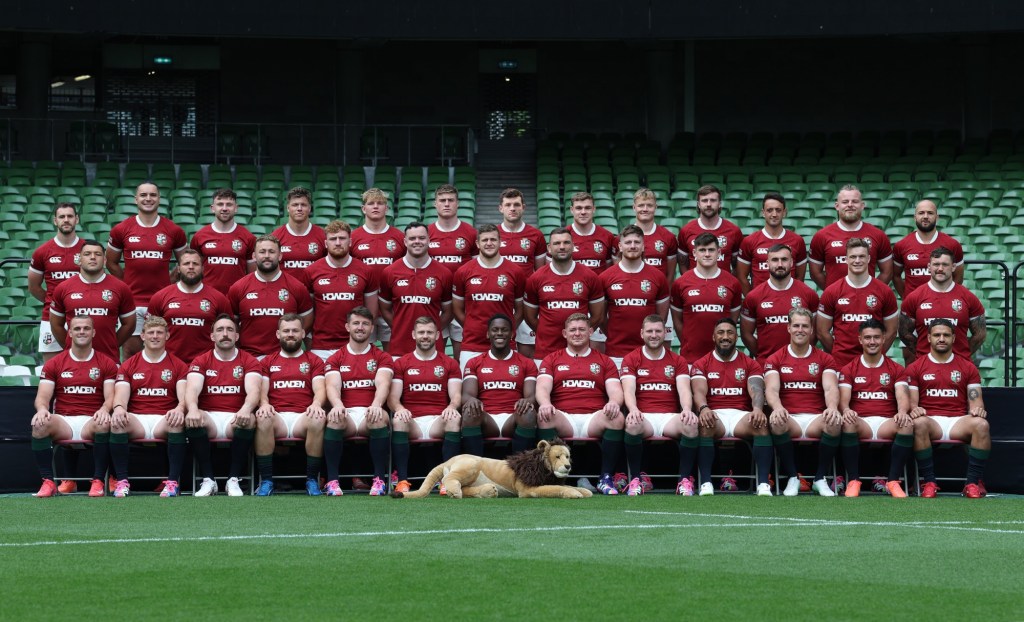
There’s something ancient in the way a British & Irish Lions tour begins.
It starts with a quiet rustling—whispers in rugby clubs from the Welsh Valleys to the Irish pubs of Limerick, in the granite towns of the Scottish Highlands and the rain-soaked lanes of northern England. There, in the corners of old bars and living rooms, people speak in reverent tones. “This might be the year,” someone says. “A new squad. A new land. A new chance.”
And then the names are called. Not just names, but dreams: Legends and upstarts, warriors and poets in the same breath. They’re not playing for just a nation now—but for four. For a legacy. For a red jersey that binds them in something greater than identity. A shirt that holds the sweat of McBride, the fire of Edwards, the bone-cracking grit of Johnson.
When the squad gathers, it’s a brotherhood forged from rivalries.
They arrive not as enemies, but as familiar strangers. Englishmen who once battered Irishmen in Six Nations slugfests now stand shoulder to shoulder in an Australian sunrise. Scots who once cursed Welsh counters now laugh over boots caked in the same foreign mud. There are jokes about accents. Banter sharp as a hooker’s throw. But beneath it all—trust begins to grow.
Training is war. Not against the opposition, but against expectation. Every pass, every ruck, every scrum in the camp is a reckoning. You’re not just playing for yourself anymore—you’re fighting to prove you belong in that jersey. The red one. The one that carries ghosts.
The Lions aren’t just a team. They are a myth that breathes. A tale told every four years that somehow always feels eternal. Wherever they tour—be it the high veldt of South Africa, the gold-cloaked fields of New Zealand, or the harsh edges of Australia—they are received like an invading storm. Admired. Hated. Respected.
And on match day, when the stadium trembles with anticipation, there is silence before the roar.
The red jerseys file out. The opposition stares them down. Locals chant. Flags fly. Yet when the anthem rings—not one, but many—something extraordinary happens. The Irish hum their hearts into “Ireland’s Call.” The Scots remember “Flower of Scotland.” The Welsh feel the pull of “Hen Wlad Fy Nhadau.” And the English—stoic, proud—tighten their shoulders with the memory of “God Save the Queen” or now “God Save the King.” But all that melts into one collective breath as the Lions stand together—not singing a song, but being the song.
Every match is a bruising glorious dogfight. You’ll see knees taped like scaffolding, eyes swollen, and breath taken in painful gasps. There are tackles that shake ribs. But then—magic. A flick off the boot. A break on the wing. A moment of brilliance that cuts through brutality like a hymn in a storm.
And win or lose—when it ends—something lingers.
Opponents come over and shake hands not out of duty, but with the weight of what just happened. They know what the Lions are. Not tourists. Not mercenaries. But messengers of an idea: that unity forged through rivalry can produce something greater than the sum of its parts.
Back home, pubs erupt. Boys and girls in playgrounds spin imaginary passes and wear oversized red jerseys. Old men cry in armchairs. Former Lions watch through clenched fists, reliving the ache of old tours. And for a few glorious weeks, the sport feels closer to a saga than a game. This is not just rugby. This is the roar that crosses oceans.
 Mike Pearce Rugby