
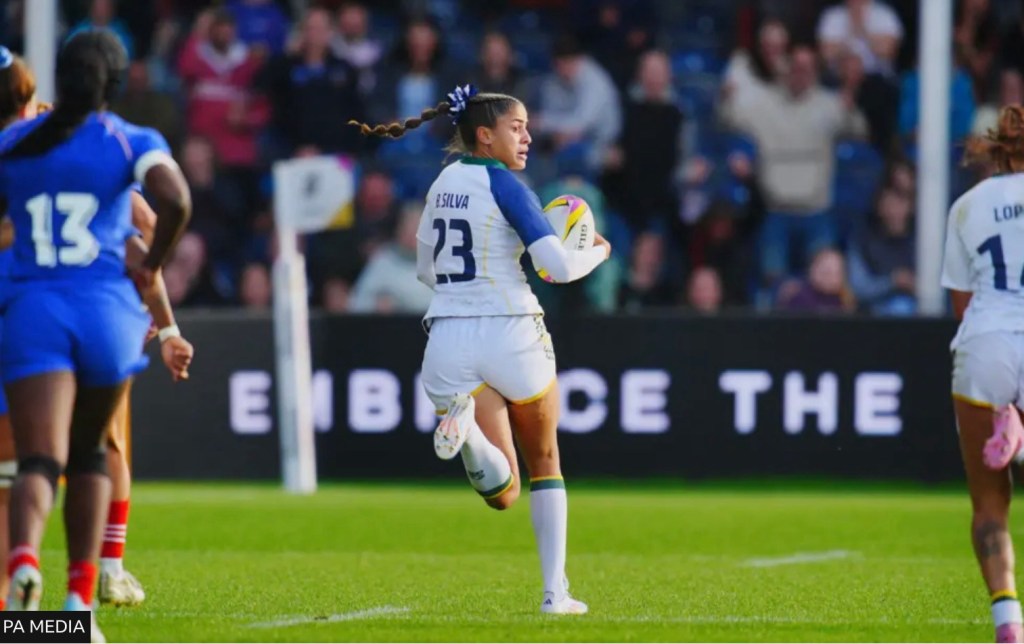
It was the 73rd minute in Exeter when the impossible became inevitable.
The scoreboard was already leaning heavily toward France, their dominance undeniable. But in that fleeting burst of space, Brazil’s Bianca Silva didn’t see the gulf in rankings, the gulf in resources, or the gulf in expectation. She saw her chance and took it.
Silva’s pace, honed from years on the sevens circuit, carried her clear. With the French line scrambling, she stretched out and touched down. Brazil had scored their first ever try at a Women’s Rugby World Cup.
The roar inside Sandy Park was louder than the margin on the scoreboard suggested. French fans, Brazilian fans, neutrals alike rose to their feet. It was more than a try, it was history being written in green and yellow.
Brazil’s rugby journey has long been tethered to the shorter format. As Olympic hosts in 2016, they invested in women’s sevens, and names like Bianca Silva became known for speed and flair. But XVs rugby, with its physical grind and tactical layers, was a different mountain.
Their path to England in 2025 wasn’t straightforward. They battled through qualifiers with limited resources, training in borrowed facilities, balancing full-time jobs with international ambitions. Many players had never experienced a full professional setup until this tournament.
For France, it was another commanding performance, their 84–5 victory a reminder of their place among rugby’s elite. But even French players joined in applause for Silva’s try. It was the kind of sporting moment that bends the narrative away from results and toward meaning.
“We’ve been waiting for this,” Silva said afterward, her voice breaking. “That try wasn’t just for me — it was for every girl in Brazil who’s picked up a rugby ball and wondered if this dream was too far away.”
Her teammates embraced her as if they had won the match itself. In many ways, they had.
Brazil’s try doesn’t erase the disparities in the women’s game. The challenges remain: funding, visibility, opportunities. But what Silva gave her team, and her country, is something beyond statistics.
A first try is a foothold. A reminder that they belong. A spark that could light fields far from Exeter, in São Paulo parks, in Brasília schools, in Rio’s favelas where children might now dream not just of football or volleyball, but of rugby.
On August 31st, 2025, in the southwest of England, Brazil crossed a line they had been chasing for years. The scoreboard may one day be forgotten. Bianca Silva’s try will not.
 Mike Pearce Rugby