

Twickenham glowed under a soft autumn sun, its stands brimming with history and hope. On the edge of south-west London, the Allianz Stadium’s 82,000 seats were packed, every voice, every flag, every heartbeat a part of something larger than sport.
England, the tournament hosts and favourites, unbeaten champions-in-waiting, faced a determined Canada, a side made strong by grit, by unexpected victories, and by the belief that they could shake the rugby establishment.
For England, this was redemption: memories of past finals lost, of near misses, of falling short when the weight of expectation was heaviest. For Canada, it was an opportunity to crown their underdog story with glory, to show the rugby world that their commitment, their spirit, could bridge gaps of experience and pedigree.
This was more than a match. It was a statement: that women’s rugby had come of age. The record-setting crowd, the sold-out Twickenham, the roar of the stands spoke of something transformed.
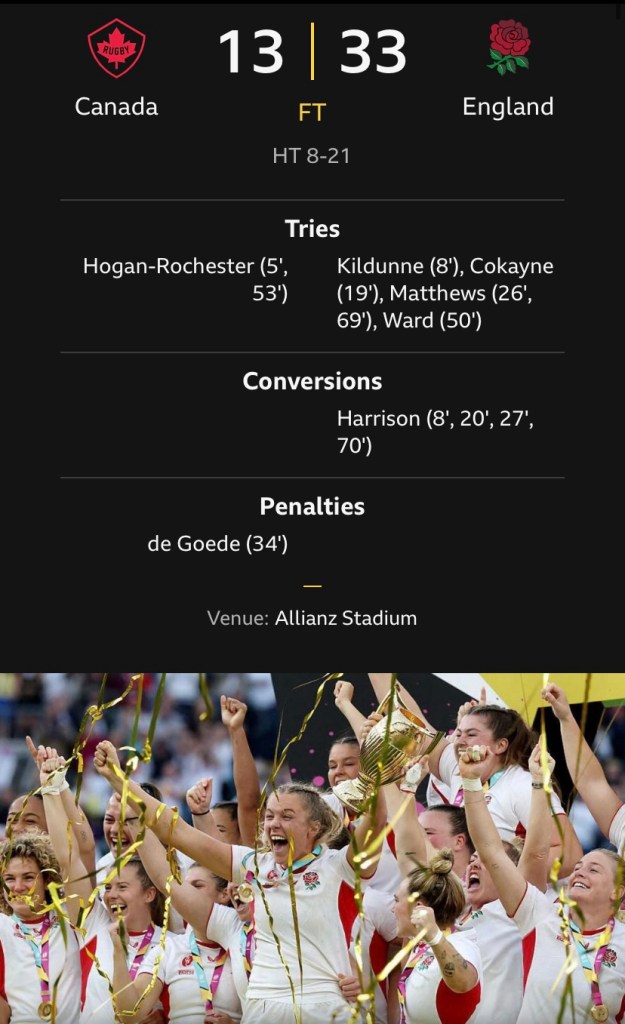
There was an early scare for England as Canada struck first through winger Asia Hogan-Rochester,
Ellie Kildunne responded with a wonderful weaving solo try of her own creating a roar that almost lifted the Emirates A380 flying overhead, turbulence was definitely a possibility.
Amy Cokayne, Abbie Ward, and Alex Matthews added tries to give England a commanding 26-8 halftime lead.
In the Second half Canada gained some momentum when England’s Hannah Botterman was shown a yellow card. Hogan-Rochester scored again for Canada, stirring hopes of a comeback, but Matthews’ second try sealed the game and the World Cup for England.
This final will serve as both inspiration and foundation. And for the sport globally, the 2025 final will be a reference point, a moment of unity, where the women’s game’s potential shone in full.
 Mike Pearce Rugby