
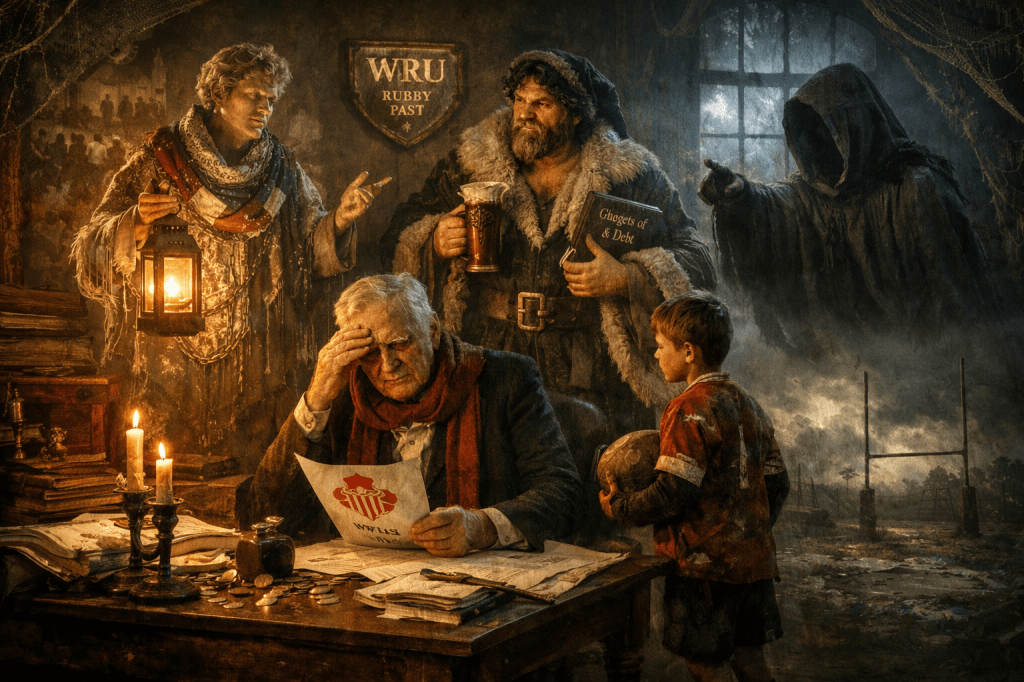
It was Christmas Eve, and the WRU was dead dead as the crowds that once shook the Arms Park. There was no doubt whatever about that. The door-knocker bore the dragon still, but it was tarnished, as if it had not known polish since the last Grand Slam.
The Ghost of Rugby Past came softly, wrapped in old programmes and coal smoke, its face at once youthful and ancient.
“Rise,” it said, “and walk with me.”
They walked through streets alive with song. Miners in caps stood shoulder to shoulder with teachers, choirs swelled before kick-off, and mud-streaked heroes ran not for contracts but for county, chapel, and pride.
“Do you remember this?” asked the Ghost.
The WRU trembled, for it remembered and could not return.
The Ghost of Rugby Present strode in with a balance sheet under one arm and a festive scarf under the other, though neither brought warmth. It showed the WRU a table set poorly: regions scraping by, players overworked, supporters counting pennies where once they counted tries.
In a cold meeting room sat men speaking warmly of “strategy” while outside, clubs shuttered like shops on Christmas Day.
“See here,” said the Ghost, pointing to a small, pale boy training alone in the rain.
“Is he a player?” asked the WRU.
“He is Grassroots,” replied the Ghost. “And unless you care for him, he will not long survive.”
The final spirit arrived shrouded in silence, black as a Neath rugby shirt.
The WRU saw empty terraces where songs once rose like prayer. It saw red jerseys worn by few, watched by fewer still. It saw headlines of decline, and a dragon remembered only as a crest on old pint glasses.
“Are these the shadows of what must be?” cried the WRU, “Or only what may be?”
The Ghost answered not, but turned its hand toward a neglected field, overgrown and locked.
Awakening with a start, the WRU found it was Christmas morning.
“No more meetings without meaning!” it cried. “No more gold before game! I will honour the past, support the present, and invest in the future!”
It flung open its coffers (modest though they were), spoke plainly, listened carefully, and remembered at last that rugby was made by people, not paperwork.
And so it was said, in years that followed, that Welsh rugby kept Christmas well — and if not always victorious, then always alive.
And Tiny Tim, now a fly-half, said:
“God bless us, every club.”
 Mike Pearce Rugby