Roses Blossom In Twickenham Sunshine

Blue skies and sunshine have been a rare commodity this year, but as the Guinness Womens Six Nations entered its penultimate weekend there was finally a taste of spring in the air, albeit with a chilly northerly wind just to remind us not to get too carried away.

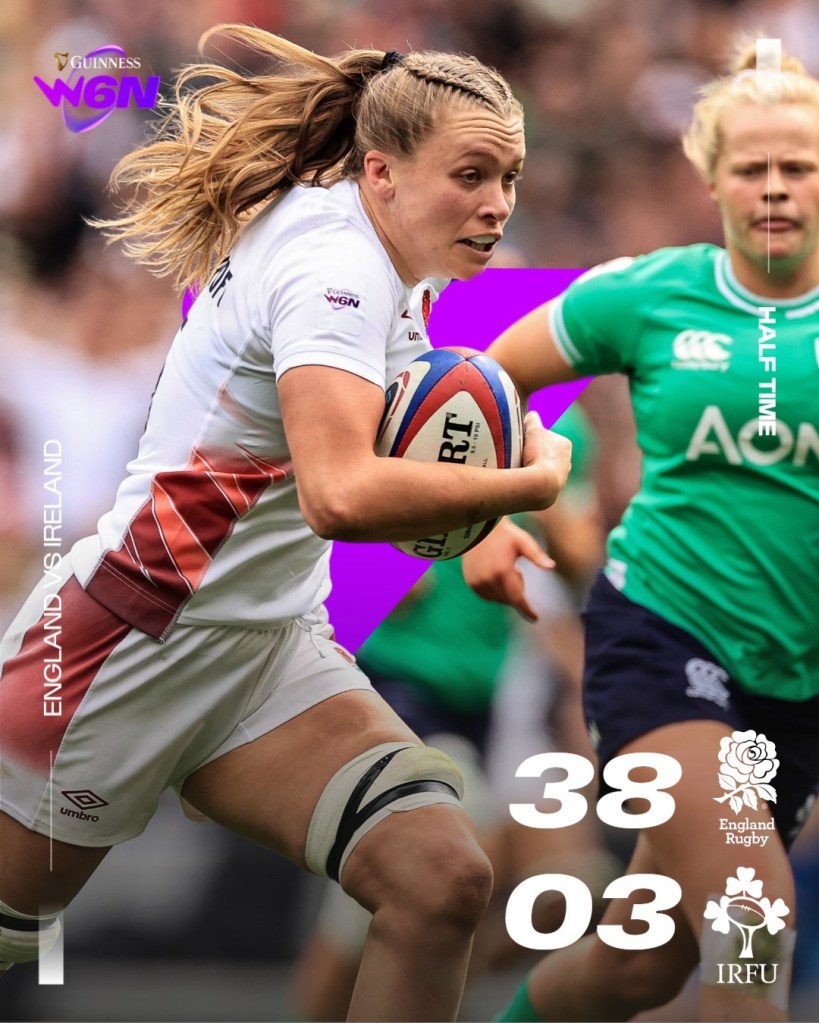
England faced a vastly improved Ireland in front of 48,778 excited fans, and as Sophie-Ellis Bextor sang ‘Murder on the dance floor’ the Irish whilst not contemplating homicide were certainly hoping for a giant killing against the number one team in the world.

Even Michael Flattley’s feet don’t move as fast as Ireland’s Beibhnn Parsons but she was starved of ball the entire game and it was the soft shoe shuffle of England’s Ellie Kildunne that ran Ireland ragged and helped win the day for the Red Roses. The Harlequins full back was imperious in everything she did in a wonderful performance.

It took England just six minutes to opening the scoring with a try from Abby Dow. Six more tries followed for the Red Roses in a one-sided first half.

At half time they led 38-3 and maybe it was the Sophie Ellis-Bexter song ‘Take Me Home’ that was echoing in the Irish players ears in the interval.

The second half was barely three minutes old before ‘The Chichester Express’ Jess Breach outpaced Katie Corrigan in a thirty metre run to touch down in the corner.

Things just got steadily worse for Ireland as England let rip, the Red Roses racked up fifty points in the second period and their fourteen try haul was a cavalcade of joyous movement and sublime handling.

Ireland had the scant consolation of a penalty try for their efforts.

You do wonder if and when there will be a serious Womens Six Nations challenge to the Red Roses, maybe next week in Bordeaux as they attempt yet another Grand Slam the opposition will be stiffer but at the moment they are streets ahead of anyone else in the Northern Hemisphere.

England Women 89 Scotland 0 Women’s Six Nations 2011 Twickenham

England recorded their sixth straight Six Nations title after a comprehensive win over Scotland Women at Twickenham.The rout was the biggest in England’s history, surpassing the 82-0 World Cup win over Kazakhstan last year.

The hosts took a 41-0 lead into the break after a totally dominant display.

England scored 15 tries in all, with Heather Fisher, Maggie Alphonsi, Emily Scarratt, Fran Matthews, Rochelle Clark and Danielle Waterman all getting two.

England’s women have now won all four matches in this year’s tournament and last year’s World Cup finalists are on course to clinch a fifth Grand Slam in six years.

The women ran onto the pitch immediately after their male counterparts had put a packed Twickenham through 80 minutes of tense, nervy rugby, which Grand-Slam chasing England eventually won 22-16.

For those fans who stayed behind, of which there were plenty, there was little of that tension in the day’s second international as England – much-changed from the line-up which beat France in their last outing – scored four tries in the opening 20 minutes.

Scotland, yet to record a victory in this year’s Six Nations, could not muster one attack in the first half and were constantly under the cosh as England broke tackle after tackle to score try after try.

Katherine Merchant went over in the second minute and Matthews scored her first of the evening four minutes later before captain Katy McLean put full-back Scarratt through to score underneath the posts.

McLean made sure of the conversion, her first of the evening, as England led 17-0 after 12 minutes.

In the 16th minute, Becky Essex proved unstoppable when she burst down the left to score in the corner.

Clark touched down from a yard out for a try which McLean converted, then Matthews went over before, in the dying moments of the half, the impressive Fisher scored a deserved try.

Fisher scored her second of the evening immediately after the break as she burst through from the 22-yard line to score under the posts to leave McLean with an easy conversion.

England made a host of changes, the most notable being Alphonsi for former captain Catherine Spencer, and they passed the half-century mark in the 49th minute when Scarratt scored her second of the evening, which McLean converted.

The dynamic Alphonsi was soon in the thick of it and it was the flanker’s 30m dash down field which eventually led to prop Clark’s second try.

McLean converted to extend the lead to 60-0 and the scoreboard kept ticking over as Merchant burst down her right wing, fending off would-be tacklers, and put the supporting Alphonsi clear for an easy try.

McLean was the next to cross the line and, in the 68th minute, the remarkable Alphonsi scored her second try of the evening and her 19th try in 53 internationals.

Captain McLean once again converted and two tries in quick succession by replacement Waterman, with McLean converting the latter, took England’s score to new heights.

England Women: E Scarratt (Lichfield); K Merchant (Worcester), R Burford (Richmond), K Oliver (Bristol), F Matthews (Richmond); K McLean (capt, Darlington Mowden Park Sharks), LT Mason (Wasps); R Clark (Worcester), A Garnett (Saracens), S Hemming (Bristol), R Essex (Richmond), J McGilchrist (Wasps), S Hunter (Lichfield), H Fisher (Worcester), C Spencer (Bristol).

Replacements: E Croker (Richmond), C Purdy (Wasps), R Burnfield (Richmond), M Alphonsi (Saracens), G Rozario (Lichfield), G Roberts (Darlington Mowden Park Sharks), D Waterman (Worcester).

Scotland Women: Caroline Collie (Old Albanians), Katy Green (Murrayfield Wanderers), Annabel Sergeant (Dundee University), Steph Johnston (Hillhead/Jordanhill), Victoria Blakebrough (Richmond), Lisa Martin (Murrayfield Wanderers), Louise Dalgliesh (RHC Cougars); Heather Lockhart (Hillhead/Jordanhill), Lindsey Smith (Hillhead/Jordanhill), Tracy Balmer (Worcester), Anna Swan (Edinburgh University), Lindsay Wheeler (Darlington Mowden Sharks), Charlotte Veale (London Wasps), Ruth Slaven (Murrayfield Wanderers), Susie Brown (Richmond).

Replacements: Alison MacDonald (RHC Cougars), Beth Dickens (Murrayfield Wanderers), Tess Forsberg (Richmond), Jemma Forsyth (Hillhead/Jordanhill), Tanya Griffith (RHC Cougars), Laura Steven (Murrayfield Wanderers), Lauren Harris (Aberdeenshire Quines).


Goodbyes Goodnights And See You Later

With the Men’s 2024 Guinness Six Nations disappearing further in our rear view mirror a period of reflection inevitably follows.

To call the tournament disappointing from a Welsh point of view would be the understatement of the year, but not since the great Rugby League defection in the late 1980’s has there been such a loss of talent in such a short space of time, and when you add in the list of injuries to current key players it underlines the perfect storm the international team find themselves in.

But the biggest and saddest losses of all are those greats of the game who have passed away recently, names that will forever live in the pantheon of Welsh rugby.

It has been a tough time for everyone connected with Welsh rugby let us hope there are some happier days ahead soon.

GOODBYES

Alun Wyn Jones (Retired)

Leigh Halfpenny (Retired)

Josh Navidi (Retired)

Justin Tipuric (Retired)

Dan Biggar (Retired)

Rhys Webb (Retired)

George North (Retired)

Ken Owens (Retired)

Liam Williams (Moved to Japan)

Tomas Francis (Moved to France declared unavailable)

Gareth Anscombe (Moved to Japan returned injured)

Rhys Patchell (Moved to New Zealand)

Rhys Carre (25 cap rule now illegible)

Joe Hawkins (25 cal rule now illegible)

Louis Rees-Zammit (Switched sports to NFL)

GOODNIGHTS

JPR Williams (1949-2024)

Barry John (1945-2024)

Brian Price (1937-2023)

Lewis Jones (1931-2024)

SEE YOU LATER

Taulupe Faletau (Injured)

Jac Morgan (Injured)

Taine Plumtree (Injured)

Christ Tshiunza (Injured)

Dewi Lake (Injured)

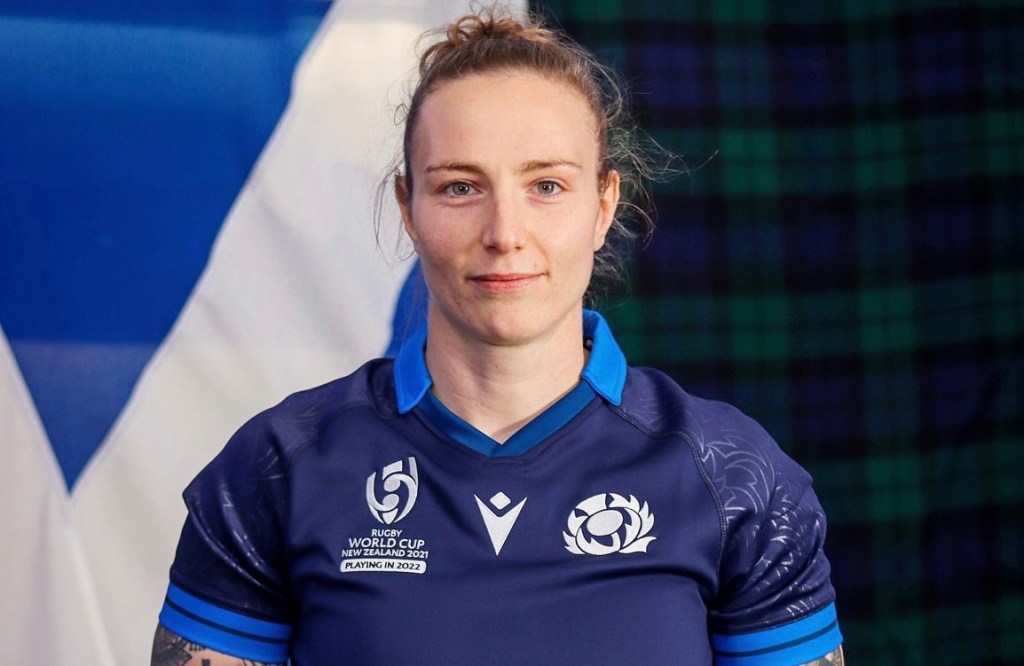
Black Isle Jade The Bionic Number Eight

It is fourteen miles from Inverness to Loch Ness, a place known around the world for its mythical monster, but Nessie’s neighbour is a sporting monster, and a very real one, that is frightening the life out of everything that crosses its path.

There have been many reported sightings this season, both north and south of the border, and the conclusion is that Nessie is a lightweight compared to the Inverness version.

I am in my cryptic way referring to Scotland and Harlequins number eight Jade Konkel-Roberts who has been knocking the living daylights out of the opposition since her return from a long term shoulder injury in the latter stages of 2018.

Jade made her Scotland Women debut against England when she came on as a replacement in the opening round of 2013 Six Nations.

She became Scotland’s first full-time female player in 2016, and joined top French club Lille Metropole Rugby Club Villeneuvois in 2017.

The basketball skills honed at the top level following two seasons with the Highland Bears, are evident on the rugby field, I do not recall witnessing her drop a single ball during last season’s Premiership campaign, where she has wore the Harlequins shirt with such pride and passion.

After joining Harlequins in 2018 following shoulder surgery, she returned to international duty with only a handful of club games under her belt, and hit Canada like a guided missile,

Scotland lost on that occasion but Jade had a storming game tacking, as the great Bill McClaren once said “Like the crack of doom” and launching those “Rhino” charges from the base of the scrum as if her life depended upon it.

Jade Konkel was born on December 9 1993 in Inverness, and lived on the Black Isle an appropriately named location for any respectable monster to reside. Inverness lies on the Great Glen Fault, where there are minor earthquakes, usually unnoticed by locals, about every three years, I have a theory they nearly always occur when Jade is home doing some tackling practice, but geological confirmation is difficult to come by.

Fortunately off the field Jade is one of the most modest and friendly individuals you could wish to meet, a smile is always close to hand, and her soft highland brogue could charm the birds from the trees.

That aforementioned brogue is now delighting BBC viewers as she has become a part of their commentary team for the Guinness Women’s Six Nations tournament.

The forward combines her sporting career with her role as a Firefighter with Red Watch, based at Feltham Fire Station, which she joined in 2021.

Sadly due to the attritional nature of her game injuries have become a regular if unwelcome visitor, one that is residing with her as I write, some say she has spent more time in re-hab than Brittany Spears

The dictionary definition of Jade is ” A semi precious stone” maybe that should now be changed to “An extremely precious Scottish rugby player”, one thing we do know is that she’ll be back from injury stronger than ever as her quest to become fully bionic reaches fruition.

Nolli The Red Rose That Always Bloomed

When the mist rolls in off the Bristol Channel on a cold winters night, the folks that inhabit “The Old Ship Aground” pub in Minehead tell tales that send chills down your spine, tales of shipwrecks and smugglers, tales of peril and tragedy in the local waters that have one of the highest tidal ranges in the world.

Inevitably as the night gets darker, and the ale gets more plentiful, the tales get taller, as indeed do the stories of local heroes who have become legends, largely through many misty ale soaked nights where the thin line between fact and fiction is breached.

One local legend is immune from such treatment, a local Barbarian whose exploits are so incredible in their own right, there is no need for embellishment, even fiction writer Arthur C Clarke, also born in Minehead, would have difficulty making these tales taller, even ale assisted.

Rugby can be a brutal and unforgiving sport but every now and then a player arrives on the scene that can raise the game above the ordinary, a player who amid the bump and grind of top-level sport, manages to make the difficult look easy, a player whose skill and execution provide a sheer beauty, grace and elegance that warms the soul, sets our pulses racing,  a player that appears to have more time and space than those around them, Danielle Waterman is such a player, a red rose that could always be guaranteed to bloom, whatever the weather, whatever the soil conditions, she has graced the white shirt on eighty-two occasions.

It is impossible to calculate how many girls and women have been inspired to take up the game by watching her, but I have witnessed first hand the  “Nolli Effect” around the playing fields of Europe. She is renowned for her bravery on the field, but perhaps even more noteworthy is her bravery off it, for being part of the RPA “Lift The Weight” campaign and discussing her depression candidly, typically, not for her own benefit, but through a desire to help others who may or have suffered similarly.

Danielle Waterman’s list of achievements is endless, a Rugby World Cup winner in 2014, nomination for World Player of the Year, a member of the first ever Team GB Rugby Sevens squad to compete at the 2016 Olympic Games in Rio.

Nolli captained England A at the tender age of seventeen, and made her full England debut in 2003 whilst revising for her A levels, aged just eighteen. But in the years to come we will not be discussing the cold statistics, it will be that sidestep, that tackle, or the unique running style, and that joyous smile after scoring a try or making a last ditch tackle.

So if you ever happen to visit “The Ship Aground” on a damp misty moonlit night and you notice the locals huddled together speaking in hushed tones, they may well be telling tales of horticulture, or to be specific their favourite local Red Rose.

Red Rose Trailblazer Rachael Burford

Sport at its simplest is an expression of joy and competition, an arena where players and fans can unite in a common cause, sharing hope despair joy and heart breaking sadness.

Sport mirrors society, and yet in many ways sport can be a catalyst for social change, to create equality in gender, sexuality and in the way we treat our fellow human beings.

Rachael Burford is a rugby player, she is a brilliant rugby player, and when you discover that she is a thoroughly lovely, friendly down to earth, and modest, individual to boot,  you can see why she is hugely admired and respected by those in our game.

Women’s rugby is growing and growing, and it will be forever grateful to people like Burf for lighting the blue touch-paper, those that follow will find the path a lot smoother, thanks to Rachael and co having paved the way.

I’m not sure what magical properties lurk in depths of the River Medway in Kent, but the Garden of England has produced Red Roses by the bouquet load, along with the odd flower of Scotland.

Working tirelessly to promote foster and encourage the women’s game, the formation of the Burford Academy has given young girls a wonderful opportunity to learn and train  with the greats of the game, including Danielle Waterman, Rocky Clarke and Katy Daly McClean.

But it’s not just about rugby, the attitudes and confidence gained at the academy translate into life skills, transferable into society at large, which is perhaps the greatest legacy of all.

Rachael is a Red Rose legend but at Harlequins she is just one the gang, taking and giving the banter in her own humble way

When her playing days are over, which is hopefully a long way off,  I have no doubt she will become a brilliant coach, in fact she has already achieved her RFU level 2 coaching badge.

Her media skills are also superb, and she looks supremely assured in front of the camera.

Revealed as one of the top 50 most influential rugby people In Rugby World magazine, Rachael continues to set the standards on and off the field

Her playing career has been nothing short of incredible, 81 England caps, four world cups, two World Cup finals, two World Cup Sevens, a six nations grand slam and the RPA merit award in 2017 together with some bloke called Richie McCaw.

Burf’s floating passes are a thing of beauty, World Cup winning coach Gary Street compared them to Beethoven’s Fifth Symphony, but for me they have an operatic quality more akin to a Puccini aria you know exactly what’s coming but it is still always a joy to behold.

Burf has straddled the bridge between old world rugby and the new order, managing to retain the old values, whilst embracing the hard edged professionalism that is an essential requirement at the top end of the game.

Those so important roots were established at Medway RFC which was virtually a family concern, Dad did everything from the bar to the books and the boots, whilst Rachael spent her formative years in the scarlet and gold shirt, the highlight being a season playing alongside mum Renata and sister Louise.

Everything that can be written about Rachael Burford has already been done so, and in many forms and guises, but for me it is her actions that separate her from the rest.

She has been a pioneer and pathfinder  for the women’s game, quite a weight to carry when you are trying to focus on your own game, but those strong shoulders, the ones that rotate to provide a pass worthy of Beethoven or Puccini, bear the load with grace, poise, and in a light humble manner that make it appear effortless.

Maybe the River Medway does have magical properties after all.

Graceful Gaby The Centre Of Attention

The western Paris suburb of Rueil-Malmaison has had a few notable residents, perhaps the most famous being Napoleon Bonaparte and his beloved Joséphine.

Nestled on the banks of the Seine, and less than 20 km from Paris, the town, as well as its river banks and “guinguette” dance halls, became, at the end of the 19th century, a favourite setting for artists, including Monet, Renoir and Sisley.

But now there is a new artist emerging, French centre Gabrielle Vernier. Born in “Rueil” on 12 June 1997 she began training at the tender age of ten for Rueil Athletic Club. After spending four years at the club, where she developed her knowledge and passion for the game, she moved to Racing Club Nanterre as Rueil had no junior side.

After three years in Nanterre, Gaby continued her rugby journey northwards to Lille to pursue her academic studies and develop her game. In 2016, she made her senior debut for Lille MRCV and won the French championship during her first season at the club. This led to selection for France U20s and her senior international debut came one year later on 11 November 2017, in a match against Spain.

“My studies then took me to the north, to Lille, where I was able to combine my career as a student and a sportswoman. In 2016, I started my senior years at the LMRCV, club de villeneuve d’ascq. During these Lille years, I was lucky to be selected in the French team under 20 years old and then in the French Senior team the following year when I had the opportunity to make some appearances. Since 2018, I have been under a semi-professional contract with the French rugby federation”.

Gabrielle Vernier left Lille to join Blagnac Rugby Féminin where she currently plays her club rugby. “I wanted to change my air and challenge myself. It’s going really well. It is a dynamic club, with a very well-supervised group of young people. A real happiness! ” says the general engineering graduate.

The Rugby World Cup in New Zealand was an incredible experience especially that wonderful semi-final which France lost 25-24 to eventual winners New Zealand. Gaby’s 39th minute try shook the Black Ferns and gave France an unexpected half time lead.

She says she will never forget the memories lining up for her first le Marseillaise with the U20’s in Esher, and the second time in Mont-de-Marsan. “It’s the first time I played in front of so many people, it made a big impression on me.”

In her spare time she plays the saxophone and will aiming to hit all the right notes in the Guinness Womens Six Nations tournament this year.

The combination of grace beauty and power that she possesses are in the French DNA database tapped into by of all the great centres that have worn that wonderful blue shirt, irrespective of their gender.

France face Ireland in Le Mans on Saturday and Gabrielle will be looking to engineer a try or two.

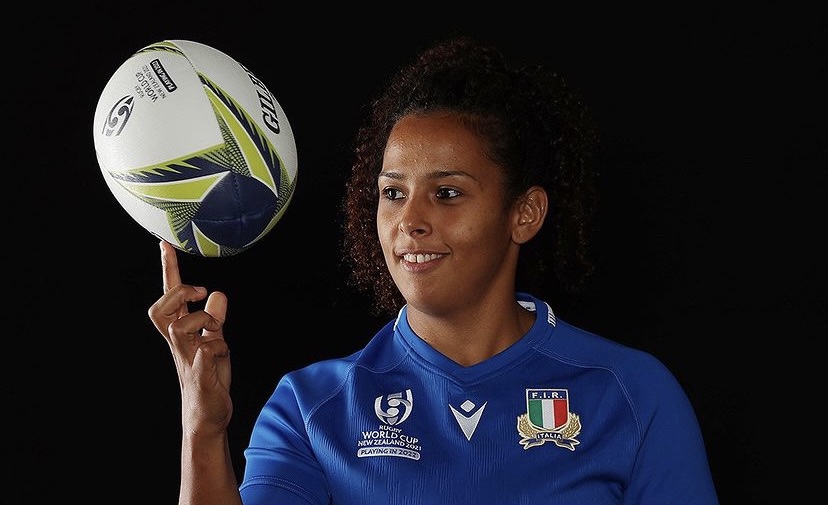
Force Of Nature Giada Franco

GUINNESS WOMENS SIX NATIONS 2024

Naples is no stranger to seismic activity, Mount Vesuvius is the only volcano to have erupted on mainland Europe in the last one hundred years.

Situated on the breath-taking gulf of Naples, it has a majesty, beauty and power that showcases nature in all its terror and wonderment.

The last eruption came in 1944, although in 1996, another force of nature was about to enter the local landscape, Giada Franco.

The family moved 54 kilometres south east, along the Amalfi coast, to settle in Salerno, a lively port with a relaxing Mediterranean ambiance, and an historic town full of tiny little passageways and hidden corners.

The bubbly Italian started playing rugby aged 13 at school, before starting senior rugby with Colerno, just north of Parma, in the Emilia-Romagna region.

Many have felt the aftershock of the dark haired flanker’s rib shattering tackles, and her eruptions, unlike Vesuvius, take place weekly at training and on match days.

Away from rugby the young lady of Naples is a big fan of “Le vechia signora”(The old lady of Turin) which for the uninitiated,  is the nickname of Juventus football club, one of the giants of the game.

A firm fixture in the national side, Giada made her  international debut in the 2018 Six Nations in Dublin.

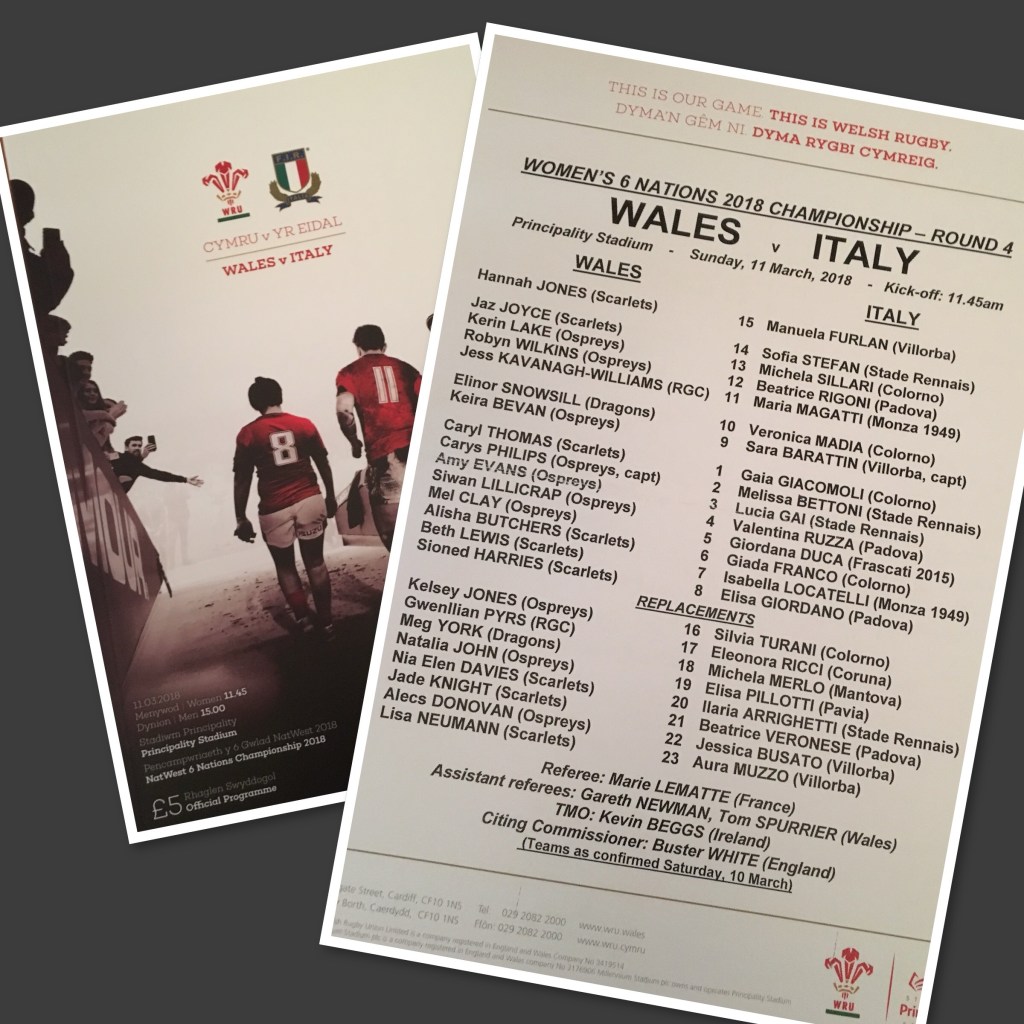
One of her most memorable moments came at the Principality Stadium in the Six Nations double header against Wales in 2018, when the “Azzura Assasin” played a blinder, it was the first time I had seen her play, she made a huge impression and has been a permanent fixture in the national team ever since.

Following her stint in England with Harlequins, where much to my good fortune we became friends, she returned to her first senior club back home Colorno.

Colorno is a comune in the Province of Parma part of the Italian region of Emilia-Romagna, located about 90 kilometres northwest of Bologna and around 15 kilometres north of Parma.

She enjoyed her time in England with Harlequins but she did admit to missing the sunshine and the gastronomical delights of home, particularly “Bistecca alla Fiorentina” which is a thick cut of porterhouse steak from an ancient breed of Tuscan cattle, instead of inches, these steaks are measured in fingers, and a good one will be 3-4 fingers thick, and Giada insists they don’t forget the fries.

Giada says “It was a fantastic experience, in England I experienced a totally different way of seeing rugby, especially women’s rugby. In addition to the very high level of play, there is a great organization behind the championship, structured to perfection and very competitive … Then the Harlequins are a fantastic club. I’m sorry that this experience ended prematurely because of the covid. ”

The “Leonessa di Colorno”, a nickname derived from her determination and those luscious locks, will be prominent on and off the field the 2024 Guinness Womens Six Nations.

This planet is a small place where the past and present are indelibly linked, when I first met Giada we sat over a coffee discussing the joys of rugby, and life, we discovered that both our grandfathers saw active service in Salerno during the Second World War, it is a small world indeed, but one in which Giada Franco is making a big impact.

Wales Fail To Stir In Wooden Spoon Decider

In Italy Olive wood is rare because there are only a limited number of trees that can be sustainably harvested each year. In addition, it takes many years for an olive tree to mature enough to be harvested for wood, making it a highly sought-after commodity. This durable long lasting wood is used to make traditional spoons used in kitchens throughout Italy and beyond.

Whilst these wooden spoons are rare and much sought-after, the rugby equivalent is the exact opposite, but it has been in mass production in Italy since the Azzuri entered the Six Nations tournament back in 2000.

The bond between Wales and Italy is a very close one, particularly in the Welsh capital, and when heading northwards up in to the valleys.

There was a time when every little town and community in Wales had an Italian cafe and an ice cream parlour, many of them have now disappeared, superseded by multi-national chains, but the memories still remain, not just of the cafes, but also of the people who ran them and how they and their establishments became a centre of those communities.

As Wales and Italy prepared to battle it out for that unwanted piece of kitchenware, Cardiff’s wealth of Italian eateries filled up, Giovanni’s, Da Mara’s, Stefano’s and Antonio’s provided a conveyor belt service of antipasto, meatballs al forno and pizza.

Whilst the meatballs were mouthwatering Wales performance in a miserable defeat was unpalatable and left a bit aftertaste.

Despite the narrow score line this was a day when Wales were rudderless and error strewn.

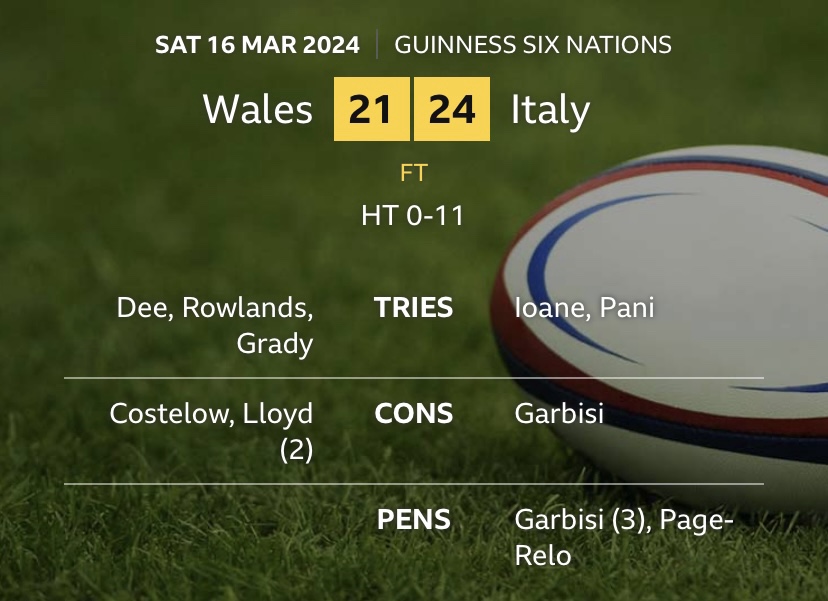
An 11-0 Italian half time lead was the least Italy deserved against a Wales team who were poor in every facet of the game.

A converted try by Pani after 45mins stretched Italy’s lead to 18-0.

On 63mins Wales final got on the scoreboard with a converted try from Elliot Dee (18-5) Two further penalties from Garbisi and Page-Rolo gave Italy an unassailable 24-5 lead with 72 minutes on the clock.

Two converted tries for Wales by Will Rowlands and Mason Grady in the final two minutes of the match were a consolation that created the false impression of a close game.

Whilst the men in red cannot be faulted for effort their lack of physicality and error count were alarming, this was indeed a very dark day for welsh rugby.

You feel that Wales first wooden spoon since 2003 will not be their last.

Mam’s The Word As France Finally Fizz In Cardiff

There were many sons and daughters facing an agonising decision yesterday, do they risk the wrath of Mam by neglecting Mothering Sunday duties and head to the Principality Stadium, or do they take the safest and most diplomatic option to stay at home and indulge their maternal parent.

Of course the alternative, and perhaps most obvious option, was to buy an extra ticket for Mam and take her to the game, whether she wanted to go or not.

Those brave souls who took the first option, with early morning appeasing flowers and chocolates delivered, were there on hand to witness new boys Joe Roberts and Gaël Fickou lining up for their respective National anthems, certainly no soft centres on view there.

Those gnarly French props have the kind of faces only a mother could love, but nothing that compares to the grizzly front row legends of yesteryear, Messrs Ondarts, Cholley, Garuet and co were once described by Bill McLaren as “Having faces like a bag full of chisel’s”.

But beauty is in the eye of the beholder and this current French outfit are obviously fully paid up members of the ‘big is beautiful’ brigade with Emmanuel Meafou and Uini Atonio pounding the Cardiff turf at a Teutonic plate sheltering combined weight of 46 stones, the former also measuring 6ft 8ins in height.

But good things also come in small packages and Cameron Winnett is the gift that keeps on giving this season. Despite being positively diminutive in comparison at 13st 5lbs and 5ft 10, his calm demeanour and graceful running and safety under the high ball have been one of the positives of this campaign, and you feel that the Wales number 15 shirt if not nailed down then certainly has a few drawing pins firmly pressed into it.

Max Boyce singing a new version of Hymns & Arias warmed up the 71,242 crowd before kick off, and the big French contingent responded with a stirring rendition of Le Marseilles.

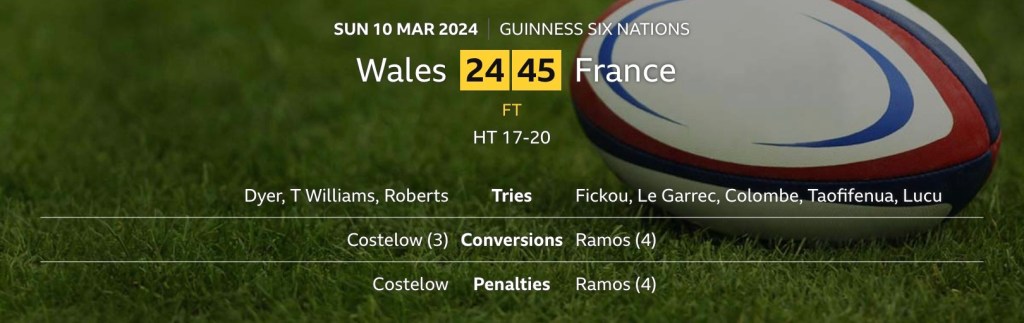
Wales took it to the French in the first half matching Les Bleus in the try scoring stakes with Rio Dyer and Tomos Williams’ touchdowns matched by those of Gaël Fickou and Nolann Le Garrec. France took a narrow three point lead into the interval (17-20).

Wales could not have started the second half much better, a try from Joe Roberts two minutes after the restart gave Wales a 24-20 lead, a lead they maintained until the 60th minute when a Tomas Ramos penalty opened the floodgates for France. Three tries in fifteen minutes took the game away from a brave and entertaining Welsh side who were unable to get field position to mount any attacks.

The superior quality and power of France’ bench made the difference as the timings of their scores suggests.

21 year old scrum half Nolann Le Garrec, the man from Vannes, received the man of the match award and France leave Cardiff with a huge sense of relief after finally wearing down Wales in the final quarter to register a 45-24 win.

Wales remain winless and now have a must win match against a buoyant Italy in Cardiff next Saturday to avoid a whitewash and the wooden spoon.

France will look forward to entertaining England in Lyon with the hope of finishing their disappointing tournament with a flourish.