The Colour Red

In Ancient Rome the colour red symbolised blood and courage, whilst in China, it is regarded as a vibrant optimistic colour symbolising success, happiness and warmth, along with good luck and wealth.

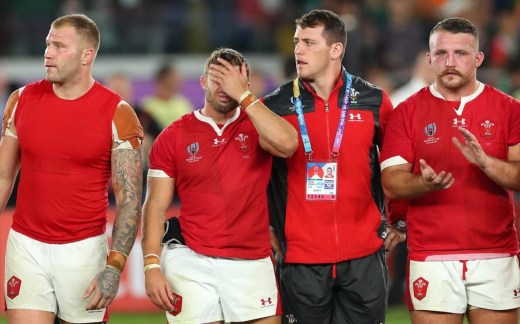
In Wales the colour red has been a symbol of our nationality, and heritage, the Red Dragon on our national flag, the red shirted heroes of our national rugby team.

But on a damp night at Eden Park, Auckland, on 15 October 2011, the colour red came to symbolise the end of a glorious dream, the cruel twist of fate that cost Wales the place in a Rugby World Cup final for the first time in their history.

With Nineteen minutes on the clock, Sam Warburton upended France’ Vincent Clerc, referee Alain Rolland pulled a card from his pocket, the colour ? Red.

Fast forward to 2019, in Japan the colour red is believed to bring good luck particularly when paired with white.

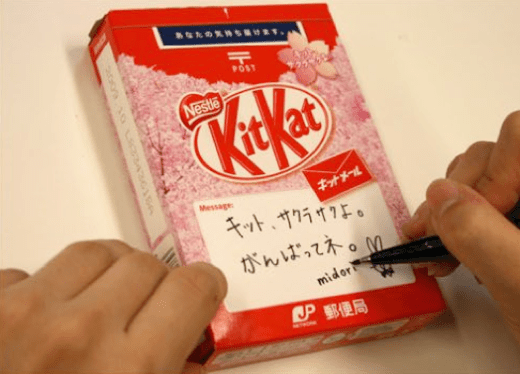
The red packaging of Kit Kat has made the chocolate a good luck token to the Japanese and it is a popular gift for students at exam time.

So far the colour red is doing rather well at the Rugby World Cup maybe a few kit Kat’s could be delivered to the Wales squad currently residing in Otsu, as they prepare to face further stern examinations and tests next week and hopefully beyond.

Fire and passion are also associated with the colour red, both of which were visible by the bucket load when Wales beat Australia in Tokyo in one of the most thrilling and brutal games of the tournament so far, a result that has given Wales a huge foothold in their ascent to the world crown.

Next up are Fiji, on Wednesday followed by Uruguay on Sunday, five days which will determine the men in red’s World Cup future.

Under Warren Gatland there will not be a single morsel of complacency, Welsh fans still shudder at the mere mention of Fiji which evokes memories of Nantes 2007 for which many of us are still getting flashbacks in the dead of night,

There is still a long way to go in the 2019 tournement and we dare not get involved in the arithmetical accumulation of fowl, but maybe,  just maybe the colour red will, be the colour in which we Welsh will paint the town on November 2 ?… now where’s that Kit Kat ?

The Miracle Of Kamaishi

On the morning of March 11 2011 an earthquake struck Japan leaving a small coastal town 500 miles north of Tokyo devastated  by the resulting tsunami.

In a town with a population of 35,000 people 1,300 lost their lives, to bring rugby into the equation may seem crass and inappropriate, but in the months that followed the total devastation, locals wanted to give the town a sense of purpose, a start to the healing process and restore pride, rugby was at the very heart of the process.

The Kamaishi Recovery stadium was built on the exact spot where the local school was washed away.

Stadium director Takeshita Nagata “We wanted to build something that would symbolise hope for the future, it’s not just rebuilding something physically it’s about rebuilding hearts”.

Last Wednesday a group of men from 11,500 miles away ensured that Kamaishi will always be remembered for a joyous uplifting heart pounding event to counteract that soul and life destroying event of March 2011.

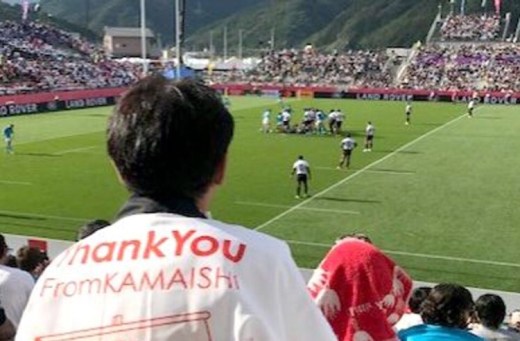
Before Wednesday’s game, local woman Rui Horaguchi (pictured above) gave an emotional account of the tsunami that swept away her home, and her school, which once stood on the site where the new stadium has been built.

My house was washed away in the waves, and after that I remember we had donations from across the world”

“It is all of that support that allowed us to look forward, and once it was decided that Kamaishi would host the Rugby World Cup there was huge increase in the construction of the city”

“That was when we began to understand why Kamaishi was chosen, to help grow the area again, this has really helped the community to come together, and I am hopeful that we will maintain that unity to make it even better”

For once the gods smiled kindly on Kamaishi a glorious sunny day with a temperature of 22 degrees and a rugby match that is now enshrined in Rugby World Cup history.

Sport has an amazing power to unite and inspire, and more often than not it can provide comfort and a platform for healing, Rui Horaguchi and the people of Kamaishi will never forget March 11 2011, but thankfully they will also never forget September 25 2019, when the rugby world held them in its arms in the warm Japanese sunshine, and for a short while everything was alright with the world.


Sunny Stoop Century For Harlequins Women 

There are glorious rugby days with the warm autumn sun on your back, when the world seems a wonderful place, Saturday afternoon at the Stoop was such a day.

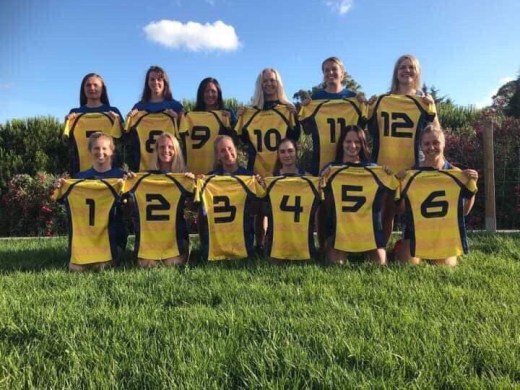
Harlequins Women started their 2019/20 Tyrrells Premier season with a side full of players and combinations being tried and tested for the first time.

From minute one Quins played with a dynamism backed up by immense physicality and accuracy that sometimes took your breath away, their power and pace blew away a Richmond side that battled bravely and never gave up, but I don’t think any team could have lived with Harlequins on Saturday’s form.

A true United Nations outfit with Ireland, England, Scotland, Wales, France, Sweden and Italy represented, scored fifteen tries to pass the century mark as records tumbled at the Stoop.

Irish eyes were smiling when Anna Caplice went over for a try on her debut within the first three minutes, and when Green converted a try by Brown after seven minutes we knew we were in for a colourful occasion.

Quins earned their four try bonus point after only fourteen minutes, nine tries in the first half gave them a 61-0 lead at the interval.

The second half showed no let up as ruthless Quins continued their assault on the scoreboard, six second half tries gave the home side an 101-0 victory.

Ellie Green had the eyes of sharpshooter converting thirteen of the fifteen tries including  one of her own in the 20th minute, her matchday total accumulating 31 points.

The season has a long way to run but Harlequins Women have set down a marker that sent shockwaves through social media on Saturday evening, bearing in mind internationals Burford, Riley, McCormack, Petersson and Cornborough will also become available in the near future, the completion for places will ensure that standards are not only maintained but improved.

Its going to be one heck of a ride.

QUINS CENTURY OF SCORING

Timeline Of Tries

3 Mins.   Anna Caplice

7m.   Shaunagh Brown

10m.    Lucy Packer

14m.   Jess Breach

20m.    Ellie Green

25m.    Leah Lyons

32m.    Chloe Rollie

38m.     Emily Scott

40m.     Khadi  Camara

41m.     Shaunagh Brown

52m.     Jade Konkel

63m.     Abbie Scott

70m.     Amy Cockayne

75m.      Emma Swords

80m.       Chloe Rollie

Georgia On My Mind

It has finally arrived, after months of anticipation the wall charts are blue tacked to the kitchen units, fridges are full and we are ready to embrace a Rugby World Cup in the land of the rising scrum.

For Wales going into a Rugby World Cup as potential winners is a totally new experience, but they dare not think too far ahead, and for now, like Ray Charles, they’ve only got Georgia on their mind.

A nation that borders Azerbajan, Russia, Armenia and Turkey in one of the most volatile regions of the world, is not going to be passive and take too much nonsense, physicality will be their main weapon particularly at scrum time.

Mikheil Nariashvili, the Montpellier prop, is one of the best loose heads in the game, hewn from the rocks of the Caucasus he is so tough it is said he can even break Tonka toys.

Fellow Montpellier lock Konstantin Mikautadze has turned out for the Barbarians and at 6ft 7ins and 20 stone his line out presence will be notable, although you can only feel sympathy for his lifters.

The French connection is felt throughout the squad with 16 of the 31 players plying their trade in the Top 14 or Pro D2.

Georgia’s main industries are steel and coal, a throwback to Wales glorious industrial past, and the capital Tblisi is twinned with that other war torn region of the world, Bristol, an unlikely twin you would think.

Wales face Australia on Saturday after a short six day turnaround, so selection will have given Warren Gatland plenty of food for thought, but this is a match they dare not lose.

In 2017 Gatland put out a second string outfit to face Georgia in Cardiff, Wales were very nearly embarrassed, but scraped home 13-6.

It has been yet another roller coaster week in the history of Welsh rugby, after the joyous reception in Kitakyushu, where 15,000 turned up to watch Wales train, but things soon came crashing back down to earth as backs coach Rob Howley was forced to return to Wales, to face an investigation of an alleged breach of World Rugby’s regulation six which covers gambling and anti corruption.

Tomorrow’s match at the City of Toyota stadium will be a tough one and with Australia and Fiji to come things will not get an easier.


Shane Williams Big In Japan

Shane Williams is well acquainted with Japanese life, having spent three years at Mitsubishi Dynaboars – a second-tier club based about 50km west of Tokyo – at the end of his playing career. But setting up home in Japan was never part of the plan for Wales’ record try scorer. Back in 2012, Williams was ready to retire – he’d scored a try in what was meant to be his final professional appearance, and life at home was settled and happy.

‘It came completely out of the blue,’ he says. ‘My boy had just started Welsh language school and my daughter, who had struggled at school initially, was doing well. My wife and I had just started a business and we were happy living in the town we and our families had lived in all our lives.’

Despite this, Williams left the tiny mining village of Glanamman and headed for Kanagawa Prefecture. ‘I was petrified,’ Williams admits. ‘I was worried about the language; about how busy it would be, coming from a small town; simple things like getting around, reading signs when getting a train, all that stuff – but I also thought it was a once-in-a-lifetime opportunity.’

Hungry to experience the country and its culture as much as possible, Williams began a process of total immersion. He had toured Japan in the past, with Wales, but that involved ‘eating at McDonald’s most of the time’. Big Macs and fries were replaced with yakiniku and sushi, and even today Williams maintains he’d ‘much prefer to travel around Tokyo than London’. Whether he was swimming in the sea in Okinawa, walking up Mount Fuji or snowboarding in Hokkaido, Williams fell in love with a completely new life, all while still getting to play rugby.

‘I know the game inside out, but I had to learn how to manage people and get my points across, all in Japanese,’ he remembers. ‘I messed up so many times, and they all took the mickey, of course, but they helped me so much along the way.

‘It’s not a place to steadily retire. I was worried the drop in quality would be massive. I had more space and time, but the tempo was relentless and their fitness levels were incredible – that was a shock to the system that playing style has become synonymous with Japanese rugby. Trying to compete with the huge packs of France or South Africa simply isn’t going to bear any fruit, so the Japanese – from the grassroots up – keep the ball and move it quickly. The style has proved successful, and ultimately played a part in growing the sport throughout the country.

They play to their strengths, and they play cleverly,’ Williams says. ‘When they beat South Africa [at the 2015 World Cup], viewing figures in Japan quadrupled for the next game and attention shifted massively. They beat Italy recently and teams view them as a threat. They’re proud – rugby may not be huge in Japan, but the nation will get behind them in a big way.’

That South Africa win – masterminded by England’s current boss, Eddie Jones – was the biggest in Japan’s history and couldn’t have come at a better time. Casual fans’ sudden surge in interest was heightened further by the realisation that Japan would play host next time around.

It was the same year that a Japanese rugby franchise, the Sunwolves, entered Super Rugby, the southern hemisphere’s top club competition. This put some of the best players in the world – David Pocock, Kurtley Beale, Michael Hooper – in front of Japanese audiences. Having such powerhouses regularly playing in Japan is integral to growing the game in Asia, and with Tokyo hosting the Olympics in 2020, excitement is building.

‘When I started playing there were a few hundred fans in the stands – that grew to a few thousand,’ Williams says. ‘Rugby must be the fifth, sixth, maybe seventh most watched sport in Japan. Certainly within the three years I was there, the levels rose significantly. The high-school matches were getting 30,000 supporters, as were the college [ones], and that definitely wasn’t the case before 2015.’

Before the last World Cup, Japan had won just a single game on the sport’s biggest stage, a 52-8 victory over Zimbabwe in 1991. In the 2015 tournament, they won three. Next year they are in a pool with Ireland, Scotland and Russia. Getting out of the pool will be an unprecedented success.

The 2019 World Cup sees the hosts play in the opening game, while the Russians will be providing the opposition and attempting to dampen local excitement. ‘What I like about the Japanese people is they’ll support anything,’ says Williams. ‘They’ll make a day of it, turn it into a festival environment. It’s why I’m excited about this World Cup, because they’ll not only support Japan, they’ll back all the teams and watch all the games, and they want this to be the best. They genuinely could make the best World Cup that there’s been.’

Shane was initially offered a one year contract worth a reported £600,000, unlike many of his ilk, Shane took his wife and children with him, they embraced the culture, an experience which they all thoroughly enjoyed

“I just think now is a great time to go over there,“They’ve obviously spent a lot of money in preparation for the Olympics and they’ll have the World Cup before that. That’s perfect timing as far as I’m concerned.

“It means everything is going to be ready for both events.

“And the whole country is just something that you will never have experienced before in your life. It’s very unique.

“The fact that they have the Olympics after it… everyone’s going to be ready. All the sporting fans in Japan are going to be ready for this Olympics and will jump on the rugby bandwagon.

“What you find with the Japanese fans and supporters is that, if they think there’s a match on or something’s happening, everyone will come and support it.

“It doesn’t matter who’s playing, they’ll support anyone. They’ll put the jerseys on and they’ll enjoy it. I think that will reflect on the World Cup itself.”

And Williams believes the tournament will be all the better for being played in front of a new audience.

“I’ve been to a number of World Cups now in big rugby nations,” he added. “However, Japan is a country that is growing in respect to rugby but they’re completely fanatical about the things they put on.

“They’re going to really embrace it, make sure that everyone enjoys it and wants to come back to Japan.

“Having experienced Japan for three years and seen the kind of festivals and events they do there, I just think it could be amazing and very different to any other World Cup we’ve ever seen. I’m looking forward to it.”


 

Fika And Welshcakes A Tale Of Two Swedes 

Sweden holds a warm place in British hearts, from Ikea to Abba via Volvo, they appear to produce nothing but quality, and reliability, with a touch of class, the same can be said of two their Women rugby players.

Abba may have had Agnetha and Anni-Frid but Harlequins Women have an even better double act in Victoria and Tove.

Any city that has a beach called the cat’s bottom (Kattrumpan) must be pretty special, the city in question is Kalmar the home of Victoria Petterssen, situated alongside the Baltic Sea it is one of Sweden’s most beautiful.

Heading north some 245 kilometres and a three hour drive via route 35 and the E22, we arrive at Norrkoping Sweden’s tenth largest city situated at the mouth of the river Motala Strom, and the birthplace of the other half of Quins Swedish duet, Tove Viksten.

Both of these young ladies have brought their own scandanavian warmth to darkest Surrey, there is always a smile and a friendly greeting from this modest pair, and their addition to Harlequins Women’s already international entourage has been a massive plus for the club.

Tove is a prop and Victoria a wing/centre/fly half ,in rugby terms you coudnt get much further apart, but there are many similarities between them both stand at 5ft 6ins in height, their birthday’s are a month apart, and they both love welsh cakes.

Tove and Vic are classic exponents in the art of “Fika” an important part of Swedish culture, it is much more than just coffee and cake, its about making time for friends and colleagues over coffee and a bite, it’s a state of mind and I can vouch for their Fika skills first hand, back home in Sweden even the mighty Volvo car plant stops for Fika.

Victoria’s rugby journey started due to a chance meeting at a party, following game time at university and local club Kalmar Sodra she found herself jetting off to leafy Surrey at the tender age of 22 to join Harlequins.

She displays a maturity beyond her tender years in the way she talks about life and rugby, with her wonderful modesty and a smile as wide as the oversund she is one of the most popular members of the squad.

Having settled into English life the one thing she misses from home is her mum’s potato and leek soup, on the plus side she and her partner have delevoped a taste for Welsh cakes, my home country’s economy has taken a dramatic upward turn thanks to those two.

Injury prevented any Quins action from January onwards, but a summer of Sevens with the Swedish national team has left her looking very sharp at pre season training, having the ability to play fly half, centre and wing she will be an integral part of Harlequins Women’s drive for success this coming season, and whatever happens the down to earth Swede will take it all her stride, Abba recorded  “The winner takes it all ” but they also sang” I let the music speak” a much more appropriate title for Vic.

Some 16 kilometres south west of Stockholm, the Motala river flows through the former industrial city of Norrkoping, once the centre of Sweden’s textile industry, this is the place Tove Viksten calls home.

Tove is a scandavian name that derives from the old Norse “Thorfrithr” meaning beautiful Thor.

Having seen her demolish a scrummaging machine at pre season training there is also plenty of “beast” to go with that derivation.

She arrived in the UK in 2017 after impressing Quins coach Gary Street at a training camp in Sweden, another engaging and intelligent Scandinavian she has settled into the English rugby season like a duck to water, someone who has a great regard for rugby values the game is in safe hands with people like Tove around.

Holding down a demanding full time job and playing amateur rugby with professional commitments is a tough juggling act for the affable Swede, but her love of the game is so strong that she somehow finds a way to achieve success at both, quite an achievement.

Her Dad is a big rugby fan who comes over to watch Harlequins Ladies whenever he can especially the annual “Game Changer” at the Stoop, we look forward to seeing Mr Viksten next April when Quins face Wasps in the 2020 event.

Tove feels very much at home in England but does miss Sweden’s unique natural beauty and its vast unpopulated spaces.

Both Vic and Tove take huge pride in representing their native country which comes at price both physically mentally and financially.

Playing for Sweden at both sevens and fifteens requires them to fund their own transport to and from training camps international matches and tournaments which due to their adopted country of residence involves expensive flights.

This is the burden for many players at the top end of the women’s game, and like Victoria and Tove they never complain about the crippling costs involved, in fact rather than financial gain they would much prefer to have the time to rest and recover  properly.

Maybe we should end our Swedish odyssey back in Kalmar, and just along the coast from cats bottom beach is Kalmarsunsbet, it doesn’t have a bus stop but instead a pusshalplats in other words a “kiss stop” Borta bra men hemma bast.


From The Taff To The Liffey And A Drop Of The Red Stuff

One of the joys of visiting Dublin for a rugby international is sitting watching the sun set over Dublin Bay with a cold pint of Guinness for company, a drop of the black stuff always seems to taste that little bit better in the emerald isle.

There a few myths about this wonderful creation, firstly it is not made with water from the nearby River Liffey, that flows alongside the St James’s gate brewery in the heart of Dublin, the water comes from the beautiful Wicklow mountains further south

Also, I hate to tell you, Guinness is not actually black but rather a dark shade of red, a colour the brewers attribute to the roasting of malted barley during the preparation process.

So with Wales visiting the Aviva Stadium for their final Rugby World Cup preparation match, at the weekend a drop of the red stuff was essential both on and off the field.

A defeat to Ireland meant Welsh followers were set to drown their sorrows in a sunny Dublin as despite a promising first half their second half was very flat, and those with a thick head this morning will spare a thought for Rhys Patchell who left the field for an HIA and never returned.

Having lost Gareth Anscombe in the opening warm up game against England to lose another fly half for the World Cup would be disastrous.

Ireland will be happy with the fact they have beaten Wales home and away in the space of a fortnight which will do a lot to help repair their confidence after being battered by England at Twickenham.

It was also a day for raising a glass to Rory Best the Ulster hooker and coach Joe Schmidt, both making their final appearance at home in the Aviva.

How these warm up games will affect either team come the Rugby World Cup will become evident in two weeks time in the land of the rising scrum.

But for now the sunset is slowly fading and the bay and the Guinness are calling.

Sláinte.


 France I’ve Still Got Les Bleus For You

I’m pretty sure rock guitarist and song writer Gary Moore was not a follower of French rugby, but his lyrics to Parisienne Walkways were the theme to my first ever trip to Paris to see Wales at the Parc des Princes in 1979, those were the days when France were France, they could combine breathtaking beauty and spine chilling thuggery in equal measure, and often in the same move.

An awful lot of water has passed under Pont Neuf since then, and these days Gary’s composition  “Still got the blues” seems a much more appropriate theme.


“It used to be so easy to give my heart away” 

  “But I found out the hard way there’s a price you have to pay”


Indeed it was so easy to give my heart away to Serge, Phillipe, Denis and co, and it was the fab three Blanco, Sella and Charvet, that seduced me with their flair, style, elegance and angles of running that would have even had Pythagoras purring.

With their collars turned up against the warm Parisian spring sunshine, these players made rugby Sexy, they had a swagger and a confidence, and a sheer joy that translated onto the field of play.

France could also provide a more earthy kind of love if that was your preference, in the form of Cholley, Paparemborde and Condom, yes Jean Condom (who never practised safe rugby), but for pure romance it was always the numbers neuf to quinze.

The years that we thought would last forever somehow faded ,we were left with warm memories, and although we had glimpses of romantic reconciliations they were few and far between, the holiday romance of RWC 1999 was short and sweet as Bernat-Salles, Dominici and Lamaison seduced us, all too briefly, once more.


“So many years since I’ve seen your face here in my heart there’s an empty space”


The world of rugby moved on and big became beautiful, but still every now and then the beauty shone past the beast in the form of Gael Fickou, Wesley Fofana and more recently Teddy Thomas, but sadly French rugby occupied the region even lower than the doldrums, and confidence and flair failed to bloom in those dark nether regions.


“You’re playing to win but you lose just the same”


We can still dream that some way, some how, in the land of the rising scrum, the emptiness can be at least partially filled by the new Romantics Dupont, Penaud and Ntmack, maybe the time is right for another holiday romance .


“Though the days come and go, there is one thing I know, I’ve still got the blues for you”

Home Is Where The Calon Is

Firstly to explain to the uninitiated, Calon is the Welsh word for heart, which will hopefully explain the title of this piece, just as you were about to question my sanity, quite rightly, and probably not for the first time, or indeed the last.

Anyway I digress, there is a patch of grass in the centre of Cardiff that has an almost reverential status for welsh rugby people, the ghosts that inhabit this stadium do so with a haunting presence that seeps into your soul, Gareth, JPR, Gerald, Jiffy, Barry, Shane and a list that goes on and on.

The pitch at the Millenium Stadium, now known as Principality, but forever known to my generation as the Arms Park, was turned 90 degrees in 1999 when the new stadium was built, but it is still the same patch of grass that has filled us with lifetime memories good and bad, we can all tell you in which corner Gareth and Ieuan scored, which corner JPR barged Gourdon into touch, and the exact spot where Paul Thorburn kicked that monster penalty.

Wales did not lose a five nations match in Cardiff between 1968 and 1980, but after that it was pretty much full your boots time for visiting teams, everyone came and won including Western Samoa, Canada and Romania

But after years of invaders coming without any fear, Cardiff has once again become a bit of a fortress.

As Warren Gatland prepares for his final home game as Wales coach, a win against Ireland on Saturday would stretch their unbeaten run to 12 matches, one short of Wales all time record of 13 matches unbeaten between 1907 and 1912.

Wales last defeat on home soil came in November 2017, and to none other than New Zealand, since then they have defeated South Africa Scotland and England on two occasions along with Italy, Australia, Tonga, Ireland, and France, incidentally one of the home games against South Africa was played in Washington D.C., such is the way in modern professional rugby.

The Cardiff factor has been a big part of Wales reaching the number one spot  in the World Rugby Rankings, something those of us who witnessed Canada, Western Samoa, the whole of Samoa, and Romania capturing our flag on home ground, would never have dreamed possible.

It may not count for much in Rugby World Cup year, but for those that spend their hard earned cash on vastly overpriced and frequently changed replica shirts, and those who save up every two years to go to Dublin, Paris, Rome and Edinburgh well they have earned enough “Misery  Miles” to bask in every second that Wales spend at that top spot, these days may never return.

So as our friends from across the Irish sea join us on Saturday, a Wales home win could keep the home fires burning, and a whole new range of rugby ghosts will prepare to haunt this wonderful sporting cathedral for the next generation of rugby mad Taffs, and that’s just as it should be.

Tyrrells Premier 15s The Next Stage


The Rugby Football Union (RFU) has today confirmed the process for finalising the next three-year structure of the Tyrrells Premier 15s – the top-flight women’s domestic rugby competition in England.


In the first half of the upcoming season (2019/20) the RFU will audit all ten existing Tyrrells Premier 15s clubs on a combination of their ability to deliver the Minimum Operating Standards and their on pitch performance.

This audit will be independently verified and the clubs ranked from 1 to 10 based on the audit results. 

Following this, the top six ranked teams will be invited to join the next three-year league structure covering seasons 2020/21 to 2022/23.


The bottom four ranked teams will be invited to re-tender for a place in the competition should they wish to do so. At the same time, applications for tender will open to all clubs that wish to apply.

Expression of interest letters are being issued this week to all RFU member clubs, universities and colleges in England.


All tenders will be assessed by a selection panel and a shortlist will be created.


The original four Tyrrells Premier 15s teams who were invited to tender and the winners of the Championship North and Championship South divisions will be automatically shortlisted provided that they choose to tender to join the next three-year competition structure. They will be joined by any other teams meeting the shortlist criteria.


All successfully shortlisted clubs will be invited to interview and assessed by the selection panel.


The best four teams selected by the selection panel after the interview and assessment stage will then be invited to join the league starting from the 2020/21 season. The new structure will be maintained for three years and then reviewed again for the 2023/24 season.


This proposal means that potentially a maximum of four teams could be removed from the Tyrrells Premier 15s at the end of the 2019/20 season. These teams would then be included within the Women’s Championship competition by increasing the pool size of Championship North and Championship South to a maximum of 10 teams each.


Nicky Ponsford, RFU Head of Women’s Performance said: “We are delighted by the progress made by Tyrrells Premier 15s clubs over the last two years and by their commitment to driving the programme forward. This process allows us to recognise the input of the clubs but still open up the league to potential new entrants with a geographical spread maintained where possible. This keeps the focus on minimum standards and ensures we continue to raise the bar and increase performance.”

Nigel Melville, RFU Professional Rugby Director added: “The commitment and dedication from all clubs as well as the standard of rugby over the first two seasons has been fantastic. 


“The league was initially set up for three years to give clubs a chance to embed, grow, invest and develop support services. It also coincides with World Cup cycles so there’s minimal disruption to players.


“We always felt this was the best time to review as we aim to create the best domestic 15s women’s competition in the world which will give us the winning advantage on the world stage.


“The purpose of the league will remain the same. It’s a competition at the highest domestic level of the women’s game which continues to support the overall objective to produce winning teams for England Women 15s and 7s teams.


“We want the women’s game to continue to flourish at all levels and know a strong domestic game is imperative in increasing participation and interest.”