WRU WTF Another Review

Had I the heavens’ embroidered cloths,
Enwrought with golden and silver light,
The blue and the dim and the dark cloths
Of night and light and the half-light,
I would spread the cloths under your feet:
But I, being poor, have only my dreams;
I have spread my dreams under your feet;
Tread softly because you tread on my dreams.

For those of us who love or even just care about Welsh rugby, our dreams are not only being trodden on they are being rained down on by the contents of a metaphorical seagull suffering from gastroenteritis.

The incoming co-head of the United States Department of Government Efficiency Elon Musk allowed me to launch the following message on his X platform a few weeks ago.

“Breaking News, The WRU have stated that a review of all the reviews is being undertaken. The reviewers who review the review will present a view of the review of all the reviews after it has been viewed by the WRU”

The incredible response I had shows just how much and how many people still care deeply and passionately about Welsh rugby, and almost all voiced their concern about the governing body whose communication output makes a Trappist monk appear verbose.

So here we are a week after Wales final Autumn Series International and guess what, there’s another review on the way. 

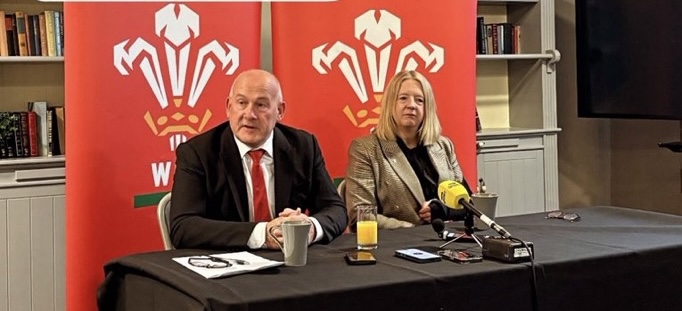
A review of the November programme will be led by, yes you guessed it, Welsh Rugby Union chief executive Abi Tierney who says it will be completed before Christmas, although whether the turkey’s will vote for Christmas is a moot point.

A completed ‘One Wales’ strategy designed to give Welsh rugby a definitive five-year plan due in June has been delayed yet again as the WRU and regions continue to negotiate a fresh financial deal.

These reviews are stacking up in greater number than Welsh defeats and are just as painful and demoralising to witness

Meanwhile, the task of capturing young hearts and minds is a woeful afterthought in all the turmoil. 

As Welsh international football enjoys success, it often appears that there is a mindset with the powers that be that there is somehow a divine right that rugby will always be the national sport of Wales.

This will not happen at international level without some serious emphasis on grasping social media output which at the moment is pretty woeful.

Innovative fresh and bold initiatives need to be explored, it is 2024 not 1971 after all.

A visit to Cardiff City Stadium for the round ball game is a cheaper more atmospheric experience with a family friendly vibe uninterrupted by people continually getting up and down from their seats collecting beer. The National Anthem is sung much better.

We need a dynamic, exciting programme to entice youngsters to capture hearts and minds keep them enthused, involved and valued, but I expect we will need another review led by the governing body before that happens.

Gwlad! Gwlad! Pleidiol wyf i’m gwlad.

Forever Autumn Wales v South Africa

John Keats described Autumn as;

Season of mists and mellow fruitfulness,
Close bosom-friend of the maturing sun;
Conspiring with him how to load and bless
With fruit the vines that round the thatch-eves run;

In the Autumn Nations Series, Wales have been the lonely Banana left stranded in the fruit bowl, slowly turning black and looking more and more unappetising as the days go by.

Yesterday that banana was finally put out of its misery and thrown in the bin, and along with it the hopes and dreams of a proud rugby nation.

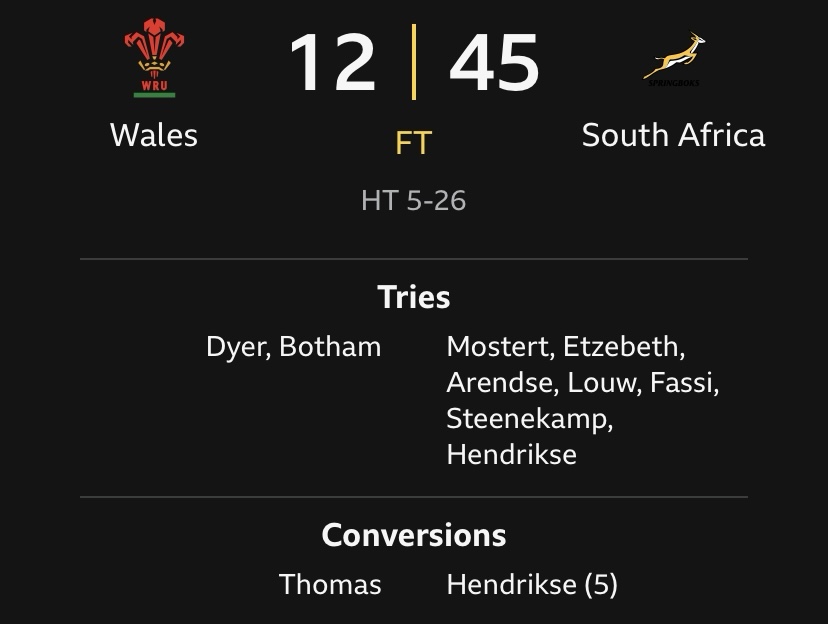
This was Wales twelfth defeat in a row and creates the damning and embarrassing statistic that they have gone an entire calendar year without a win, a feat, if you can call it that, last suffered in 1937.

There was a time when attending a rugby international in November necessitated the acquisition of gloves, scarves, hats, and even a hip flask to keep out the bitter cold.

These days, as the seasons all blend into one and the climate becomes as unreliable as the Welsh line out, some Autumn days are actually warmer than those we endured during a miserable summer.

However, yesterday, Storm Bert was in town and decided to hit Cardiff like a Damian De Allende tackle.

The rain fell from the heavens some say it was the tears of JPR, Barry, JJ and Grav, luckily the closed roof obscured their view of Welsh rugby at its lowest point in the professional era.

Just six days after being trampled and caught on the hop (forgive the pun) by the Wallabies, it was the turn of the antelope fraternity to pick over the Welsh rugby carcass.

The Springboks are a team for all seasons and all conditions. The apparent simplicity of their game would, you imagine, be equally simple to negate. But they do it so well, and with such power and physicality, whilst also continuing to provide more add-ons than even my O2 mobile phone contract can offer.

Before kick off, the only thing that appeared in doubt was the margin of victory for the visitors. The was even talk of Wales 96-18 defeat in 1998 being bettered.

The 45-12 score line does not make great reading and with the Springboks leading 26-5 at half-time the prospect of a second half avalanche looked ominous.

But what wales lacked in precision accuracy and physicality, they made up for in calon (heart) effort and sheer bravery.

Straw clutching may well have become a Welsh national pastime but to limit this Boks team to 19 second half points was a creditable effort.

Sadly, as Autumn turns to winter the problems throughout welsh rugby continue, and we still await a plan from the WRU, plus ça change as we say in West Wales

Pumas Frozen Out By Red Hot French Flyers

On dark winter evenings, the flat landscape of Saint-Denis can feel like Siberia. Last night, the icy winds whipped around Avenue Jules Rimet and Rue Henri Delaunay like a gaucho’s boleadora.

Icy sleet and snow had permeated the capital in the lead up, making the brightly lit cafés and bistros look a much more inviting proposition than a cavernous, bitterly cold stadium.

Stade de France hosted Les Bleus final international of 2024 against Argentina. A team that ruined their home 2007 Rugby World Cup campaign, beating them twice on their own patch, once in the pool stages and again in the third place play off.

It was another late one in the Northern suburbs of Paris, with the customary post 9pm kick off ensuring that the temperatures plummeted even further.

Pumas in the wild can run at speeds of fifty miles per hour, but the two legged variety were no match for France’s flying winger Louis Bielle-Biarrey and Gabin Villiere.

Back when I was young we had a definition of outrageous speed that referred to excrement and a shovel the boys from Bordeaux and Toulon encapsulated that definition perfectly, each scoring a try that warmed the cold Parisian night.

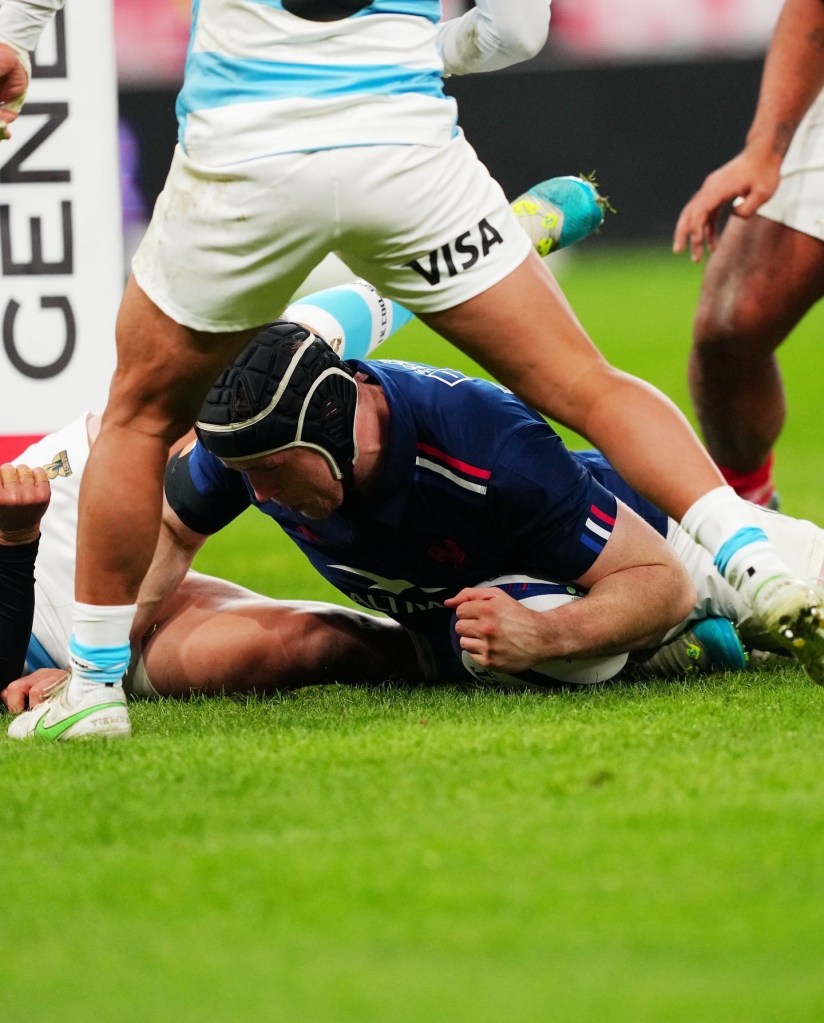
France went into an early lead thanks to a Thibaud Flament try in the ninth minute. Thomas Ramos and Tomás Albornoz exchanged a few penalties before the Toulon Tornado, Gabin Villiere’s 33rd minute try. A penalty try followed three minutes later, followed by another Ramos penalty to give France a 30-9 half-time lead.

France we’re home and hosed but a 57th minute try from Thomas Gallo brought the score back to 30-16 and Argentina sucked in some hope, but Louis Bielle-Biarrey flew in for a try in the 58th minute to execute the coup de grâce.

Ignacio Ruiz 70th minute try was a mere consolation for the Pumas, who were inaccurate and disjointed throughout and hampered by two yellow cards.

France v New Zealand Autumn Leaves & Black Ferns

Autumn in the French capital is normally a relaxed tranquil time to stroll the boulevards, as the leaves begin to fall, the colours add an extra dimension to this already beautiful city.

This year things are different, there are signs that the bright red, orange and brown flora has a new kid on the block joining them, the black fern.

Blowing up from the south, the black fern threatened to spoil the native tranquillity and put the residents in the shade.

France however had no intention of turning over a new leaf, but rather to continue with the power, beauty, and brilliance that has served them so well over recent years.

Yesterday morning the city was covered in a chilly clawing blanket of fog and as the mists floated eerily above the Seine it was a timely reminder that Winter is just a side step away.

New Zealand arrived at the Stade de France with impressive victories against England and Ireland under their belt, not bad for a side in transition.

The last time these two teams met was in the opening match of the 2023 Rugby World on 8 September 2023. There were thirteen survivors from that home win (27-13). Seven in the All Blacks starting line up and six in Les Bleus.

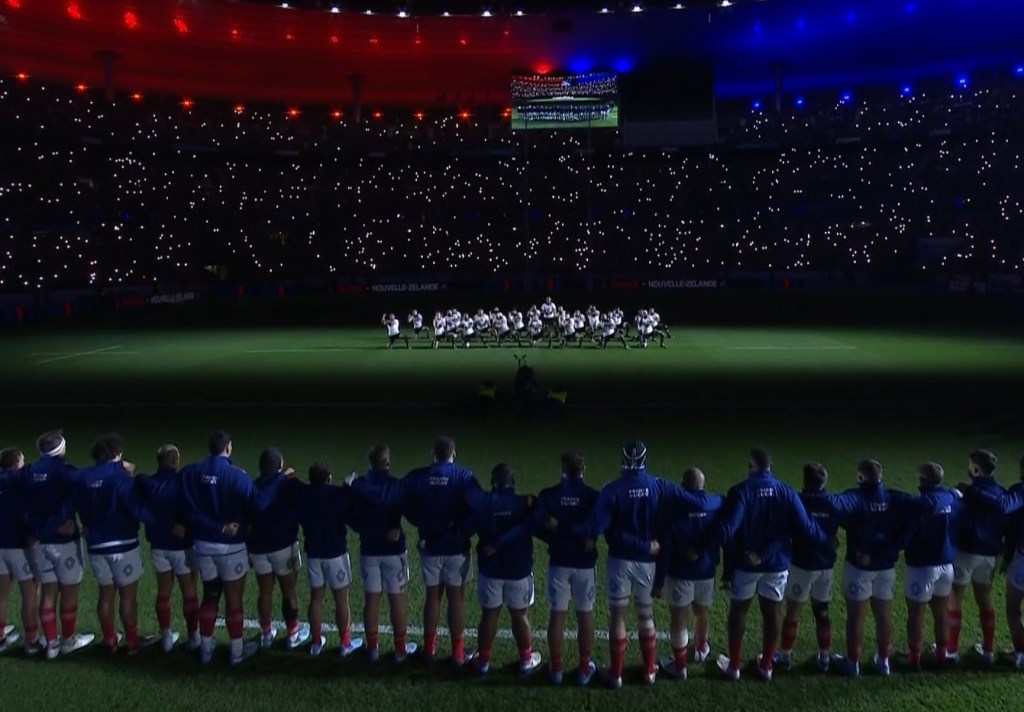
82,000 fell silent as they were plunged into darkness to witness a spine tingling Haka with just a single spotlight shining solely on the All Blacks. It set the scene beautifully for a brutal first half, in which the New Zealand scrum shoved the French eight back almost as far as the Gare du Nord.

Tries for the white shirted All Blacks from early replacement Peter Lakai and scrum-half Cam Roigard took New Zealand into an early lead. New boy Romain Buros cut a line that D’Artagnan would have proud of to score a 36th minute try on his international debut.

The All Blacks led 17-10 at half-time and were more than worthy of their lead.

France came out all guns blazing after a gentle chat from Shaun Edwards after just four minutes of the restart Paul Boudehent crashed over from a driving maul, Ramos converted, and it was all square at 17-17.

Seven minutes later, Louis Bielle-Biarrey broke the land speed record chasing a kick ahead to touch down. As the smoke cleared from his boots, Ramos popped over the conversion and France led 24-17 and there was daylight between the two team in the Parisian darkness.

On the 67th minute it was time for musical chairs as only the French can perform it. Dupont moved to fly half, Ramos to full back, Le Garrec came on as scrum-half and Mauvaka moved from hooker to the back row.

Penalties were exchanged between replacement All Black fly half Damian McKenzie and the faultless Frenchman Thomas Ramos and with five minutes remaining France led 30-29 it was squeaky derrière time but Les Bleus held on for victory in a pulsating match.

As Saturday night drifted into Sunday morning, the crowd raced Bielle-Biarrey style to catch the last metro, Le jour de gloire est arrivé.

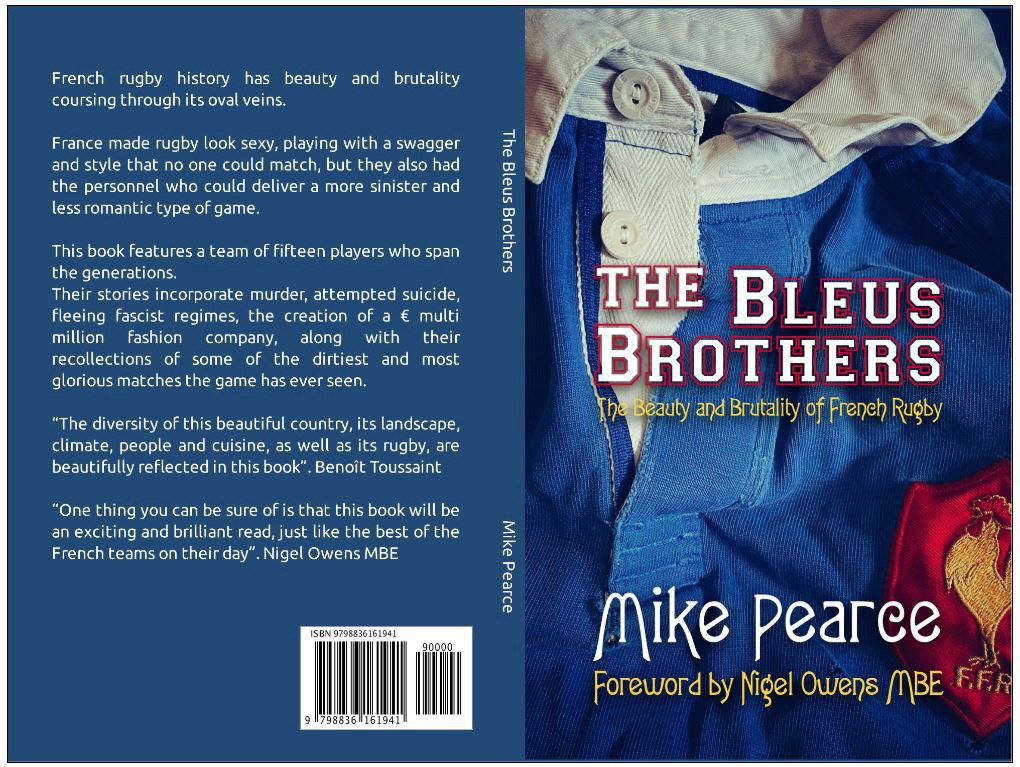
Mike Pearce is the Author of The Bleus Brothers available from Amazon £7.99 post free. https://amzn.eu/d/6H8pN8D

Blues Night For Japan In Saint-Denis

Paris in November a time when the city of lights is illuminated that little bit longer as the days shorten and the evenings lengthen.

The brightly lit cafés and restaurants give off an enticing warm glow that call you like the sirens in Greek mythology who lured sailors to destruction by the sweetness of their song.

But this is business, the start of France’s Autumn international campaign and the French capital welcomes the rugby men from the land of the rising scrum.

On 25 November 2017 at the U Arena in Paris, with 74 mins on the clock and the scores tied 23-23, Yu Tamara lined up a simple conversion that would have given Japan victory.

Had the kick been successful, it would have given Japan their first ever win over France. The drawn game was a creditable result for the Cherry Blossoms, but a golden opportunity to make history was well and truly blown.

It was a result and a performance that drew an avalanche of jeers on the final whistle from the frustrated home fans. France won just three of their 11 tests in 2017 and this was the final game of their Annus horribilis.

Eight years later and the French phoenix that has risen stratospherically from those ashes is unrecognisable in thought, word, and deed from that depressing night in Nanterre.

Last night at Stade de France in one of those 9pm kick-offs that makes time for one of France’s other great passions-Dinner, the Cherry Blossoms found Autumn defoliation a painful process.

The 80,000 crowd were treated to a demolition job by the boys in blue. Defeat was never on the cards as eight try France blew away a Japanese side that came to life in the second half, but it was never going to be enough against the pace and power of the French.

An astonished fever pitch crowd witnessed the unthinkable after just third four seconds, a mistake from Antoine Dupont and an event seen as infrequently as Halley’s Comet. The number nine had his clearance kick charged down and Japan were inches away from the most amazing start.

But two tries in the opening ten minutes from Bielle-Biarrey and Gailleton set the platform. Despite elements of rustiness, further first half tries from Roumat, Mauvaka, and another from Belle-Biarrey provided the rugby equivalent of WD40 to give France a 31-0 half-time lead.

Les Bleus started the second half brightly with a try from Gros before Paul Boudehent grabbed a brace.

Japan got on the scoreboard in the 50th and 61st minute with tries from Tatekawa and Tatafu.

A 52-12 final score was a fair reflection of the game, and France will be delighted with the run out as a sterner test looms next week against the All Blacks.

The Cherry Blossoms have been scattered by the high-powered French leaf blower now it’s time to sweep away the Black Ferns it’s an exciting time in the French capital.

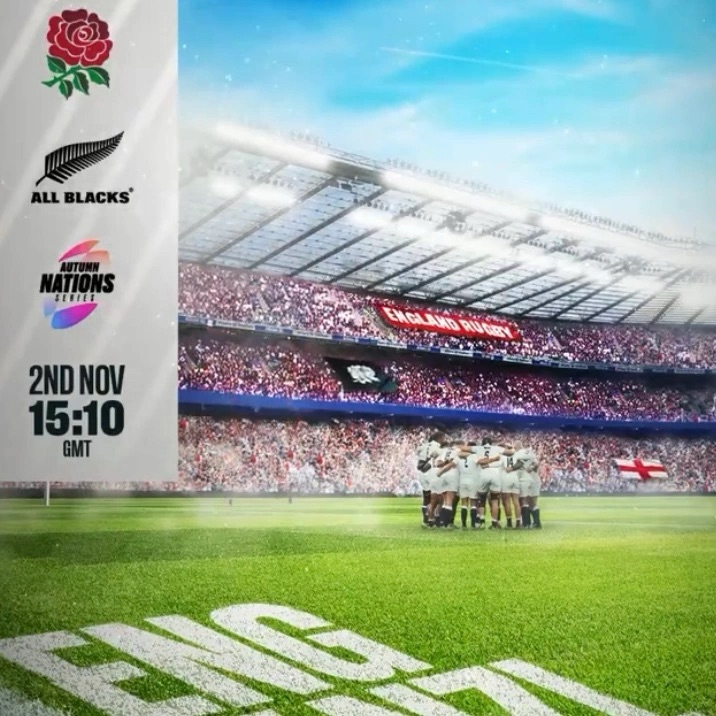
The Black & White Mistrial Show England v New Zealand

20 minute red cards, clocks counting down scrums, line outs, penalty kicks and conversions and referees talking to the crowd, welcome to international rugby 2024 style.

Amidst the plethora of law trials, one thing that hasn’t changed is the excitement and anticipation of England and New Zealand going head-to-head in front of a capacity crowd at a place they used to call Twickenham.

The London branch of the Allianz Stadium (as opposed to the Sydney and Turin branches) played host to one of the great rivalries in sport yesterday in a match launched the 2024 Autumn Nations Series.

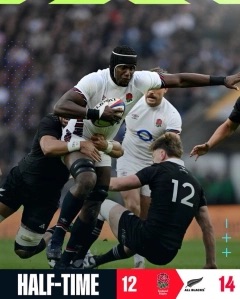
On a muggy misty day with Joe Marler’s motivational team talk ringing in their ears post Haka the All Blacks indiscipline and England scrum dominance kept them in the hunt in a first half where the All Blacks scored two tries through Mark Tele’a and a gliding seemingly effortless run from Will Jordan, but the beauty was negated by the beastly metronomic boot of Marcus Smith who kicked four out of four penalties to put England within two points of their rivals at half-time.

Four minutes into the second half with the All Blacks attacking, a three to two overlap was intercepted by Marcus Smith who ran the length of the field before feeding Furbank. He passed immediately left to Feyi-Waboso to score a try. The 81,910 present greeted with a defeaning roar. Smith’s conversion gave England the lead. Another penalty on the 59-minute mark extended that lead to 22-14.

The All Blacks were looking very ordinary in the face of England’s suffocating defence. Their attack was littered with one up carries, and it was difficult to see anything other than an England win.

But the raft of substitutions that are part of the modern game had an effect on both teams. For England, they lost momentum and scrum domination and for the All Blacks the introduction of Damian McKenzie and the sharper scrum-half Cam Roigard put a spring in their step.

A McKenzie penalty with thirteen minutes remaining brought the score to 22-17, and even this clunky, inaccurate All Blacks side could smell English blood.

Sure enough with five minutes remaining Mark Tele’a, the man who could side step you in a telephone box, went over in the corner for his second try of the game (22-22). Beauden Barrett’s miraculous touchline conversion made it 24-22 to New Zealand.

A George Ford penalty hit the post and his attempted drop goal drifted wide during a fever pitch final few minutes, as the All Blacks clung on to a victory, but for England it was a case of déjà vu and another narrow defeat to add to the back catalogue.

Leanne Infante Retires From The Game But Not From The Memories

According to Elton John, ‘sorry seems to be the hardest word’ but I have to take the legendary musician and composer to task on this occasion.

For me, without doubt the word that seems to be the hardest is Goodbye.

Whichever way you try to take the sting out of it, whether that be with a farewell, a see you soon, or any other platitude, it doesn’t take away from the fact that something is coming to an end. In this rugby case, something, and someone very special indeed.

This afternoon Leanne Infante, the artist formerly known as Riley, called time on her professional rugby career in what was her 100th game for Saracens with a resounding victory against reigning Women’s Premiership champions Gloucester-Hartbury.

Even when the difficult decision is made on your own terms, as is the case with Leanne, it doesn’t necessarily make it any easier.

But over a wonderful career at the top, she always did things on her own terms, and her decision to retire was no different.

Success comes from knowing that you did your best to become the best that you are capable of becoming, and Leanne worked tirelessly to achieve that, whilst also helping those around her to achieve their best. Any fly half she has ever played with will testify.

I don’t think Leanne will ever realise just how good a player she was, or indeed how popular she was with team mates, fans, and journalists alike, only because that does not fit in with the humble way in which she operates.

As a Red Rose, she was often the pick of the bunch, a hardy perennial that bloomed season after season and never failed to brighten up the green fields she inhabited.

It has been my pleasure and privilege to follow Leanne’s career at close quarters. I’ve seen her mature and develop on and off the field, both as a player and person, the results have been pretty impressive.

As in the words of Rudyard Kiplings famous poem ‘If’ she has met with Triumph and Disaster and treated those two impostors just the same. 

She has kept close council when things have not gone her way, frequently through no fault of her own, and chosen instead to do her talking on the field.

We are all in this wonderful game for a relatively short time. And to be able to have a career where you have maintained and upheld the values and the spirit of rugby is as big an achievement as all the trophies, titles and championships won, Leanne can be justifiably proud.

Rugby, and in particular the women’s game, will be all the better for her legacy, those following in her wake will find their paths that little bit smoother, thanks to her and her generation.

Leanne did everything on her own terms during a long club and international career, so it comes as no surprise that when it came to the agonising moment of dealing with sporting retirement, she had the strength of character. She also had the wisdom to make that difficult decision.

Having achieved the CIl Level 4 Diploma in Regulated Financial Planning, Leanne is a fully qualified Financial Adviser authorised by the FCA. She is also a qualified member of the Personal Finance Society, working with the prestigious Quilter group. So whilst our rugby days may not shine quite so brightly, our pension pots will almost certainly be booming. 

Thank you, Leanne, for all the memories, you will be missed.

Number 10 & The Biggar Picture

The number 10 in Numerology represents fresh new beginnings, leadership and innovation, self-discovery and independence, almost the perfect definition of a certain fly half now residing in the south of France.

Dan Biggar having exchanged Hymns and Arias for the Pilou pilou, a chant which describes the Toulon players as warriors coming down from the mountains towards the sea, has just released his autobiography “The Biggar Picture”.

When ‘Number 10’ is mentioned, the first thought that comes to mind is Downing Street and the individual who has the unenviable task of running the country, unless of course you happen to be Welsh.

In our case the number 10 only represents one thing that magical red jersey worn by the individual who has the unenviable task of running our country on the rugby field and as is the case with the Prime Minister he gets the blame for anything that goes wrong whether or not it is his fault.

I always felt that a lot of people would never appreciate how good Dan was until he finished playing for Wales, and this has already proved to be the case.

Memories get shorter as the M4 extends westwards the much loved Neil Jenkins had a torrid time for having the temerity to not be Barry John or Phil Bennett but once he stopped playing became a national treasure.

It is also worth remembering that Phil Bennett was dropped by Wales and also had his critics, although mostly in the Eastern areas of Wales.

Dan though had to prove himself time and time again his book unlike a lot of autobiographies draws you in, and you can feel the highs and lows with him.

This collaboration with Ross Harries is a brilliant red and a wonderful record of the career of a likeable, charming and friendly young man.

Honest and self-critical, Dan offers a rare insight into his personal and professional life. He talks candidly of his place within rugby, from the Premiership through to the Lions, and of the power dynamics within Wales’ most successful squad ever. He also opens the changing room doors and explores his relationships with past team mates, coaches and managers, from Warren Gatland and Shaun Edwards to Alun Wyn Jones and Wayne Pivac.

The book is available from Amazon via this link https://amzn.eu/bqFInXp

A Bunch Of Red Roses & A Box Of Black Magic

Cyathia Medullaris and Rosales have cross-pollinated on many occasions over recent years, at or to give them their non-scientific names, Black Ferns and Red Roses.

And there are startling similarities between the rugby and flora aspects of both.

The Black Fern can grow quite large, block out Roses and will take advantage of any open space regardless of sun and shade.

Red Roses are extremely versatile, hardy and can be placed in a variety of locations where they will flourish.

They have blossomed over recent weeks in the mixture of rain and warm sunshine that has visited these shores, with the hope of reaching full bloom yesterday.

In New Zealand it was 1.30am on a Sunday morning back here at Twickenham or the Allianz stadium as it is now called. It was a much more sociable 2.30pm on a sunny Saturday afternoon. Such are the vagaries of the global time differences across the hemispheres.

Whichever day of the week you were watching, this was one of the most eagerly awaited international fixtures, a contest carrying more baggage than my wife on a weekend break.

Five Rugby World Cup finals have seen victories for the women from the land of the long white cloud over their English counterparts yet outside the world crown the Red Roses have had their fair share of success.

The Black Ferns buoyed by a Collective hug from King Charles on Wednesday evening started brightly, but it was the power of England that produced three first half tries for Marlie Packer, Abbie Dow, and Ellie Kildunne. With a 17-0 half-time lead, the Red Roses were looking comfortable.

After the interval, the 41,523 crowd did not have to wait long for another try. Mo Hunt stretched out for a touchdown just two minutes after the restart, and Hollie Aitchison’s conversion gave England a 24-0 lead that looked unassailable.

Katelyn Vahaakolo however had other ideas and the Black Ferns wing grabbed a brace of tries in the 51st and 60th minute to bring the score back to 24-12. All of a sudden, the match was beginning to look like a contest once again.

England saw the game out fairly comfortably, but there are injury concerns ahead of WXV 1 in Canada, with Amy Cokayne leaving the field in pain.

As the departing crowd headed across the A316 into the blinding sunlight, fanciful thoughts of a return here in twelve months time for a Rugby World Cup final between the two sides were not a million miles away. But if a week is a long time in politics then a year in rugby is a lifetime.

The Red Roses will undoubtedly flourish once again, so now it is important that any required pruning takes place. They should be tended, cared for, and nurtured to enable them to bloom again in a packed twelve months that includes a WXV tournament in Canada, the Women’s Six Nations, and of course the Holy Grail of a home Rugby World Cup next Autumn.

Hit Me Baby One More Time With Toulouse The Top 14 And Brittany

Vannes is the poster boy of Brittany, the medieval port town is normally the strolling arena for late season tourists this time of year .

The crumbling ramparts and fortified bridges look out over waterfront gardens; cobbled lanes snake through a maze of half-timbered buildings in the old town; and café-lined squares line the modern marina.

But last night there was a new kid in town. The Top 14 had arrived in this French outpost for the first time and if that wasn’t exciting enough then having arguably the best rugby team in the world as visitors made the heady experience almost unbearable.

RC Vannes with a twenty-one million euro budget, one of the poorest financially in the Top 14 (what we wouldn’t give for that kind of poverty this side of the channel) faced Toulouse, the team with the biggest budget who have a staggering forty-nine million Euros at their disposal. 

The 12,000 tickets for this match were sold ages ago, Vannes could not have wished for a more illustrious opponent to start their new adventure than the current Top 14 and European Champions.

There are 699 Kilometers between Toulouse and Vannes and light years between the two in rugby terms, but these are the fixtures that gladden the heart, feed the soul and show the game of rugby in its finest light.

Stade de la Rabine in Place Théodore Decker has never known a night like last night. The eleven-minute walk from Crêperie Les Joséphine on Rue des Orfèvres to the stadium took on the air of a pilgrimage, admittedly one that did not involve carbohydrate abstinence. 

The teams being led on to the field by bagpipes was a delightful new experience for the Top 14 and their distinctive sound added a backing track to the game, their drone echoing into the night sky during breaks in play.

It took Toulouse just three minutes to score their first try after a delightful disguised pass from Kinghorn sent Tomas Ramos over the whitewash. 

Alexandre Roumat scored Toulouse second try on 29 minutes, Ramos’ conversion gave the visitors a 23-6 half-time lead.

The moment the whole of Vannes had been waiting for arrived in the 53rd minute, when new signing Mako Vunilpola crashed over for their first ever try in the Top 14.

Toulouse scored a further three tries through Théo Ntamack, Pita Akhi, and David Ainu’u interspersed with one from Vannes lock Christian Van der Merwe.

The 43-18 final score earned Toulouse a bonus point win. For Vannes the realisation has probably sunk in how difficult a season this will be in the top flight.

But for now the memory of such a memorable and historical occasion in this rugby outpost should be savoured. Thoughts will quickly turn to next week’s visit to face Stade Francais in Paris, before entertaining Racing 92 back at the Stade de la Rabine the following weekend.