Graceful Gaby The Centre Of Attention

The western Paris suburb of Rueil-Malmaison has had a few notable residents, perhaps the most famous being Napoleon Bonaparte and his beloved Joséphine.

Nestled on the banks of the Seine, and less than 20 km from Paris, the town, as well as its river banks and “guinguette” dance halls, became, at the end of the 19th century, a favourite setting for artists, including Monet, Renoir and Sisley.

But now there is a new artist emerging, French centre Gabrielle Vernier. Born in “Rueil” on 12 June 1997 she began training at the tender age of ten for Rueil Athletic Club. After spending four years at the club, where she developed her knowledge and passion for the game, she moved to Racing Club Nanterre as Rueil had no junior side.

After three years in Nanterre, Gaby continued her rugby journey northwards to Lille to pursue her academic studies and develop her game. In 2016, she made her senior debut for Lille MRCV and won the French championship during her first season at the club. This led to selection for France U20s and her senior international debut came one year later on 11 November 2017, in a match against Spain.

“My studies then took me to the north, to Lille, where I was able to combine my career as a student and a sportswoman. In 2016, I started my senior years at the LMRCV, club de villeneuve d’ascq. During these Lille years, I was lucky to be selected in the French team under 20 years old and then in the French Senior team the following year when I had the opportunity to make some appearances. Since 2018, I have been under a semi-professional contract with the French rugby federation”.

Gabrielle Vernier left Lille to join Blagnac Rugby Féminin where she currently plays her club rugby. “I wanted to change my air and challenge myself. It’s going really well. It is a dynamic club, with a very well-supervised group of young people. A real happiness! ” says the general engineering graduate.

The Rugby World Cup in New Zealand was an incredible experience especially that wonderful semi-final which France lost 25-24 to eventual winners New Zealand. Gaby’s 39th minute try shook the Black Ferns and gave France an unexpected half time lead.

She says she will never forget the memories lining up for her first le Marseillaise with the U20’s in Esher, and the second time in Mont-de-Marsan. “It’s the first time I played in front of so many people, it made a big impression on me.”

In her spare time she plays the saxophone and will aiming to hit all the right notes in the Guinness Womens Six Nations tournament this year.

The combination of grace beauty and power that she possesses are in the French DNA database tapped into by of all the great centres that have worn that wonderful blue shirt, irrespective of their gender.

France face Ireland in Le Mans on Saturday and Gabrielle will be looking to engineer a try or two.

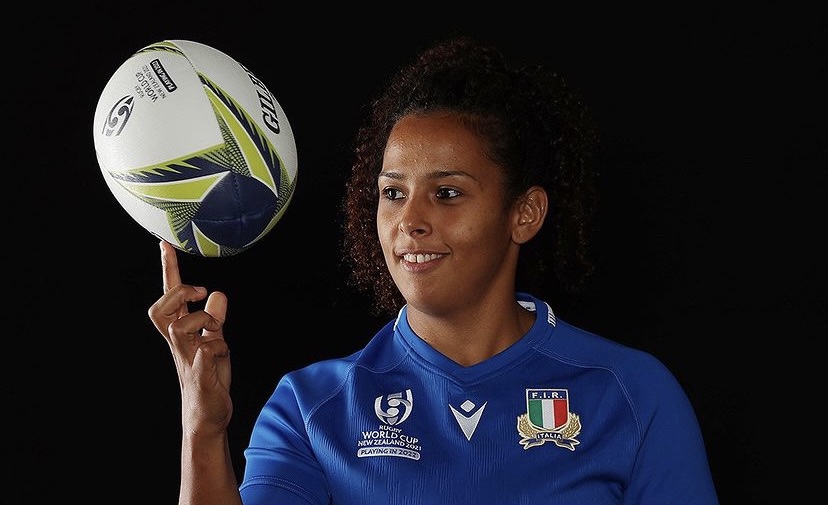
Force Of Nature Giada Franco

GUINNESS WOMENS SIX NATIONS 2024

Naples is no stranger to seismic activity, Mount Vesuvius is the only volcano to have erupted on mainland Europe in the last one hundred years.

Situated on the breath-taking gulf of Naples, it has a majesty, beauty and power that showcases nature in all its terror and wonderment.

The last eruption came in 1944, although in 1996, another force of nature was about to enter the local landscape, Giada Franco.

The family moved 54 kilometres south east, along the Amalfi coast, to settle in Salerno, a lively port with a relaxing Mediterranean ambiance, and an historic town full of tiny little passageways and hidden corners.

The bubbly Italian started playing rugby aged 13 at school, before starting senior rugby with Colerno, just north of Parma, in the Emilia-Romagna region.

Many have felt the aftershock of the dark haired flanker’s rib shattering tackles, and her eruptions, unlike Vesuvius, take place weekly at training and on match days.

Away from rugby the young lady of Naples is a big fan of “Le vechia signora”(The old lady of Turin) which for the uninitiated,  is the nickname of Juventus football club, one of the giants of the game.

A firm fixture in the national side, Giada made her  international debut in the 2018 Six Nations in Dublin.

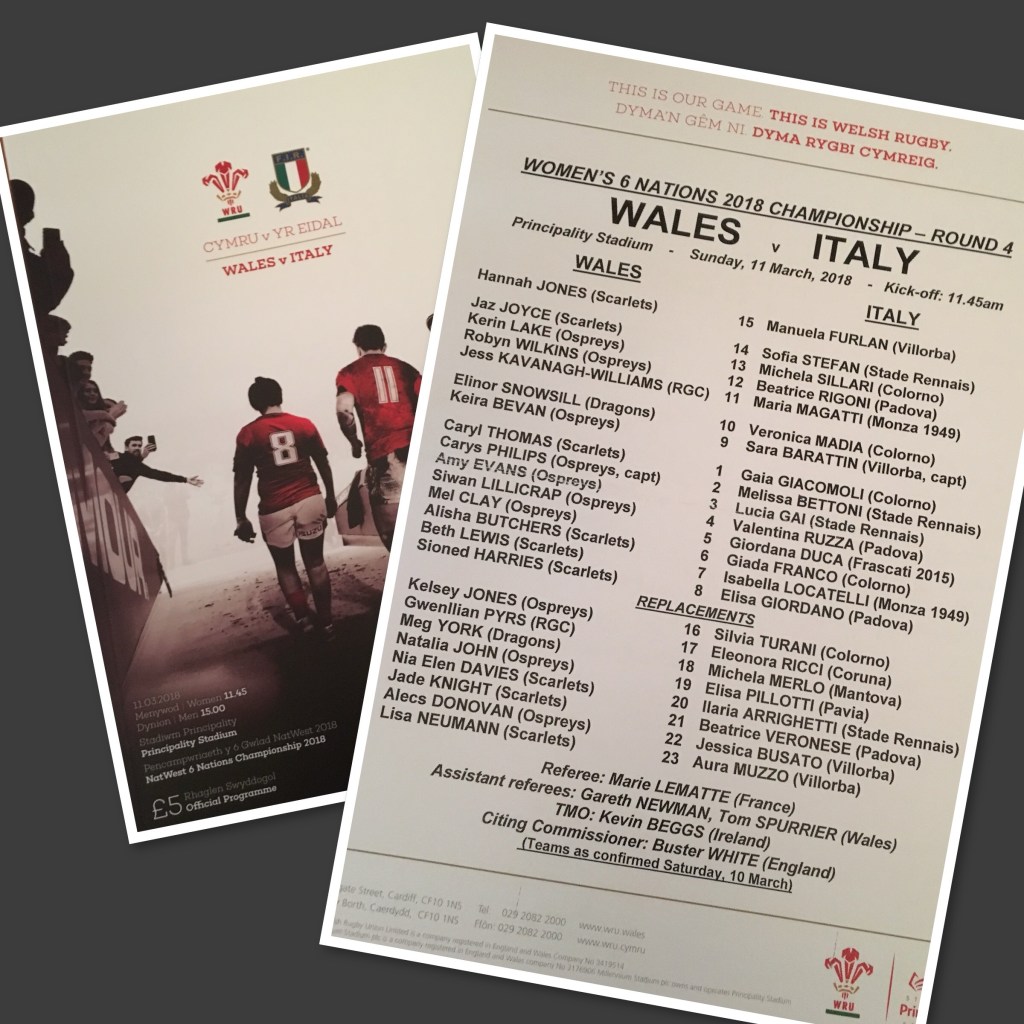
One of her most memorable moments came at the Principality Stadium in the Six Nations double header against Wales in 2018, when the “Azzura Assasin” played a blinder, it was the first time I had seen her play, she made a huge impression and has been a permanent fixture in the national team ever since.

Following her stint in England with Harlequins, where much to my good fortune we became friends, she returned to her first senior club back home Colorno.

Colorno is a comune in the Province of Parma part of the Italian region of Emilia-Romagna, located about 90 kilometres northwest of Bologna and around 15 kilometres north of Parma.

She enjoyed her time in England with Harlequins but she did admit to missing the sunshine and the gastronomical delights of home, particularly “Bistecca alla Fiorentina” which is a thick cut of porterhouse steak from an ancient breed of Tuscan cattle, instead of inches, these steaks are measured in fingers, and a good one will be 3-4 fingers thick, and Giada insists they don’t forget the fries.

Giada says “It was a fantastic experience, in England I experienced a totally different way of seeing rugby, especially women’s rugby. In addition to the very high level of play, there is a great organization behind the championship, structured to perfection and very competitive … Then the Harlequins are a fantastic club. I’m sorry that this experience ended prematurely because of the covid. ”

The “Leonessa di Colorno”, a nickname derived from her determination and those luscious locks, will be prominent on and off the field the 2024 Guinness Womens Six Nations.

This planet is a small place where the past and present are indelibly linked, when I first met Giada we sat over a coffee discussing the joys of rugby, and life, we discovered that both our grandfathers saw active service in Salerno during the Second World War, it is a small world indeed, but one in which Giada Franco is making a big impact.

Wales Fail To Stir In Wooden Spoon Decider

In Italy Olive wood is rare because there are only a limited number of trees that can be sustainably harvested each year. In addition, it takes many years for an olive tree to mature enough to be harvested for wood, making it a highly sought-after commodity. This durable long lasting wood is used to make traditional spoons used in kitchens throughout Italy and beyond.

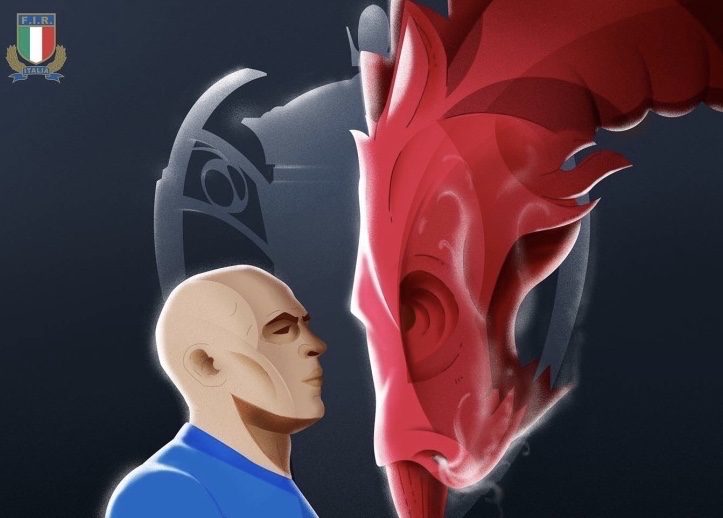
Whilst these wooden spoons are rare and much sought-after, the rugby equivalent is the exact opposite, but it has been in mass production in Italy since the Azzuri entered the Six Nations tournament back in 2000.

The bond between Wales and Italy is a very close one, particularly in the Welsh capital, and when heading northwards up in to the valleys.

There was a time when every little town and community in Wales had an Italian cafe and an ice cream parlour, many of them have now disappeared, superseded by multi-national chains, but the memories still remain, not just of the cafes, but also of the people who ran them and how they and their establishments became a centre of those communities.

As Wales and Italy prepared to battle it out for that unwanted piece of kitchenware, Cardiff’s wealth of Italian eateries filled up, Giovanni’s, Da Mara’s, Stefano’s and Antonio’s provided a conveyor belt service of antipasto, meatballs al forno and pizza.

Whilst the meatballs were mouthwatering Wales performance in a miserable defeat was unpalatable and left a bit aftertaste.

Despite the narrow score line this was a day when Wales were rudderless and error strewn.

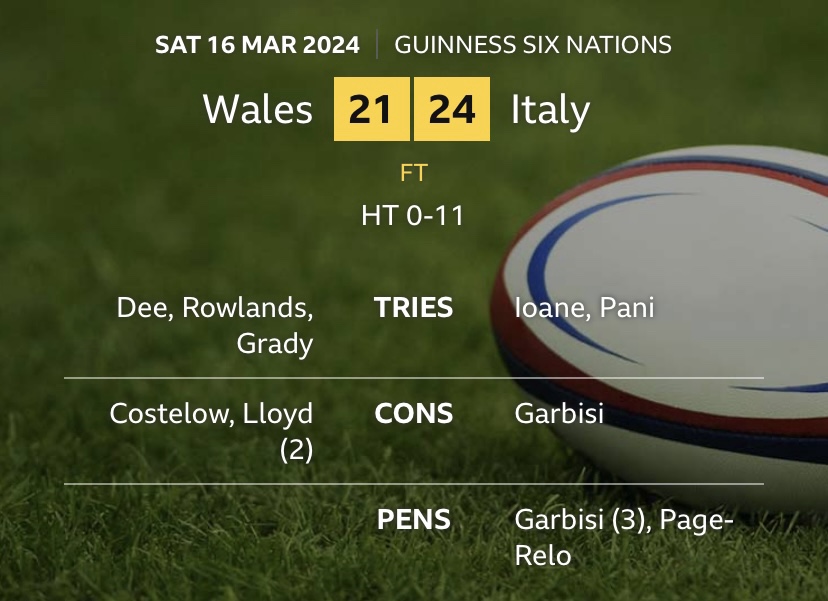
An 11-0 Italian half time lead was the least Italy deserved against a Wales team who were poor in every facet of the game.

A converted try by Pani after 45mins stretched Italy’s lead to 18-0.

On 63mins Wales final got on the scoreboard with a converted try from Elliot Dee (18-5) Two further penalties from Garbisi and Page-Rolo gave Italy an unassailable 24-5 lead with 72 minutes on the clock.

Two converted tries for Wales by Will Rowlands and Mason Grady in the final two minutes of the match were a consolation that created the false impression of a close game.

Whilst the men in red cannot be faulted for effort their lack of physicality and error count were alarming, this was indeed a very dark day for welsh rugby.

You feel that Wales first wooden spoon since 2003 will not be their last.

Mam’s The Word As France Finally Fizz In Cardiff

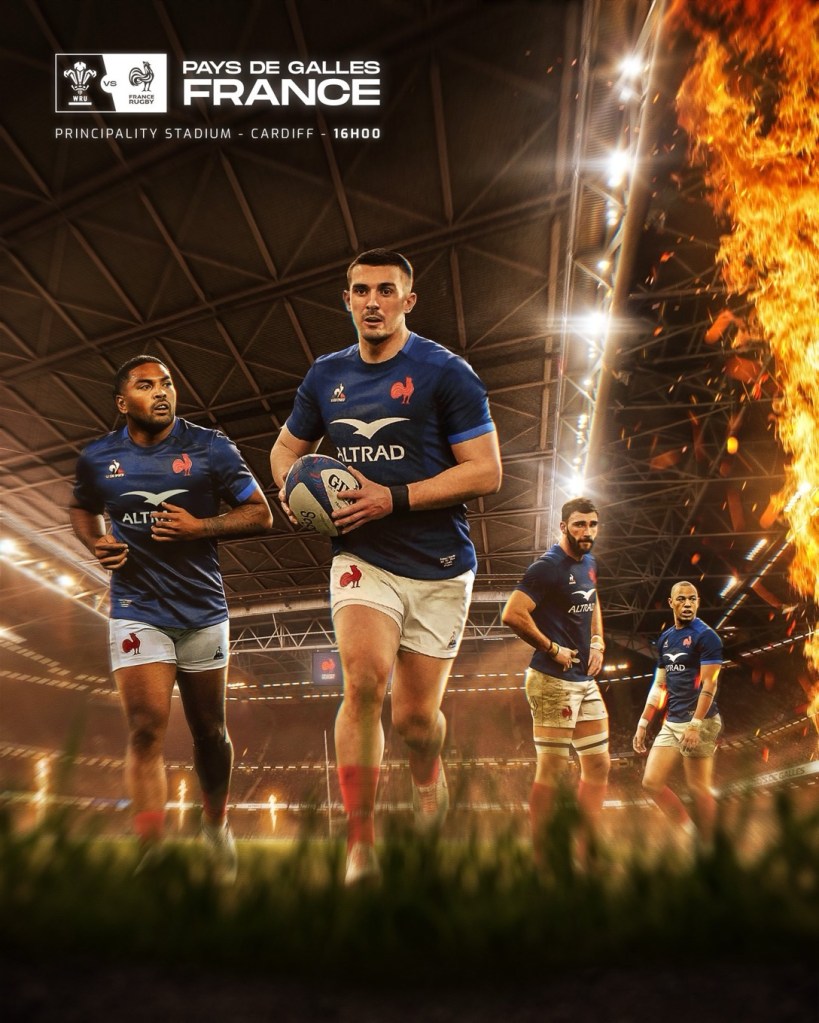
There were many sons and daughters facing an agonising decision yesterday, do they risk the wrath of Mam by neglecting Mothering Sunday duties and head to the Principality Stadium, or do they take the safest and most diplomatic option to stay at home and indulge their maternal parent.

Of course the alternative, and perhaps most obvious option, was to buy an extra ticket for Mam and take her to the game, whether she wanted to go or not.

Those brave souls who took the first option, with early morning appeasing flowers and chocolates delivered, were there on hand to witness new boys Joe Roberts and Gaël Fickou lining up for their respective National anthems, certainly no soft centres on view there.

Those gnarly French props have the kind of faces only a mother could love, but nothing that compares to the grizzly front row legends of yesteryear, Messrs Ondarts, Cholley, Garuet and co were once described by Bill McLaren as “Having faces like a bag full of chisel’s”.

But beauty is in the eye of the beholder and this current French outfit are obviously fully paid up members of the ‘big is beautiful’ brigade with Emmanuel Meafou and Uini Atonio pounding the Cardiff turf at a Teutonic plate sheltering combined weight of 46 stones, the former also measuring 6ft 8ins in height.

But good things also come in small packages and Cameron Winnett is the gift that keeps on giving this season. Despite being positively diminutive in comparison at 13st 5lbs and 5ft 10, his calm demeanour and graceful running and safety under the high ball have been one of the positives of this campaign, and you feel that the Wales number 15 shirt if not nailed down then certainly has a few drawing pins firmly pressed into it.

Max Boyce singing a new version of Hymns & Arias warmed up the 71,242 crowd before kick off, and the big French contingent responded with a stirring rendition of Le Marseilles.

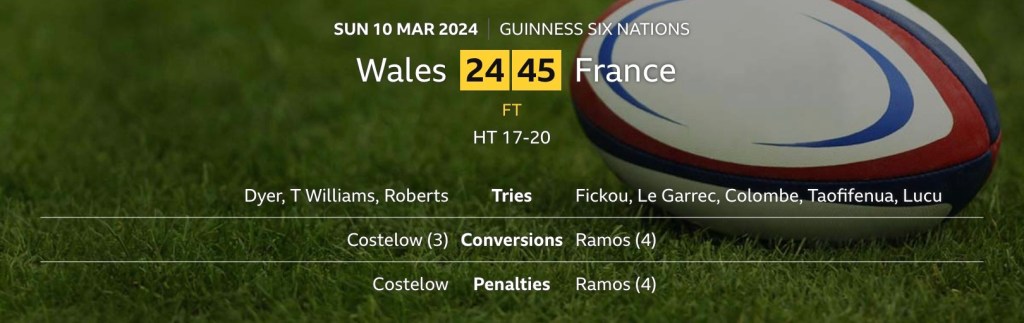
Wales took it to the French in the first half matching Les Bleus in the try scoring stakes with Rio Dyer and Tomos Williams’ touchdowns matched by those of Gaël Fickou and Nolann Le Garrec. France took a narrow three point lead into the interval (17-20).

Wales could not have started the second half much better, a try from Joe Roberts two minutes after the restart gave Wales a 24-20 lead, a lead they maintained until the 60th minute when a Tomas Ramos penalty opened the floodgates for France. Three tries in fifteen minutes took the game away from a brave and entertaining Welsh side who were unable to get field position to mount any attacks.

The superior quality and power of France’ bench made the difference as the timings of their scores suggests.

21 year old scrum half Nolann Le Garrec, the man from Vannes, received the man of the match award and France leave Cardiff with a huge sense of relief after finally wearing down Wales in the final quarter to register a 45-24 win.

Wales remain winless and now have a must win match against a buoyant Italy in Cardiff next Saturday to avoid a whitewash and the wooden spoon.

France will look forward to entertaining England in Lyon with the hope of finishing their disappointing tournament with a flourish.

France Flounder On Flanders Field

With Stade de France unavailable due to Olympic Games preparations, Les Bleus are touring the country this year, to undertake their Guinness Six Nations home games.

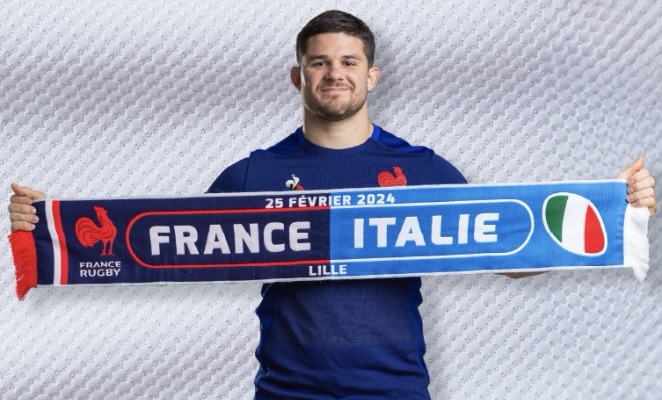
Having suffered a miserable loss to Ireland in Marseille on the opening day of the tournament, they headed 621 miles north to Lille for their second home game of the championship against Italy.

In a country where wine is generally king, Lille is France’s beer capital. Pelforth is a French brewery founded in 1914 in Mons-en-Barœul by three Lillois brewers. It was originally called Pelican, after a dance popular at the time, but changed its name to Pelforth after World War II. The name is a mash up of Pelican and “forte”, which means strong – and this is the style of beer they brew, including a blonde, brune and amber.

Stade Pierre Mauroy is tucked away in one of those out of town shopping complexes at Villeneuve d’Ascq, a suburb 6km southeast of Lille City Centre, just a gentle meandering fifteen minute driver less metro ride from Gare Lille Flandres.

France, after defeat in Marseille, gained an uninspiring win at Murrayfield, so this was surely the match, and the opposition, to enable them to get back on track, to display the wonderful power and wizardry we all know they possess, but which has proved elusive since their Rugby World Cup exit last October.

A typical grey February Sunday afternoon in Northern France gave way to glimpses of sunshine which was totally immaterial as the 50,000 throng belted out La Marseillaise under the stadium’s closed roof.

France started with pace and power and after just six minutes Charles Ollivon crashed over for a try converted by Jalibert.

Dominating territory and possession France continued with the high tempo game and created plenty of chances but a plethora of errors cost them a handful of tries.

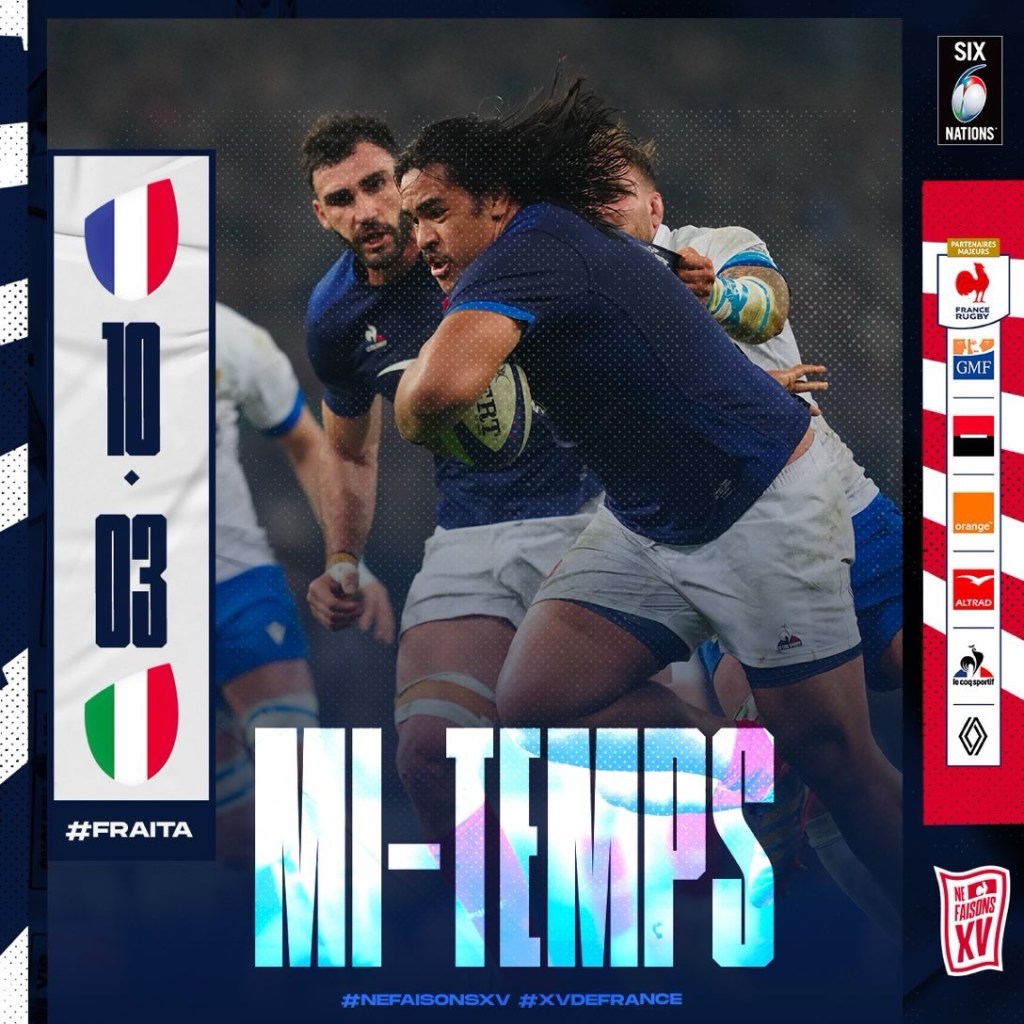
With 43:55 on the clock Page-Relo kicked a penalty for Italy following a yellow card to Jonathan Danty and France ended the first half with just a seven point lead.

The second half began with Danty’s yellow card upgraded to red as an error strewn frenzy began. France were a shambles and as the half wore on it suddenly dawned on Italy that they could win this.

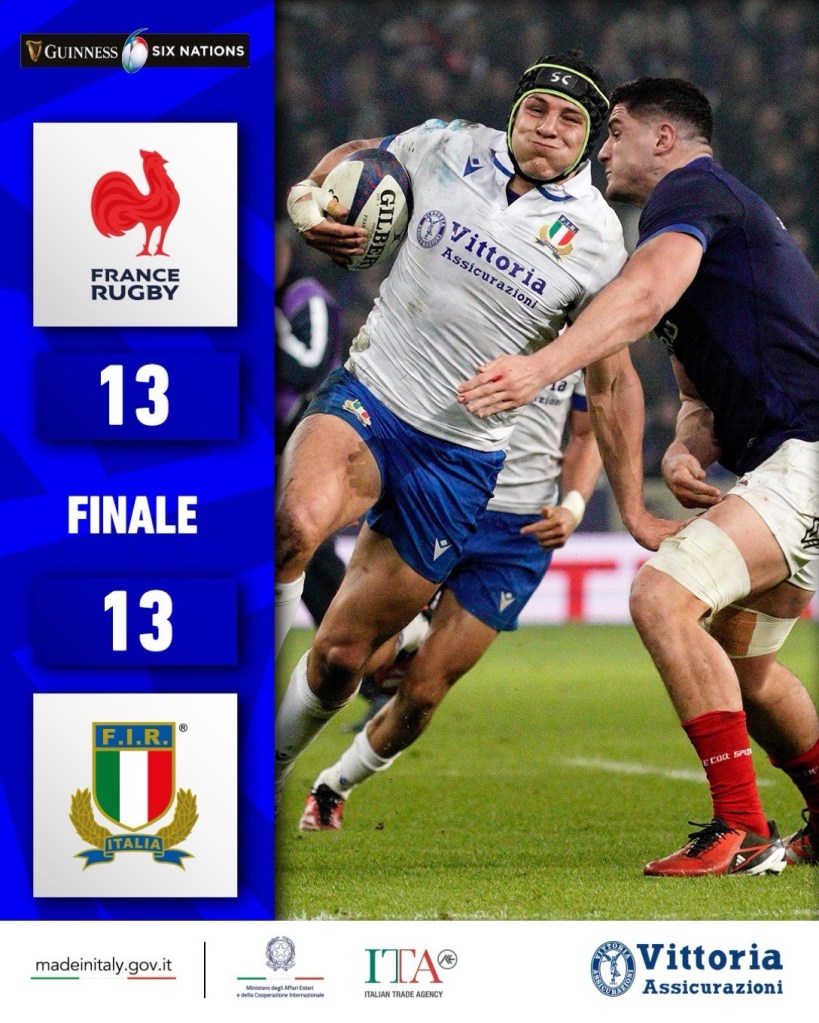
A 69th try from Capuozzo converted by Garbisi brought the scores level at 13-13.

Italy were awarded a penalty with the clock in the Red but Paolo Garbisi hit the post and the azzuri were denied a first Six Nations victory in France.

The fly-half looked set to seal the historic win until the ball fell off the tee, which resulted in a rushed attempt due to the amount of time left on the shot clock.

As for France their unforgiving press will give the group a tough time during the coming weeks. They look a shadow of the team that lit up the Rugby World Cup and their list of absentees grows ever longer.

Jalibert injured in the first half looks doubtful for the Wales game in two weeks time, Danty will be absent after his red card, and with Dupont and Jelonch unavailable resources are being stretched.

As the jammed packed metro headed back to the delightful cobbled streets of Lille, it’s time for a Pelforth or two before another wonderful Guinness Six Nations weekend melts into Monday morning, but it is probably the Peroni that will taste that much sweeter tonight.

No Bread Of Heaven But Crumbs Of Comfort

“How you think when you lose determines how long it will be until you win”.

GK Chesterton (1874-1936)

This Guinness Six Nations championship was always going to be a tough one for Wales.

After restoring pride at the Rugby World Cup in France, injuries and retirements, along with the perilous state of the club game in Wales, result in a crop of youngsters having to be exposed to the brutal environment of international rugby much earlier than would ordinarily be expected.

Wales have lost their opening two matches in this years tournament at home to Scotland by a single point, and away to England by two.

So as the tournament takes a weekend break it is already evident there will be no bread of heaven for the men in red this season, but there are some crumbs of comfort.

Cameron Winnett

The boy from Llantrisant looks to the manor born on the international stage, as safe as houses under the high ball, wonderful positional sense and a wicked turn of pace, still only twenty-one his potential is limitless.

Alex Mann

The fly half factory in Wales has been bought out by “Back Row Forwards Unlimited”, and yet another top of the range model has rolled out of the showroom, two tries in his first two internationals and plenty of grunt, a real find.

Rio Dyer

Looks better with every game, now getting much more involved in looking for the ball ,looks threatening every time he gets the ball, and has more gas than Russia and Saudi Arabia combined.

Tommy Reffell

Tommy Reff has been at the scene of more breakdowns than the AA, the Tiger has had his paws on so much opposition ball and was instrumental in setting up Alex Mann’s beautiful try at Twickenham.

Aaron Wainwright

The Dragons number 8 looks like a mild mannered Open University lecturer off the field, but on it he has been a beast. Played like a runaway train against Scotland and is on track to nail down that legendary shirt.

Discipline

Discipline has been excellent from Wales, they did not concede a single penalty in the second half against Scotland, and also the entire first half against England, they only gave away a total of 9 penalties across both games.

Tries

Wales have scored Six tries in the opening two rounds through Alex Mann (2), Aaron Wainwright, Rio Dyer, James Botham and a penalty try.

Bonus Points

The three bonus points earned could prove invaluable come the end of tournament, Wales got two losing points in their opening two matches plus a try scoring bonus point against Scotland.

So Next weekend Wales travel to Dublin probably their toughest task of all. They will then return to Cardiff for their final two games of the tournament against France on Mothering Sunday and Italy six days later.

There may be no bread of heaven this year, but those crumbs of comfort might well turn into a pretty decent sandwich before 2024 ends.

Hymns & Arias England v Wales

“We paid our weekly shilling for that January trip
A long weekend in London, aye, without a bit of kip
There’s a seat reserved for beer by the boys from Abercarn:
There’s beer, pontoon, crisps and fags and a croakin Calon Lan

Times have changed dramatically since Max Boyce penned Hymns & Arias. For a start that January trip now takes place in February, and the guaranteed Wales win has long since evaporated.

For many, England v Wales at Twickenham is no longer a case of “Rolling into Paddington with an empty crate of ale” but rather a day trip by car with pit stops at Leigh Delamere and Reading M4 Eastbound services, where swathes of red clad caffeine depleted individuals endure longer queues at Costa and Pret than those at the gates of the stadium itself.

One thing that hasn’t changed is the desire of Welsh fans to “just win this one please”.

This legendary trip has been a rite of passage for generations of Welsh fans and continues to be so.

For those of us still doing missionary work on the wrong side of the River Severn, a Welsh win makes the next twelve months just that little bit more bearable with bragging rights secured.

The great JPR Williams who sadly left us last month, used to roam these fields like a proud stallion, Twickenham was a happy hunting ground for him, and it seems implausible to think it was 48 years ago that I was here watching him tear England apart with two tries, and a million tackles, with a face full of ever increasing stitches.

The current crop of Wales fans had travelled more in hope than expectation following their opening day one point heart-stopping defeat to Scotland in Cardiff.

The match ended in a single point victory to England, but it also ended with a feeling that this young Welsh outfit have something a little bit special about them further down the road.

With the backdrop of a glorious sunset in south west London, Wales came intent to express themselves, to play without fear and give reign to the wonderful skills they displayed in the second half against Scotland.

Wales took the game to England and with a blink of an eye a penalty try and an England yellow card ensued and the boys in red were 7-0 up.

Ben Earl scored for England with a rampaging run from a five metre scrum before Alex Mann finished off a wonderful Welsh move and Ioan Lloyd’s conversion gave Wales a 14-5 half time lead.

Incredibly Wales didn’t concede a single penalty in that first half, sadly they also didn’t score a single point in the second period.

England scored 11 unanswered points in the second half through a Fraser Dingwall try and two Penalties from Ford. Wales finally surrendered the lead in the 71st minute and couldn’t find field position in the last nine minutes to attempt a score to clinch victory.

So no Hymns and Arias this time around for Welsh fans but there is plenty to optimistic about. Cammy Winnett the 21 year old earning only his second cap looks calm composed and to the manor born on the international stage.

Alex Mann with two tries in two appearances looks a star in the making, and Tommy Reffell was his wonderful best yesterday.

Max Boyce’s “Hymns and Arias” epic endures even now, fifty years later. Sadly the subject one of its most popular lines is no longer with us.

The management team of Heaven RFC decided they could wait no longer to secure the services of the greatest fly half I have ever seen. Barry John left us last Sunday, and his presence hung over Twickenham, the crowd even sang God Save The King before kick off and you get much better than that.

Hymns and Arias indeed and I leave you with Max’s immortal line

But Will is very happy though his money has all gone, he swapped five photos of his wife for one of Barry John”

Things Turn Out All White In The End For France

Maybe it was the thought of another Monday morning showdown with Shaun Edwards, or perhaps the change of colour of their shirts from blue to white, whatever it was the France finally managed to grind out a win at Murrayfield.

Perhaps the Ireland game was their “hair of the dog” to cure a Rugby World Cup hangover that refused to go away, one thing is for sure they will land back at Charles de Gaulle much much happier than when they left.

The Edinburgh dreich was a far cry from Marseille and it was a difficult first half for France with Scotland scrum half Ben White scoring an early touchdown, but a Gaël Fickou try on the half hour kept them in the hunt as Scotland led 13-10 at the break.

A penalty from Finn Russell took Scotland 16-10 ahead and as errors increased with the conditions worsening it took a moment of magic from the lightning Bordeaux speedster Louis Bielle-Biarrey who touched down after a kick and chase with 69 minutes on the clock.

Thomas Ramos converted and added a 76th minute penalty to give France a 20-16 lead.

Scotland threw the kitchen sink at France and may well have scored try right at the death. Replays suggested the ball may have been grounded in a heap of bodies, but referee Nic Berry had called no-try on the field and the television footage could not definitively prove otherwise.

For France this was not vintage fare but the win may just clear their heads a little before they face Italy in two weeks time.

A major concern will be the injury to captain Grégory Alldritt who was carried off in the 49th minute.

A celebratory red or two may be the in order tonight but not too many as France do not want another hangover to contend with.

Barry John A Humble Tribute


On Saturday at the Principality stadium we said a fond and emotional farewell to JPR Williams followed by a barnstorming match that left everyone who watched emotionally battered and bruised.

Just as we were beginning to recover, around Sunday teatime, out hearts were ripped out once again when the news hit that Barry John had passed away.

It is hard to describe just how good Barry John was, he retired from the game at his peak when only 27 years old, but those of us who saw him play knew we were in the presence of a rugby genius.

In 1971 I was just thirteen years old, the Lions had just beaten New Zealand in a series win, and to be British, and specifically to be Welsh, was to be on top of the rugby world, emotionally as well as statistically.


Before social media, e mails, selfies, Twitter and Instagram, in order to communicate with people over any sort of distance, you had to write what we called letters.

I sent my letter to Barry addressed “Barry John, Fly Half, Cardiff Arms Park, Cardiff” I asked him, in my best handwriting if I could somehow get an autographed photo.

Two weeks later, a letter arrived on my doorstep, sent by Barry, which included a signed autographed photo.

I cannot tell you what a thrill it was to have the great man’s signature, sadly he retired from the game a few months later, at the height of his fame and talents, at the tender age of twenty-seven.

To describe his career in caps and statistics seems somewhat cold and soulless, and tends to devalue the magical qualities, and the almost ethereal presence that he possessed.

Dr Dai Smith described him as The dragonfly on the anvil of destruction, Barry John ran in another dimension of time of space. His opponents ran into glass walls which covered his escape routes from their bewildered clutches. He left mouths, and back rows agape”.

Every time I saw Barry play he gave off a cool superiority which spread to those playing alongside him.

Whilst the hustle and bustle went on around him, he could distance himself from all the frantic action and keep a cool and almost distant control of proceedings.

Everyone else on the field played the game on Barry’s terms.

Forty five years later on November 5th 2016, I found myself in the media room at the principality stadium whilst covering the Wales v Australia international.

Heading toward the most popular area of the this centre, the food counter, I spot a stocky, but somewhat frail looking  dark-haired man, the slight frame and the chiselled cheek bones have gone, but there is no mistaking a “King” or in this case THE King.

Barry smiles humbly as I offer my apologies for the fact that it has taken forty-five years for to deliver my “Thank You”, and as we headed  pitch side it seemed only apt to get another photo, this time of the two of us together.

We sat next to each other in the press box, a bigger thrill for me than for him that’s for sure, and as we stood for the Welsh national anthem  I could see his dark eyes sharpen and moisten he was back there, where he strutted his stuff on the field of dreams, and I was back there with him, in my daydream watching him.

For me he will always be the greatest, it was Barry John scoring a mesmerising try, against England, in 1969 that first ignited my love of rugby, for that, I cannot thank him enough.

In 2016 his side step and swerve were naturally not what they were in those distant glorious years, but he still must have been pretty quick, he managed to blur the photo.

Rest in Peace Barry and Diolch

Scotch Mist And a Tearful Farewell In Cardiff

‘Scotch Mist’

Meaning: The phrase ‘Scotch mist’ is used humorously to refer to something that is hard to find or doesn’t exist – something imagined.

There have been more reported sightings of the Loch Ness Monster this century than those of Scottish victories in Wales, in fact success on the green green grass of our home has been rarer than scotch mist.

Scotland had not beaten Wales in Cardiff since 2002. However they were victorious in Wales during the covid disrupted 2020 Six Nations tournament, but that match that had to be rescheduled and was eventually played in Llanelli, at Parc y Scarlets, on 31 October of that year, whilst the Principality Stadium was being used as a field hospital.

This time around with the mercurial in-form Finn Russell conducting matters, there were hopes, and no little expectation, that 2024 would be the year when finally the tartan hordes would not be sent homeward to think again.

Of all the teams in this year’s championship Scotland are without doubt the most settled and it appeared to be a case of now or never for the boys in blue up against a young and inexperienced Welsh outfit decimated by retirements and injuries.

Yesterday in the Welsh capital it was a day of contrasting emotions, the inevitable excitement at the start of a new Guinness Six Nations tournament, but also the deep sadness of paying tribute to one of Wales’ favourite sons who left us far too young last month.

JPR Williams had many a battle against the Scots on this wonderful patch of green in the heart of the capital, and his immense presence quite rightly hung over this game like a nostalgic warm blanket. The emotional pre match tribute was a fitting farewell to the great man, there were plenty of moist misty eyes amongst the 75,000 in attendance.

Wales had a dismal first half, everything that could possibly go wrong came to pass, and at the break Scotland led 20-0. The second half didn’t start much better when Van Der Merwe was ushered through for his second try of the match with 42 mins on the clock, and the 27-0 lead looked unassailable.

What transpired from that moment on would have put Lazarus to shame, Wales awoke from their winter hibernation and scored 4 tries in twenty minutes to take them within one point of the Scots (26-27)

The transformation had the crowd ramped up to fever pitch, and with “Living on a prayer” blasting out of the stadium’s PA system Wales were Desperately seeking one more score of any description. That Scotch mist was beginning to form, but time was running out for the men in red and Scotland managed to regroup in the final minutes to hang on to victory.

So after twenty-two years of waiting, that old familiar feeling of heading homeward tae think again had finally dissipated, along with the scotch mist. It will be put to the test when a wounded France visit Murrayfield next Saturday, and a case of collective amnesia may well be on the cards to avoid it, but for now the young inexperienced Wales side are the ones who have to do all the thinking.

They will take heart from the positive running rugby they displayed in the second half, and the character they showed to launch an astonishing comeback.

A trip up the M4 to Twickenham looms in a week’s time and team selection for that game will be extremely interesting.

An exhausting, exhilarating nerve jangling start to the Guinness Six Nations, we expected nothing less from this wonderful tournament.