As a child, my media entertainment was somewhat limited. Television only had two channels, BBC and ITV, and both were broadcasting in black and white, or grey depending on how old your television was.
The other great form of entertainment was the radiogram, a record player and radio built into a wooden cabinet to disguise these decadent items as a piece of furniture. It was this wooden wonder that provided me with my first experience of this wonderful mystical rugby entity, the Triple Crown.
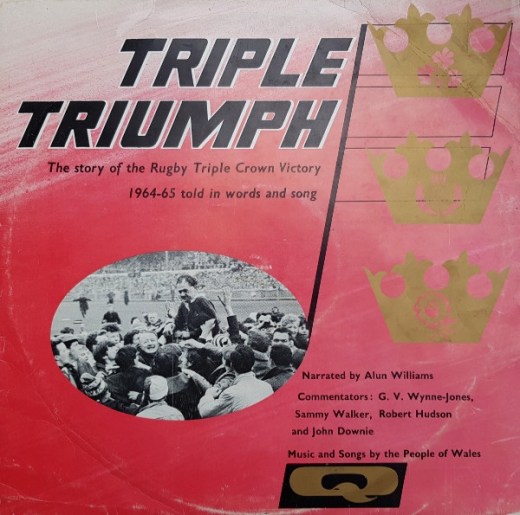
I was six years old in 1965 when Wales won my first Triple Triumph, and to mark the event my parents bought a long playing gramophone record that celebrated this achievement, with excerpts of match commentary and male voice choirs.
This LP was played to death by me, hearing the dulcet tones of commentator Alun Williams describing Terry Price’s drop goal against Ireland lives with me to this day, “The ball comes to Price who will drop at goal, it’s a good one, it’s a very good one, and it’s over !”.
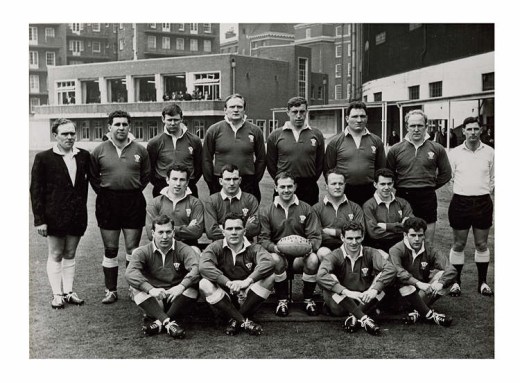
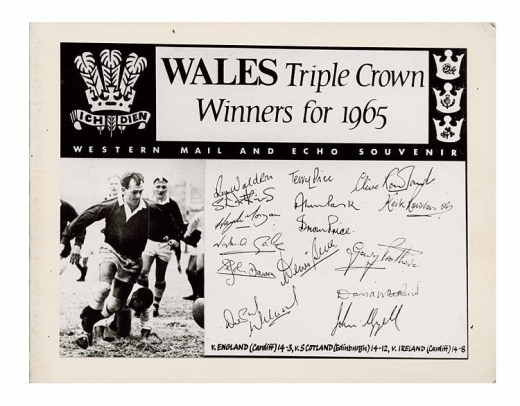
For the record, if you’ll pardon the pun, Wales won the Triple Crown by scoring the same number of points against all three teams. England (14-3) Scotland (14-12) and Ireland (14-8). Only defeat in Paris prevented a Grand Slam as Wales were beaten at Stade Colombes (22-13)
Clive Rowlands captained the side with the mercurial David Watkins at fly half, with a back three of Terry Price, Stuart Watkins and Dewi Bebb.
One of Clive’s proudest moments was winning the Triple Crown in 1965. He says: “We missed out on the Grand Slam but won the Triple Crown. It was the first time for 13 years. It’s something very special.”
Denzil Williams from Ebbw Vale one of Wales greatest ever props accompanied a second row of Brian Price and Keith Rowlands, with gnarly Llanelli hooker Norman Gale adding to a pack that didn’t take any prisoners.
Wales next won the Triple Crown in 1969, the start of a golden era that saw them repeat the feat in 1969, 1971 and a record four consecutive years in 1976, 1977, 1978 and 1979.
On December 10 1988, Wales faced Romania at Cardiff Arms Park, in what appeared, on the face of it, to be an ordinary run of the mill international rugby union match.
But on a bright winter’s day in the Welsh capital, events unfolded that triggered the onset of the biggest Welsh exodus to rugby league of all time.
A young and highly talented Wales team was about to be ripped apart, and a generation that had given us glimpses of some wonderful rugby, and more importantly, hope for the days ahead, were about to be lost to our friends in the North.
The band played the wrong Romanian national anthem before kick off, which was perhaps an omen, and things were about to get a whole lot worse.
The Wales team that day had a few new faces, but on paper looked a side strong enough to see off a Romanian team that could be best described as solid and workmanlike.
15 Tony Clement (Swansea)
14 Glen Webbe (Bridgend)
13 Mike Hall (Bridgend & Cambridge University)
12 John Devereux (Bridgend)
11 Richard Diplock (Bridgend)
10 Jonathan Davies (Llanelli) Captain
9 Robert Jones (Swansea)
1 Mike Griffiths (Bridgend)
2 Ian Watkins (Ebbw Vale)
3 Dai Young (Cardiff)
4 John Wakeford (South Wales Police)
5 Kevin Moseley (Pontypool)
6 Richie Collins (Cardiff)
8 Phil Davies (Llanelli)
7 David Bryant (Bridgend)
16 Paul Thorburn (Neath)
17 Bleddyn Bowen
18 Jonathan Griffiths (Llanelli)
19 Hugh Williams-Jones
20 Kevin Phillips (Neath)
21 Rowland Phillips (Neath)
Wales lost 15-9 to Romania, in front of 19,000 fans at Cardiff Arms Park, and apart from a classy John Devereux try, and five points from the boot of Paul Thorburn, who came off the bench as a replacement winger, there was very little to shout about.
As is often the case in Wales, it was one of the nation’s greatest players who was chosen to be the sacrificial lamb, to bear the brunt of the criticism and rancour in the aftermath of the defeat.
Trimsaran is a Carmarthenshire village that grew up around the coal industry, these days the magnificent Ffos Las racecourse has transformed the place, and although horse racing is relatively new to the area, Trimsaran knows a thing or two about producing thoroughbreds, it is the birthplace of Jonathan Davies one of the greatest talents Welsh rugby has ever produced.
Jiffy wanted a debrief with the Welsh Rugby Union, following the disastrous summer tour to New Zealand, where they lost two tests to New Zealand 52-3 and 54-9, however he was given short shrift, and his desire to get this talented team back on track was sneered at by many.
Jonathan was captain against Romania, and he took the defeat hard and personally. It seems unbelievable, but he actually feared for his place in the team.
With a young family to support, along with the uncertainty surrounding his union international future, he signed for Widnes Rugby League team a few weeks after the defeat.
The same critics that had castigated him days earlier, were now mourning his passing, and beginning to realise what a massive loss he would be to the Welsh team.
Jiffy’s wonderful career in league would be a constant sobering reminder to those that did very little to encourage him to stay.
I don’t think anyone, at the time, had an idea of what was to follow, and the large casualty count of players that would be lost to the 13 man game.
That Wales rugby Union team of 1998 had only months earlier won a Triple Crown, for the first time for nine years, and shared the Five Nations Championship title with France.
They played a scintillating attacking brand of rugby, and Jiffy at fly half was the orchestrator.
Against England at Twickenham Wales had four fly halves in the back line, Tony Clement, Bleddyn Bowen, Mark Ring and Jonathan himself. Adrian Hadley, who was to sign for Widnes, scored two tries that day as Wales ran England ragged.
On a bright sunny day at HQ Wales were irrepressible, Jonathan Davies, despite a heavily strapped ankle, tormented England flanker Mickey Skinner like a matador wielding his cape around an aged bull.
Victory at home to Scotland included Ieuan Evans “Merlin the magician” try, Wales clawed back a 20-10 deficit to seal the game with two Jonathan Davies drop goals, and won a scintillating contest 25-20.
A gutsy away win in gusty Dublin, 12-9, in a tough narrow contest, included a Paul Moriarty try, and was sealed with Jiffy’s signature finale, a drop goal.
The win gave Wales their first Triple Crown since 1979, and set them up for Grand Slam showdown in rain drenched Cardiff, a match that ended in the narrowest of defeats for the men in red, by a single point 10-9.
There was disappointment in the loss, but also for the first time since the magnificent 1970’s, there was a realisation that Wales had a team with the potential, and the talent, to set the rugby world alight.
A ridiculously scheduled tour to New Zealand, described by former Wales captain Dai Young as “the tour of death”, was the beginning of the end for this talented group of players.
It was absolutely brutal, young Wales flanker David Bryant was the victim of such ferocious rucking the scars on his back didn’t heal for a year.
Bryant made his Wales debut in the opening Test, in which Wales were crushed 52-3.
“Painful would be the word I would use to describe it. My lasting memory of the tour was I would come off at the end of the game, and they would take out the stitches I’d had the week before and put stitches in new wounds. I had 28 stitches in the head during the course of that tour.
The team suffered badly from injuries and had to call up six extra players during the course of the tour. Original tour captain Bleddyn Bowen broke his wrist in the second game and was replaced as skipper by Bob Norster, until he suffered a badly gashed knee, whereupon Jonathan Davies took over the captaincy.
Even All Blacks coach, Alex “Grizz” Wylie was horrified at the schedule the Welsh Rugby Union had agreed to. He went on record as saying he would never have excepted such a fixture for his team.
The stuffing was well and truly knocked out of a young Welsh side, but that should have been just one of the up’s and down’s that occur in the development of every great side.
The Welsh Rugby Union’s decision to sack Tony Grey and Derek Quinnell, the coaches, was a massive over reaction, and it lit the blue touch paper for the decline that was about to follow.
John Devereux, in an interview with Wales Online said: “We lost a generation, the 1988 tour did the damage. We were building something but that tour tore down all the good work that had been done by Tony Gray and forwards coach Derek Quinnell.
“It was absolutely ridiculous decision, the worst ever, to sack Tony and Derek after it, because they had learned so much from being in New Zealand and knew what they had to do, who knows what would have happened had they stayed as coaches? Maybe players wouldn’t have gone to rugby league.”
There is no doubt in my mind that the boys of 98 were something very special, it still rankles with me to this very day that the Welsh Rugby Union robbed us all of the pleasure of watching this team progress, to have them taken away from us piece by piece, player by player, was heartbreaking.
The relationship between league and union had always been a fractious one, to the extent that it was questionable whether there was a relationship at all.
Cheque books and Rolls Royce’s would glide southwards into the valley towns and the West Wales countryside in the dead of night, to entice their prey away from the amateur game, (as union was pre 1995), and for rugby men with families to support, the offers from the northern men in suits were often just too good to turn down.
Union viewed league with great suspicion, anyone associated with the professional game was persona non grata at every rugby union clubhouse and playing field. Union players suffered life long bans for simply attending a rugby league trial.
In 1947 George Parsons was picked to play for Wales against France in Paris. He got on the train at Newport but was thrown off due to an allegation of him speaking to a rugby league scout.
Widnes coach Doug Laughton, the man who signed Jiffy, turned up at the Gnoll on a scouting mission to watch the then Wales wing Elgan Rees play.
An enraged Neath committee man stormed over to Laughton and told him, “You can get out of here and you can take the big thug you’ve brought with you”.
That big thug was none other than Big Jim Mills. Laughton replied “I’ll go but only after you’ve told him (Mills) to leave”.
I would hazard a guess that the committee man found discretion to be the better part of valor, but the story is an example of how things were between the two codes.
Every Welsh rugby union generation was resigned to losing a player or two to league, it was the way of the world back then.
Terry Price and David Watkins the architects of Wales 1965 Triple Crown went North
The 1969 Triple Crown and championship winning team lost Maurice Richards and Keith Jarrett.
Even the golden generation of 1970’s were not spared, John Bevan, Roy Mathias, Stuart Gallagher and Clive Griffiths followed that well trodden path up country
The list of those great Welsh players who headed to Lancashire and Yorkshire is a who’s who of outstanding talent. Lewis Jones, Billy Boston, John Mantle, John Warlow, Colin Dixon, Clive Sullivan, Terry Holmes, Kel Coslett, Jim Mills, the list seems endless.
Jiffy’s success in league gave us all a Jekyll and Hyde sensation, there was huge delight at watching him reach his sporting peak as his genius matured and flourished, but also a hollow empty feeling of what could have been with Wales and the Lions, and when you read the list of those who followed in Jonathan Davies footsteps, you truly realise the extent of Wales’ loss.
He was presented as a Widnes player on 7 January 1989 after signing for a reported fee of £230,000.
Contrary to popular belief it was Adrian Hadley, and not Jonathan Davies who was the first of the Wales 1988 stars to switch to league, signing with Salford for a £100,000 fee, which was a record at the time .
Widnes and Warrington took the lions share of the union emigrees as 13 players left Wales for pastures new.
It was September 1988 when Adrian Hadley left Cardiff and his job with the Inland Revenue in Llanishen for the much more taxing role with Salford. Four months later Jiffy’s move to Widnes opened the flood gates.
In April 1989 Moriarty followed the path trodden by Holmes. Paul Moriarty signed for Widnes.
The following month Llanelli scrum half and fireman, Jonathan Griffiths joined St Helens.
John Devereux the wonderfully talented Wales and British Lions centre increased the ever growing Welsh contingent at Widnes when he arrived at the club in October 1989.
If the Union game in Wales was hoping for a respite when 1990 dawned they couldn’t have been more wrong.
As Valentine’s Day approached prop and cornerstone of the Welsh pack Dai Young moved from Cardiff to Leeds.
Late summer saw a further drain of union talent when Rowland Phillips and Allan Bateman both signed for Warrington in the September of 1990, Mark Jones joined them from Neath at the Wilderspool a month later.
There was a bit of lull in the exodus before Swansea, Wales and British Lions flanker Richard Webster signed for Salford in September 1993.
The effect on the union team was there for all to see, Wales were bottom of the 5 Nations Championship five times out of the next seven years.
When Wales recovered in 1993/94 and won the 5 Nations championship under the captaincy of Ieuan Evans, two further massive body blows scuppered any opportunity to build on that success when two of the stars of that team in time honoured tradition headed north.
Scott Gibbs joined St Helens in April 1994 and five months later Scott Quinnell who was proving to be a revelation for Llanelli and Wales joined Wigan in a deal worth £400,000 over four years. Quinnell’s loss was the hardest to come to terms with as he was the cornerstone of Wales hopes for the future, a massive ball carrier with great hands and at 22 years of age we had not even begun to see the best of him.
Bob Norster, the Wales team manager at the time said in his typical understated style ” I cannot pretend it’s anything less than a significant loss for us”.
We, the fans, still worshiped our heroes from afar, and even got the odd glimpse of their playing talents, albeit very rarely.
The Rugby League Challenge Cup Final at Wembley, every May, was always broadcast live on Grandstand, and invariably there would be one or two of our old flames featuring. The same could be said when Great Britain hosted Australia, or other Southern Hemisphere opposition, that too was an opportunity to look closely at the team sheets to see which Welshmen might be on display.
In our dreams we longed to be given the opportunity to see these boys back on the green green grass of home, playing league, union or even tiddlywinks, but we knew in reality that, despite our fervent hopes, the chances of it happening were very slim.
But then the year of 1995 dawned and all that was about to change.
1995 turned out to be one of the most memorable years in the history of rugby, for Union and league, things would never be the same again.
On 27 August 1995 Vernon Pugh QC announced that rugby union would become professional, and as a result the rugby road that had been heading North for generations, turned into a one way system with all the traffic heading south.
The irony in all this is the fact that in 1995 the Wales international rugby league team had the greatest year in their history.
They won a European Championship, and reached the semi finals of the Rugby League World Cup, but much more than that they captured hearts and minds back home in a rugby union stronghold.
For once, it didn’t matter a jot whether it was league or union, it was just rugby and it was Jiffy, Devs, The Clamp, Moriarty, Gibbs, Quinnell and co, wonderful players who set the pulses racing, who put their bodies on the line for Cymru. We rediscovered the lost generation, and we all welcomed them with open arms and open hearts.
In April 1995 the band Take That had a number one hit with “Back for good”, maybe Gary Barlow knew something we didn’t, because in October of that year the pied piper Jonathan Davies, whose move to Widnes started the exodus, began the flood returning back for good from league to union when he signed for Cardiff.
I am actually beginning to wonder if Gary Barlow is in fact a rugby mystic as his further compositions “Everything Changes” and “Never Forget” could well be the perfect soundtrack for that memorable year.
A litre of petrol cost 60p, in Wales and the average house price was £45,335 in 1995, John Major was Prime Minster, and perhaps even more staggering than the Wales rugby union departures, OJ Simpson was found not guilty of murder.
Wales played 7 internationals in 1995, winning 6 and losing just one, the one defeat being that memorable World Cup semi final against England at Old Trafford.
They won the European Championship, after victories over England and France, played two internationals in the USA, and reached the semi final of The Halifax Centenary Rugby League World Cup.
A regulation change in 1995 was the catalyst that set this team on the road to greatness Wales already had a back line to die for but were a bit short in the grunt and grind department. The change allowed players to qualify to play for Wales through their grandparents nationality. This opened the door to bolster the Welsh pack and set the Red Dragons on to great things.
Wales international Rugby League season began on 1 February and ended on 21 October.
During those 8 months the Welsh team had the time of their lives.
1 February
Wales 34 England 14 Ninian Park Cardiff
4 March
France 10 Wales 22 Carcassonne
11 June
USA 10 Wales 66 Philadelphia
18 June
USA 4 Wales 92 Philadelphia
9 October
Wales 28 France 6 Ninian Park Cardiff
15 October
Wales 22 Western Samoa 10 Vetch Field Swansea
21 October
England 25 Wales 10 Old Trafford Manchester
In the 7 international matches played, Wales scored 44 tries, with 17 different players touching down.
Iestyn Harris 6 Tries
Anthony Sullivan 4
Kieron Cunningham 4
Adrian Hadley 4
Gareth Davies 4
Scott Quinnell 3
Rowland Phillips 3
Mark Jones 3
Kevin Ellis 3
Allan Bateman 2
Jason Lee 2
John Devereux
Dave Williams
Ian Watson
Gavin Price-Jones
Paul Atcheson
Mark Sheals
Wales were also fortunate to have some superb kickers at their disposal. Jonathan Davies kicked 17 goals, Iestyn Harris, 12 and perhaps a less likely but talented kicker Adrian Hadley kicked 8.
Jonathan Davies the master of the drop goal also landed 2 of his delicacies in 1995.
The cold statistics are impressive, but this group was about more than fact and figures.
These boys had come home and you could sense their undiluted joy at being able to play on their fields, in their country, in front of their people, 1995 was a very special year indeed.
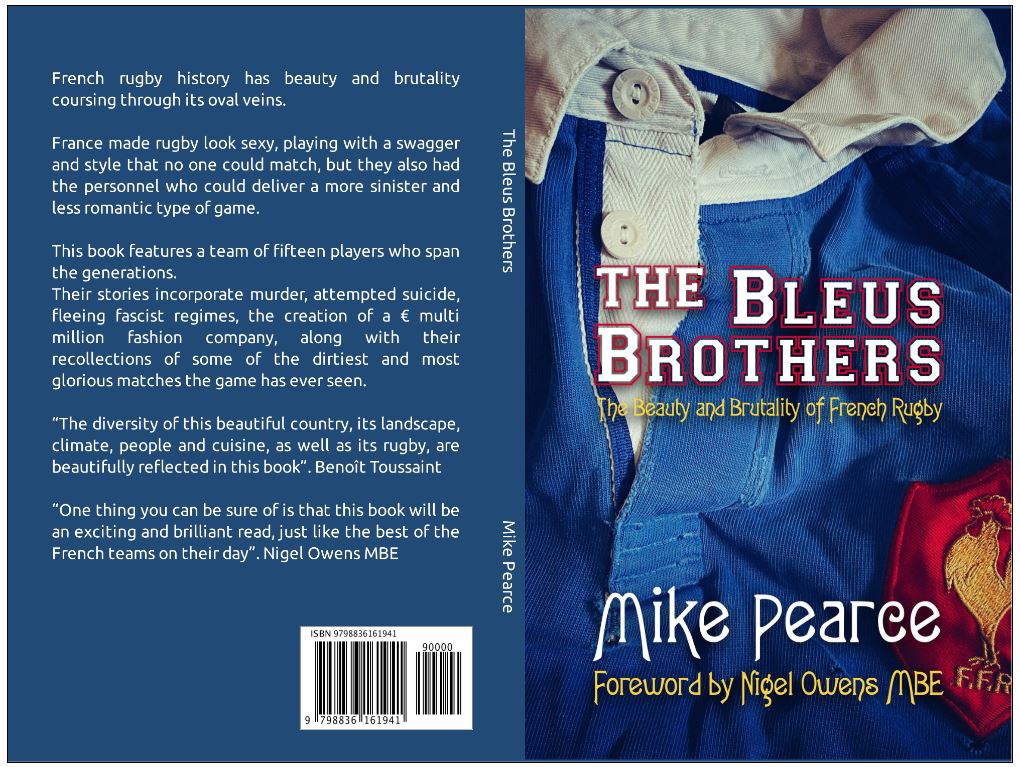
An exclusive extract from my book The Bleus Brothers. Chapter 2 features Guilhem Guirado
It is midnight in Saint-Denis, and Guilhem Guirado the France captain is still doing the media rounds. He is muddied, bruised and exhausted after the opening game of the 2019 Guinness Six Nations Championship.
Nine o’clock kick-offs may be good news for the home supporters who can indulge in a leisurely dinner pre-match but for players it is the final knockings of a very long day.
As Friday night nudges into Saturday morning, Guilhem can finally grab a shower. After the endless rounds of media commitments, it is time to start the long process of unwinding. Many more hours will pass before he can finally get the kind of sleep a warrior deserves, although sleep may be in short supply after the extraordinary events that have unfolded on the field of play.
The dark streets of Saint-Denis are illuminated by neon hotel signs, and the dimly-lit bars are nearly empty as the last train takes supporters back to Gare du Nord and central Paris.
An uneasy quiet descends on the Stade de France, the moonlight reflecting in the icy puddles as the shutters on the food outlets come echoing to a close in the Parisian night with the final Espresso dispensed.
On a bitterly cold night, the warm red shirts of Wales created a comeback that would have defied Lazarus as they turned around a 0-16 deficit at half-time, to score three second-half tries and earn a 24-19 victory.
It was Wales’ biggest ever half-time turnaround in a Five or Six Nations match, and the haunted look and sheer desolation on the French faces at full time was painful to see.
Even with Jefferson Poirot in the front row it is difficult to fathom the mystery of how France let such a big lead slip. What might Poirot the detective have said? “There is nothing more amazing than the extraordinary sanity of the insane! Unless it is the extraordinary eccentricity of the sane!”
Selecting the hooker position for this French Hard Men XV was one of the decisions I struggled with the most.
Firstly, by definition, you don’t get a hooker who isn’t hard; when you are dangling in a scrum between two brutes with your arms trapped and head-to-head with the opposition, witty repartee is not going to help you very much.
Secondly, France has had such an embarras de richesses of ‘talloneurs’ – Paco, Dubroca, Szarzewski and Ibanez to name but a few.
I’m sure many will question my choice of Guilhem Guirado as hooker. The numéro deux shirt has been worn by so many wonderful hard men that I really was spoilt for choice. But hardness comes in many different forms and Guilhem Guirado had a mental and physical hardness that very few could match.
He virtually carried the national team at one of the most disappointing periods in its history, but as hooker and captain, Guilhem never let his personal standards or his level of performance drop for one second which is more than can be said for some of his colleagues in the blue jersey.
Guirado was like a one-man battering ram, running himself into the ground, not only doing all the donkey work expected of a hooker but also becoming a major try scorer.
In the 2018 autumn internationals, he scored in all three matches of the series against South Africa, Argentina and Fiji, and ended up as France’s top try scorer of the campaign with four.
In total he scored eight tries for his country, four of which came during the fourteen-day period of those 2018 autumn matches.
A Twitter debate perfectly summed up Guilhem’s situation. The question was asked: “Which player from another Six Nations team would you select for your own country?”
The overwhelming majority of people voted for Guirado. One user replied: “I would pick Guilhem Guirado just so that he doesn’t have to suffer through playing for France anymore!”
Guilhem was a warrior; he put his body on the line time and time again and he never flinched. At the end of every international, the television cameras would pan in on him in painful close-up as he stared wide eyed with despair. Sometimes you got the impression, rightly or wrongly, that he was the only one that cared.
When France lost to Ireland 13-15 at Stade de France in February 2018, Guirado made 31 tackles, a Six Nations record that he jointly holds with Luke Charteris of Wales.
His durability was incredible. For someone who was always the first to put his body on the line, he had very few absences with injury. When Guilhem went down in a match he would invariably bounce back up and if he stayed down then you knew it was something serious.
Arles-sur-Tech is a tiny village, set in a scenic forested valley in the eastern foothills of the Pyrenees, a place where Catalan and French are spoken.
It is less than one hour’s drive from the Spanish border, a journey that has a major relevance to one of its inhabitants, Guilhem Guirado.
In stature and appearance, he is exactly how you would imagine a French hooker to look. At 5ft 11ins and 15 stone 8lbs, he is as tough and solid as the local Pyrenean boulders on the field but has the calm, whispering qualities of the meandering Tech river off it.
He is a private man who puts his love of his family above all else. His grandparents were among the half a million Spanish citizens who fled the violence of the Spanish Civil War and crossed the Pyrenees with the sole aim of finding safety and refuge in France. The exodus was the biggest single influx of refugees ever known in France and was named “La Retirada”, the Spanish for retreat.
Guilhem’s parents were born in Granada. They were both five-year-olds when they arrived in France following that arduous journey with almost nothing to their name.
He says: “Until I was 15 all I knew was this village where my grandparents had arrived, my favourite memories are from here. I loved being that age; it is here everything really started for me and I found a passion for rugby.”
Guilhem is a man who knows where he is and more importantly where he has come from.
I first met him at the RBS Six Nations launch in 2016 after he had just been announced as the new France captain. He stood out as a man at peace with himself, taking everything in his stride in a calm and measured manner.
The lovely thing about Guilhem is that the moment he sees you he immediately shows you the latest photos of his children on his mobile phone. We have been through quite a few Six Nations launches and mixed zones together and he is always the same, win or lose.
“To know where you want to go, you need to know about where you came from, and the determination that went before” he says philosophically. When you delve into his family history you get a sense of where that inner strength has come from.
“What I like about rugby is the direct confrontation with an opponent, a physical contest and collisions, tackles.”
But when he gets home, he puts his bag down and rugby is done and dusted.
“The most important thing for me is my family and the people who are around me, whether they be my parents, grandparents, wife son or daughter.”
“It’s my stability, it’s something that allows me to put things into perspective and to be able to relax and see life in a different way. I’m not only thinking about rugby and that allows me to perform well on the field.”
The French region of Pyréneés-Orientales was ceded to France by Spain in the seventeenth century.
This beautiful place, nestled between the Pyrenees mountains and the Mediterranean Sea, is part of Northern Catalonia, also known as French Catalonia.
Perpignan accounts for over a quarter of the population of Northern Catalonia and is the heartbeat of Catalan culture and gastronomy. You will certainly find more red and yellow horizontally striped flags here than Tricolores.
While Catalonia is the richest part of Spain, French Catalonia is one of the poorest regions of France.
Guirado is a proud Catalan and to play for USAP was his boyhood dream.
To play for Union Sportive des Arlequins Perpignanais to give them their full title is a local aspiration akin to the boys on the Copacabana wanting to play for Brazil. For Guilhem it was no different.
“My first game for Perpignan was on 8th August 2006 in a local derby against Narbonne. I remember we played three matches in nine days. I arrived at the club aged 14. I never imagined playing for the first team. By just playing for the juniors, I felt I had reached my pinnacle.”
He broke his leg at the age of 15, an injury which should have been resolved in a few months but in this instance Guilhem was out of action for over a year.
“I watched my first Perpignan match in May 1998 and my whole life has flowed from it. I always wanted to outdo myself for the club for which I had such a wonderful attachment” says Guirado.
His final match for USAP ended in a heartbreaking defeat to Clermont, a result that confirmed their relegation to the second division, the ProD2.
“I used that awful feeling to motivate me throughout my career” he says. But there were also some wonderful moments at a club where you sense Guilhem’s Catalan heart still beats strongly.
“Two of my greatest rugby moments were the 2019 Top 14 Final win with USAP and the European Cup quarter final against Toulon which was played at Montjuïc in Barcelona. It was a wonderful Catalan occasion played in front of a packed crowd in the Olympic Stadium and a win for us 29-26.”
After nine years, 202 matches and 20 tries at Perpignan, he moved 381 kilometers along the coast to Toulon and became part of the star-studded team that won the European Cup at Twickenham on 2nd May 2015 when they beat Clermont 24-18.
Leigh Halfpenny, Juan Martín Hernández, Drew Mitchell, Juan Smith and Bakkies Botha all played for Toulon that day.
Guirado’s playing career has included Perpignan, Toulon and Montpellier along with an international career that ended in the land of the rising scrum on 20th October 2019 when France were defeated in the Rugby World Cup quarter final by Wales.
“My first memory is the first time I played rugby; it was with all my friends in Arles-sur-Tech and the most beautiful thing is we all got to know each other on the rugby field and today we are still sharing our lives and great moments together.”
“I have been lucky to be able to play for my club that made me dream when I was a kid, the Perpignan team USAP, and finally to be able to play with France a few years later and then to play with Toulon and Montpellier with the best players in the oval world.”
He won his first international cap for France on 9th March 2008, replacing Dimitri Szarzewski and coming off the bench against Italy at the Stade de France in a 25-13 victory. “I remember my first cap, a special taste, I remember it like it was yesterday.”
“It was a great pride, a huge honour for all that it means for me and for France.”
Guilhem never took for granted the responsibility and honour of putting on the French jersey.
“I think it’s always an honour to play for and represent France, everything goes more quickly, and it is a bit stressful because of the fear of not being up to the mark. You want your family to be proud of you.”
“I like to know what has happened in the past and immerse myself in it because I also have to represent all the former players. There have been some huge players and great hookers who have gone before me.”
“For me this shirt really represents the welcome given to the Spanish exiles. I am French. I grew up in France; it is a country that was ready to give a welcome to my grandparents so of course I think of them.”
Guirado had to battle for a starting place in the French team with William Servat and Szarzewski, two very talented hookers. But he eventually got his first start in the 2010 November international against Fiji.
Jacques Brunel, who had worked with Guilhem at Perpignan, became French coach after the 2015 Rugby World Cup, and he named Guirado as his captain for the 2016 Six Nations. His debut as skipper came against Italy at Stade de France, a match that took on an important significance after Paris had suffered several terrorist atrocities during the latter part of 2015.
There was a nervous eerie build-up to the game, and to see so many armed police and military personnel at a rugby match made for an unusual experience. But on a mild sunny day in the French capital, the national anthem was sung with even more emotion than usual and you could feel the crowd relax as the match progressed.
The whole occasion, and a win for Les Bleus, brought a much-needed smile to a city that had suffered so much.
France won 23-21 through tries by Vakatawa, Chouly and Bonneval although the joy was very nearly curtailed at the very end of the match when a Sergio Parisse drop goal attempt drifted wide.
“In my first match as captain everything went very fast” he says. “Meeting new staff and new players meant an awful lot of pressure.”
Guirado went on to captain France on 33 occasions, winning 12, losing 20 and drawing one.
On captaincy, he says: “I don’t have a specific style; it is mainly a feeling, a lot of conversations and a lot of questioning and the captain is nothing without the players around him.”
The Bleus Brothers is available via the link below from Amazon priced £7.99 with free postage
With an ambitious plan aimed at reducing the tournament’s environmental impact, Rugby World Cup 2023 will be more than just a sporting event.
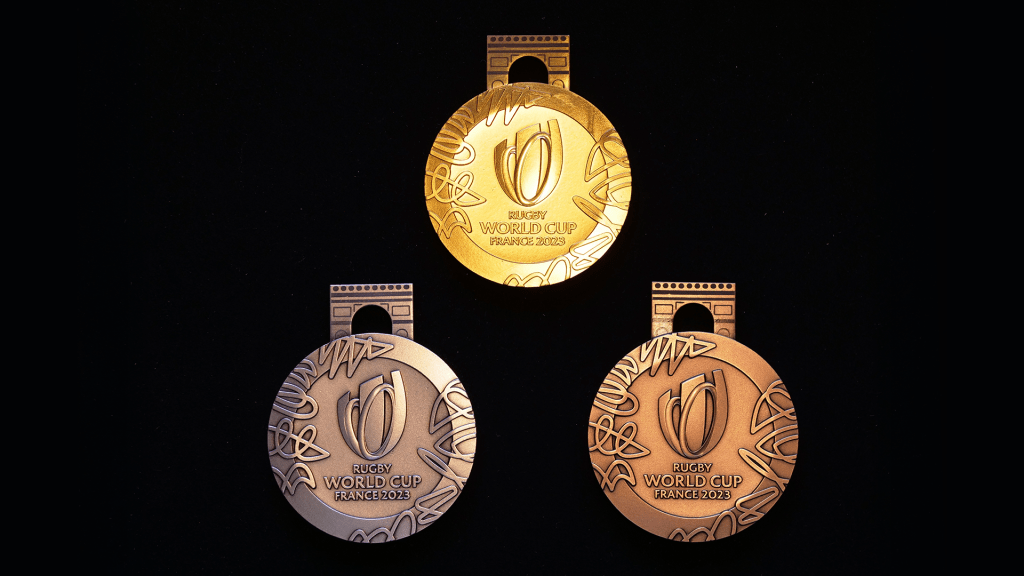
With that goal in mind, France 2023 has teamed up with the Orange Group and the Monnaie de Paris to create sustainable gold, silver and bronze medals for the tournament from recycled mobile phone components.
The medals will be awarded to players and coaches from the teams taking the top three places at Rugby World Cup 2023: the winners of the Webb Ellis Cup, the runners-up and the winners of the bronze final. Participation medals will also be presented to all the players taking part in the tournament.
The Möbius strip that wraps around the Rugby World Cup 2023 logo on the front of the medal is a unique and continuous link connecting the players to the fans, rugby to society, and France to the world. And because Rugby World Cup 2023 draws its strength from the regions of France, their uniqueness and specific characteristics, the ten host cities are represented through their very own signature.
The iconic Webb Ellis Cup featured on the back of the medal is the ultimate prize for every rugby player.
Bold yet traditional and combining nods to its history and avant-garde spirit, the medal embodies France and rugby at their strongest. It is topped by a depiction of the Arc de Triomphe.
The Orange Group played its part in the creation of the Rugby World Cup 2023 medals by arranging for the collection of used phones at its shops across France and from Campus 2023 apprentices, FFR-member clubs and partner companies.
The phones were sent to the French social and environmental cooperative Ateliers du Bocage for careful sorting. Those in good condition were repaired and refurbished, while the rest were recycled and taken to a centre specialising in the extraction of metals from electronic waste. The raw materials were then prepared by a company producing semi-finished and finished alloy products.
Working closely with the France 2023 teams, the Monnaie de Paris, France’s oldest and most illustrious minting institution, designed, engraved and struck the medals at its workshop.
They will be presented to the players taking part in Rugby World Cup 2023 in an environmentally friendly case and attached to a ribbon made from recycled material.
Key facts and figures
1,491 medals (gold, silver, bronze and participation medals) 206,000 used mobile phones collected 2,953kg of metal recovered from 31 tons of phones 138 phones to make each medal 220 participating clubs and organisations
As rugby fans count down to Rugby World Cup France 2023, Emirates has taken to the skies with its passion for the game emblazoned on one of its flagship A380 aircraft, A6-EOE.
Over the years Emirates has rolled out a series of eye-catching limited edition livery designs to the delight of sports fans and plane spotters around the world. This latest Rugby World Cup 2023 decal, designed in-house, was inspired by the fast-running lines of the backs, evident in the delicate lines that run seamlessly through the new livery.
Returning for the 4th time consecutive Rugby World Cup as Worldwide Partner, Emirates has long been at the heart of local and international rugby, cheering on teams and enriching the experience of rugby fans across the globe.
The airline has been a tournament sponsor of Rugby World Cup since 2007, and in 2011, became a Worldwide Partner when the host nation, New Zealand, won the tournament. That year, Emirates unveiled its first ever Rugby World Cup livery on an A380, A6-EDN, which operated over 40 flights to cities including France (finalist in 2011), Australia (semi-finalist), as well as other rugby nations like the US and Hong Kong.
In 2015, Emirates once again celebrated its love for rugby with its A380 A6-EDA dressed in the Rugby World Cup livery as it ferried passengers across the world, including to England, the host nation, and 21 other destinations, including Brisbane, New York JFK, Manchester, and Sydney.
Emirates continued the tradition in 2019, designing a new livery for Rugby World Cup hosted by Japan. Its A380 A6-EEU visited Tokyo Narita nine times and Kansai International Airport four times, in addition to cities across the US, Europe, and Asia, and New Zealand, even though the Webb Ellis Cup finally went to South Africa in the clash with England. The decal was also seen in LA, New York, Melbourne, and Bombay.
As the Official Airline of Rugby World Cup France 2023 and Australia 2027, Its investment in the sport as a Worldwide Partner will help support rugby’s development in both emerging and established markets, while fans will be able to watch every moment from two unforgettable Rugby World Cups live and on-demand from their flight seats, I like the sound of that.
A rare 5.8 magnitude earthquake hit large parts of western France on Friday evening, with the seismology bureau calling it “very strong” amid reports of damage to buildings. Ecology transition minister Christophe Béchu said it was “one of the strongest quakes registered on the mainland.”
The national network for seismic surveillance recorded the quake at 5.3 while the French Central Seismological Bureau (BCSF) put it at 5.8. The last earthquakes of similar strength in France struck in the early 2000s.
Last night the Tectonic plates in Saint Denis were smashed like happy hour in a Greek restaurant, as Skelton, Meafou, Antonio and company knocked the living daylights out of each other in a brutal pulsating affair.
The collisions were off the Richter scale in the steamy sultry airless Stade de France.
Alldritt ran and ran like Forest gump on steroids, if Life is like a box of chocolates than poor Grégory has gone from the coffee creams in Dublin to the montellimar nougat, the hard chewy one that everyone leaves in the box, in Paris.
The Top 14 season that never ends, finally ended in sticky steamy twenty-five degree Parisian darkness when Toulouse lifted the Bouclier de Brennus, the trophy the size and shape of a front door, as they were crowned the 2023 Top 14 champions.
Guest of Honour, President Macron has seen a lot of yellow shirts in Paris lately but this time it was a group with Top 14 title aspirations rather than pension reforms that were the focus of attention.
Santiago Chocobares took advantage of a Jonathan Dante knock-on, and outpaced the La Rochelle defence to score the game’s opening try in the 23rd minute. Ramos converted, and Toulouse lead 13-3.
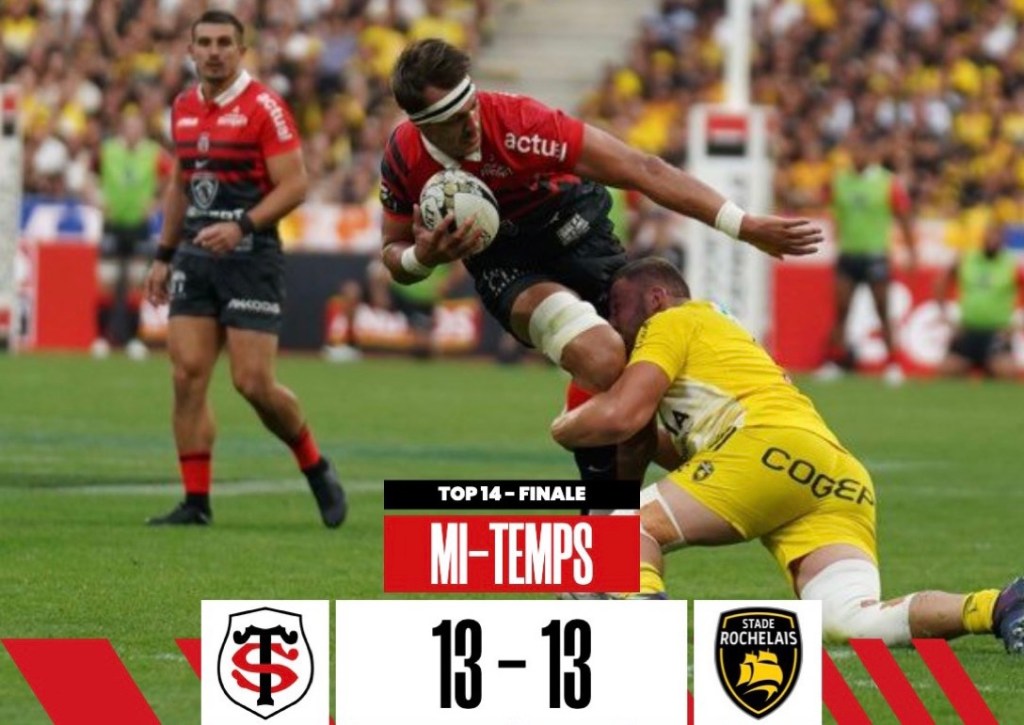
Antoine Hastoy added a penalty for La Rochelle, after failing with two kickable ones, before a Francois Cros’ knock-on five metres from his own line led to the scrum from which scrum half Tawera Kerr-Barlow sniped like a giant mole to touchdown, Hastoy landed the simple conversion to make it 13-13 at the break.
Uini Atonio barrelled over five minutes into the second half, following Pierre Bourgarit’s searing break and it looked like La Rochelle were in control with an 20-13 lead.
Ramos kicked three penalties to give Toulouse a 22-20 lead before Hastoy replied with two of his own to put La Rochelle in front 26-22.
With time running out Ntamack kicked a penalty to the corner aiming for the 5 metre mark he sliced his kick over the dead ball line, the colour drained visibly from his face, it was surely game over for Toulouse.
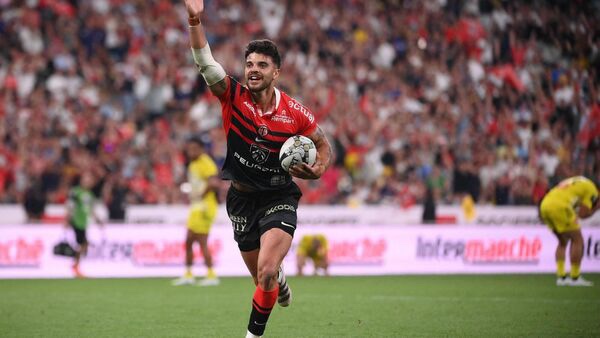
But we should have known better, the Ntmack family don’t do “game over” and with 77.42 on the clock he took a delicious pass from Dupont to ghost past Seuteni and Leyds before sprinting 50 metres to touch down behind the posts. Ramos’ conversion made it 29-26 to give Toulouse their 22nd Bouclier de Brennus, and their third since 2019.
Back in the Toulouse changing room President Macron downed a bottle of beer in one to the applause of the Stade Toulsain players and staff. Maybe pension reforms could take on a similar negotiation platform, but for now it was only the yellow shirts drenched in sweat and tears sat exhausted and stunned that mattered, and it was the boys from the Pink City that found all of the sudden that the night air was beautifully cool and sweet.
With the Top 14 Final in Paris on Saturday between La Rochelle and Toulouse, here is an excerpt from one of the chapters in my book The Bleus Brothers.
In the early morning summer sunshine in Neilly-Sur-Seine, Café du Marche is just waking up and following its regular routine. The backboard menus are getting their first taste of chalk while I am getting my much needed first taste of coffee. But today is no ordinary day. This evening 14 miles up the road, one of the most wonderful annual rugby occasions will take place.
A Top 14 Final is a rugby and cultural event like no other. It is Mardi Gras and Oktoberfest all rolled into one.
From early morning the TGVs roll into Gare de Lyon and Gare Montparnasse with their colourful human cargo disembarking and immediately heading for a station espresso with the speed and footwork of Serge Blanco.
The day of the final is an extremely long one with kick off at 9 p.m. Wherever you go in the French capital on that particular June Saturday, there are lines of families in team shirts sitting out in geometric lines of tables as far as the eye can see soaking up the sun’s rays amid the wafting aroma of steak frites.
The glass carafes of red, white and rosé glisten in the sun. This is as much a part of final day as the match itself, and just as grueling, with cheese and coffee and, maybe even a brandy to get through before setting off for Stade de France with a heavy stomach and a much lighter wallet.
If you have never been to Paris for the final, I would recommend you add it to your bucket list.
It’s not just the fans who add the colour and joie de vivre to the French rugby season’s climax. The finals of 1987 and 1990 were memorable for more than just the rugby thanks to Racing 92, the Parisian outfit, and their famous fly-half Franck Mesnel who is my selection to wear the number 10 shirt in this exclusive French XV.
Franck agonized over choice of career and had to make a difficult decision to become either a pilot or an architect. He eventually decided on the latter.
Mesnel was the ringleader of a group of eccentric Racing players who got together when they decided to mock their own image as capital city fancy dans who were known collectively as Le Show-Bizz.
“We always kept our values of respect and rugby values, but we had that impertinence” says Mesnel.
Le Show-Bizz painted their boots gold, wore fake bald heads, ran out in blazers and blackened their faces.
“These acts were a motivation for us, and each time we did one of these jokes we knew we had to back it up.”
Racing lost to Toulon 15-12 in the 1987 French Championship final. They wore pink bow ties for the first time but three years later they went to another level when they faced a hard-nosed down-to-earth and tough Agen team in the season finale at Parc des Princes.
Racing won 22-12 after extra time but the match is best remembered for the incredible sight of Mesnel and his Le Show-Bizz colleagues quaffing champagne on the pitch during the half-time team talk.
“One of our wingers who was injured told us he would come on at half-time with the champagne” says Mesnel. “It was real champagne on a silver salver. I just remember seeing the faces of Pierre Berbizier and the Agen team looking at us in amazement, but it did us good since we won the second half.”
President François Mitterrand left that final with a gift from French international Jean Baptiste Lafond in the form of a pink bow tie which the full back presented to him before kick-off.
Le Show-Bizz became such a phenomenon and attracted so much attention that Franck Mesnel, Eric Blanc and Lafond released a record, a single entitled “Quand tu marques un essai” (“When you score a try.”)
Barcelona does not instantly conjure up images of Rugby. In a football mad city the sporting names that roll off the tongue are those connected to the round ball game.
Messi, Xavi, Iniesta, Puyol, Ronaldinho, the list of greats is endless, a team that ruled Europe and despite its Catalan quest for independence helped Spain rule the football world a few years back.
Famous Spanish actor Javier Bardem once said “Playing rugby in Spain is like being a bullfighter in Japan.” even so there is a growing interest in the sport in this part of the world.
Futbol Club Barcelona Rugby currently play in División de Honor, the premier level of Spanish rugby union. The club plays home games at the Ciutat Esportiva Municipal Vall d’Hebrón-Teixonera.
The La Vall d’Hebron Area was an area designated for urban planning 1992 Barcelona Olympics.
Situated in the northern part of Barcelona at the foot of the Serra de Collserola mountain range, it was restructured for the 1992 Olympics to become a large recreational area. Cycling, tennis, archery and volleyball completions were held there along with the demonstration sport of Basque pelota.
The club was formed on September 21, 1924 and has had a long and successful history, having won 19 national titles and 19 regional competitions.
Before the Spanish Civil War, the club won the championship of Spain on three occasions and the championship of Catalonia seven times. During the 1940s and 1950s FCB was one of the strongest rugby clubs in Spain, winning a further 10 Spanish championships.
This season Barça Rugbi were eliminated in the quarter final División de Honor, play-offs losing away to Santboiana beaten by a last minute try (38-31). The result ended a great season for the Catalans,achieving a fifth place finish winning seven of their twelve league matches.
The match at Baldiri Aleu saw Santbioana lead 24-17 at half time with a Barcelona try in the first move of the second half bringing the scores level at 24-24. With the match all square at 31-31 and only seconds remaining Oriol Pujol’s try secured victory for the home side.
One of Barcelona’s most notable players was Andriy Kovalenco born in Kyiv in Ukraine. He played for three National Teams, the Soviet Union, Ukraine then after becoming a Spanish citizen, for Spain.
Gaining 37 caps he became one of the highest scoring players for Spain during his international career, from 1998 to 2006, with 2 tries, 11 conversions, 49 penalties and 1 drop goal, for an aggregate of 220 points.
Kovalenco played in two matches at the 1999 Rugby World Cup scoring all of Spain’s points in the 27-15 defeat to Uruguay, landing five penalties.
Football will always be the lifeblood of Barcelona but there is a little corner of this beautiful city where the oval ball game is doing very nicely thank you.
England versus Wales is one of the great rivalries in world sport.
Dudley Wood, formerly secretary of the Rugby Football Union, summed things up perfectly. “The relationship between the English and the Welsh is based on trust and understanding. They don’t trust us, and we don’t understand them”.
Whatever the sport, there is something extra special about meetings with our near neighbours.
Wales and England first faced each other in a Rugby League international on 20 April 1908, at Athletic Park, Tonypandy. Wales were victorious that day winning 35-8 in front of a 12,000 crowd.
The Steroephonics hit the nail on the head with their 1999 composition “As long as we beat the English we don’t care”.
The bragging rights of a victory against the old enemy cannot be underestimated, especially if you happen to be Welsh and living in England.
Old Trafford, the home of Manchester United is one of the great English sporting arenas but it is no stranger to the occasional Welshman.
The legendary football club has been graced by many wonderful Welshmen, although usually with a different shaped ball.
Mark Hughes, Mickey Thomas, Ron and Wyn Davies, and more recently Tom Lawrence, have all been feted by the Stretford End.
Watching Ryan Giggs sprinting up and down the left wing was the norm in these parts, however on this particular Saturday it was the turn of another Welsh speedster, Anthony Sullivan. the St Helens flying machine, was an equally glorious sight to behold when in full flight.
Incidently Ryan’s father, Danny Wilson, played 4 times for Wales rugby league team between 1981 and 1984. Danny was a stand off who played for Widnes, Barrow, Swinton, Springfield Borough and Runcorn after moving up north from Cardiff.
Old Trafford is no stranger to rugby It has played host to both codes of rugby football, although league is played there with greater regularity than union. The Super League grand final has been played at Old Trafford every year since the introduction of the playoff system in 1998, and is set to continue to do so until 2020, the first rugby league match to be played at Old Trafford was held during the 1924–25 season, when a Lancashire representative side hosted the New Zealand national team, with Manchester United receiving 20 per cent of the gate receipts.
The first league match to be held at Old Trafford came in November 1958, with Salford playing against Leeds under floodlights in front of 8,000 spectators.
The first rugby league Test match played at Old Trafford came in 1986, when Australia beat Great Britain 38–16 in front of 50,583 spectators in the first test of the 1986 Kangaroo tour.
The 1989 World Club Challenge was played at Old Trafford on 4 October 1989, with 30,768 spectators watching Widnes beat the Canberra Raiders 30–18.
Old Trafford also hosted the second Great Britain vs Australia Ashes tests on both the 1990 and 1994Kangaroo Tours. The stadium also hosted the semi-final between England and Wales at the 1995 Rugby League World Cup; England won 25–10 in front of 30,042 fans. The final rugby league international played at Old Trafford in the 1990s saw Great Britain record their only win over Australia at the ground in 1997 in the second test of the Super League Test series in front of 40,324 fans.
When the Rugby League World Cup was hosted by Great Britain, Ireland and France in 2000, Old Trafford was chosen as the venue for the final; the match was contested by Australia and New Zealand, and resulted in a 40–12 win for Australia, watched by 44,329 spectators.
Old Trafford was also chosen to host the 2013 Rugby League World Cup Final.
The game, played on 30 November, was won by Australia 34–2 over defending champions New Zealand, and attracted a crowd of 74,468, a world record for a rugby league international.
During the game, Australia winger Brett Morris suffered a heavy crash into the advertising boards at the Stretford End, emphasising questions raised pre-match over the safety of Old Trafford as a rugby league venue, in particular the short in-goal areas and the slope around the perimeter.
Old Trafford hosted its first rugby union international in 1997, when New Zealand defeated England 25–8. A second match was played at Old Trafford on 6 June 2009, when England beat Argentina 37–15 The stadium was one of 12 confirmed venues set to host matches of the 2015 Rugby World Cup; however, in April 2013 United pulled out of the contract over concerns about pitch quality and not wanting to compromise their relationship with the 13-man code.
Instead of travelling up to Manchester for week leading up to the 1995 Rugby League World Cup semi final, the Welsh boys were having so much fun they decided to stay in Cardiff.
With only a five day turnaround following the brutal match with Western Samoa Wales were already at a distinct disadvantage.
England their opponents had an extra rest day following a much less demanding pool match against South Africa who they beat convincingly 46-0 in Leeds.
The one thing Wales and Manchester have in common is rain, and in plentiful quantities but on this particular day the rain gods took a day off, maybe they were in front of the television watching an eagerly awaited match, as the day broke to blue skies and brilliant sunshine
A sea of red was already making its way the 200 miles or so from South Wales. From early morning the Sandbach motorway services were laden with pasty clutching Welsh fans heading back to their cars and buses before heading off to Old Trafford. An estimated
William Blake’s poem Jerusalem refers to the north of England and the industrial revolution and I’m not sure if those immortal lyrics “dark satanic mills” refer to Big Jim but I wouldn’t be at all surprised.
Wales made just one change from the team that defeated Western Samoa in Swansea. centre Scott Gibbs recovered from a knee injury, so John Devereux switched to the wing, Adrian Hadley missed out on a squad place as a result.
Wales
1 Iestyn Harris (Warrington)
2 John Devereux (Widnes)
3 Allan Bateman (Warrington)
4 Scott Gibbs (St Helens)
5 Anthony Sullivan (St Helens)
6 Jonathan Davies (Warrington) (Captain)
7 Kevin Ellis (Warrington)
8 Kelvin Skerrett (Wigan)
9 Martin Hall (Wigan)
10 David Young (Salford)
11 Paul Moriarty (Halifax)
12 Scott Quinnell (Wigan)
13 Richie Eyres (Leeds)
14 Mark Jones (Warrington)
15 Kieron Cunningham (St Helens)
16 Rowland Phillips (Workington Town)
England reached the semi finals after beating Australia (20-16), Fiji (46-0) and South Africa (46-0).
Sean Edwards was still unavailable with a knee infection, but Bobbie Goulding had proved to be a highly effective replacement.
Gary Connoly was still recovering from pneumonia, evn so, Phil Larder’s side looked a tough proposition.
England
1 Kris Radlinski (Wigan)
2 Jason Robinson (Wigan)
3 Nick Pinkey (Keighley Cougars)
4 Paul Newlove (Bradford Bulls)
5 Martin Offiah (Wigan)
6 Tony Smith (Castleford)
7 Bobbie Goulding (St Helens)
8 Karl Harrison (Halifax)
9 Lee Jackson (Sheffield Eagles)
10 Andy Platt (Auckland Warriors/Widnes)
11 Denis Betts (Captain) (Auckland Warriors)
12 Phil Clarke (Sydney City Roosters)
13 Andy Farrell (Wigan)
14 Mick Cassidy (Wigan)
15 Simon Haughton (Wigan)
16 Dean Sampson (Castleford)
England went close early on through Phil Clarke and captain Denis Betts, but it was Wales who struck the first blow in the 16th minute when Jonathan Davies landed a penalty following a Phil Clarke high tackle, Wales led 2-0, soon after Kelvin Skerrett was penalised at play the ball and Andy Farrell’s kick levelled the scores at 2-2.
Phil Clarke’s break and Andy Farrell’s pass set Paul Newlove on a bursting run through a couple of tacklers, Newlove touched down to score a try that set England on their way and eased the nerves. Farrell missed the conversion but England led 6-2.
Jiffy landed his second penalty of the match to reduce England’s lead to 6-4, but just before half time two quick scores by England changed the course of the game.
Bobbie Goulding dropped a goal on 39 minutes, and almost immediately Denis Betts scored a try, once again the conversion went wide, but England went into half time leading 11-4.
Wales start to the second half coudn’t have been much worse, Paul Moriarty was sin binned 2 minutes after the restart and the Dragons were really up against it.
Goulding cross kicked and Martin Offiah gathered unmarked to score, an almost identical score 15 minutes later with Goulding and Offiah giving a repeat performance, stretched England’s lead to 19-4.
Despite being under the cosh, the spirit that Wales had shown throughout 1995 would not be quashed, and with his first touch after coming off the bench, Rowland Phillips scored a try to give Wales and their choral legions something to shout about.
Phillips was tackled just short of the England line by Paul Newlove, spotting he had no marker he got up played the ball himself and dived over. Jonathan Davies converted and Wales were back in the match trailing 19-10.
The men in red gave it the kitchen sink in the last quarter. Kevin Ellis went close, and on 76 minutes Anthony Sullivan rounded Jason Robinson only to be denied a certain try by a wonderful tackle from England full back Kris Radlinski.
Phil Clarke’s try set up by man of the match Bobbie Goulding was the final nail in the Welsh coffin, England were victorious 25-10, and booked their date in the final seven days later where they would face Australia, at Wembley.
As the final whistle blew captain Jonathan Davies sank to his knees in tears, it was his final game of rugby league.
“I’ve never experienced such a form of camaraderie and team spirit than this squad”
John Devereux had given everything, as always. “Western Samoa had taken so much out of us, and with just a five day turn around we coudn’t back it up physically”
Wales packed their bags and head and headed home.
Clive Griffiths echoed Dev’s sentiments, “We had just played one of the toughest games of rugby ever, and for those boys to back it up a few days later was a big ask. If we’d had a bit more rest and the bounce of the ball it could have been very different.
Thousand of Welsh fans bought tickets for the final, following the win over Western Samoa in the hope and expectation of a wonderful day out at Wembley at the Rugby League World Cup Final, sadly a week later it was England who ran out under the twin towers to face Australia in the final.
Jiffy had played his last game of rugy league.
“We played hard, we worked hard, we had mutual respect for eachother which created the right culture. Also we didn’t have many injuries, we were European Champions going into the tournament and we knew were were a good side. Moriarty, Young, Jones, Skerrett, Gibbs and Devereux could mix it with anyone. football or fighting they could match anyone”.
if the stereophonics had been around I’m sure they would have been tempted to write alternative lyrics “As long as somebody beats the English we don’t care”.
The following day Australia beat New Zealand in a pulsating semi final. The scores were level 20-20 after normal time.
Matthew Ridge missed an injury time conversion that would have won the game for the Kiwi’s but his kick went just wide.
In extra time two tries for the Kangaroos by Hill and Fitler won the game for Australia.
For the record Australia beat England, 16-8 in the Wembley final in front of 66,540 spectators.
Wales success in the tournament was reflected in the fact that two of the squad were selected for the team of the tournament, flying wing Anthony Sullivan and teenage rugby sensation Iestyn Harris
.
The Halifax Centenary Rugby League Cup Team Of The Tournament
In Wales we are famous for our lack of vowels, to the visitor or the untrained eye road, village, and town signs can have a strange and unfamiliar look.
Whilst vowels may be a rare commodity in the land of my fathers, and mothers, one thing we do love with a passion are initials.
There are a few chosen ones who through their greatness are permitted to dispense with their full monikers and be universally referred to by their initials.
Being a Williams can give you a huge advantage in this department, as JPR and the late great JJ would testify.
Now there is a new kid on the block his greatness has never been in doubt but the “Initial Identity” has gradually seeped into existence.
This time it’s not a Williams but a Jones. Now this inevitable event has also come about because there are many who tie themselves up in knots trying to work out where the fine line between his first and surname ends.
I am of course referring to Alun Wyn Jones. Some call him Alun, others call him Alun Wyn the very brave call him Al, but unlike Paul Simon it was more case of you can’t call me Al not unless you know me very well.
Then there was the dilemma for those on the other side of the border as to whether his surname Wyn Jones or Jones ? But all this is a mere sideshow, whatever you called him he is, was, and ever shall be one of the true Welsh greats, a greatness that extended globally.
He terrified me at pressers so what he did to opposition players I can only begin to imagine, he terrified you with the power of silence he was a man of action rather than words which ironically belied his eloquence and intelligence.
He was our lighthouse a shining beacon to cling to when the Welsh rugby seas were rough however bad things got on and off the field you felt AWJ had a metaphorical arm around your shoulder, you knew things would turn out okay.
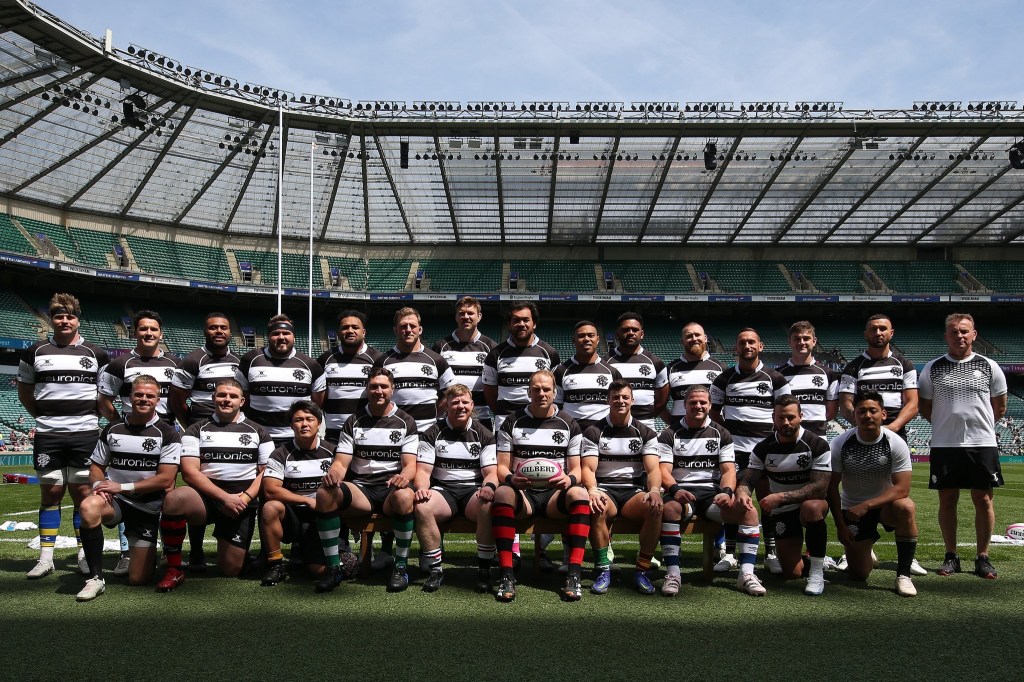
Photo courtesy Barbarians FC.
Yesterday AWJ made his final appearance at Twickenham captaining the Barbarians against a World XV.
A match won by the Barbarians 48-42 which featured 14 tries
His stats and achievements have been listed elsewhere, but my words are from the heart as someone who was just a fan when he started his international career in 2006, and then a journalist sat in the press box at Stade de France when he made his final appearance against France in the 2016 Guinness Six Nations.
Welsh rugby goodbyes are never easy and my life has been full of them from Barry in 1972, Gareth and Gerald in 1978 to Ieuan, Shane and Sam in latter years, saying goodbye to AWJ in the Twickenham sunshine was equally emotional.
AWJ has appeared superhuman in his longevity and his rapid recovery from major injuries, two missed conversions in front of the posts at the end of the match showed us that maybe he is human after all, but I’m not convinced. Diolch Alun Wyn.








 Mike Pearce Rugby