
Six Georgia players and a team official have been sanctioned for committing anti-doping rule violations as part of what World Rugby has described as “an orchestrated scheme”.
A joint investigation by World Rugby and the World Anti-Doping Agency (Wada) discovered a scheme involving sample substitution and advance warnings of drug tests.
Dubbed ‘Operation Obsidian’, the investigation was launched in 2023 and found five instances where players allegedly swapped urine samples to avoid detection.
A Wada statement said that employees of Georgia’s national anti-doping agency (Gada) also tipped off players about upcoming tests and that doping control officers failed to properly observe athletes during testing and did not witness urine collection.
World Rugby described it as “an orchestrated scheme involving recreational drugs and sample substitution”.
It added that the investigation “was triggered when irregularities in urine samples were identified by World Rugby’s athlete passport management programme, covering an extended period of time prior to the men’s Rugby World Cup 2023”.
The game’s governing body supplied historical samples which, when retested, showed five instances of sample substitution involving Sharikadze and five other players, dating back to 2019.
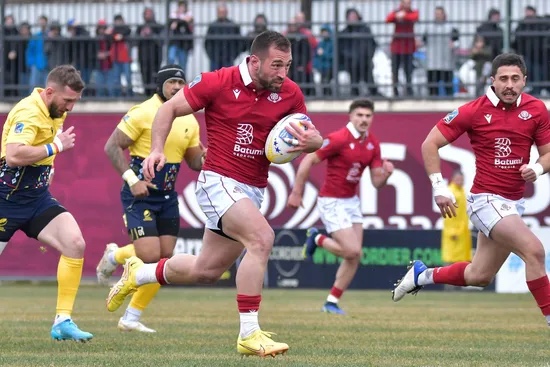
As a result Former Georgia captain Merab Sharikadze (pictured above) has been banned from sport for 11 years for his part in a secret scheme which helped national team players cheat anti-doping tests.
Hooker Giorgi Chkoidze has been banned for six years, with Lasha Khmaladze, Otar Lashkhi and Miriani Modebadze receiving three-year suspensions, and Lasha Lomidze being banned for nine months.
Sharikadze, who led Georgia to a famous win over Wales in Cardiff in 2022, admitted providing ‘clean’ urine to team-mates.
Having considered this recommendation, World Rugby issued a misconduct charge against the Georgia Rugby Union. The Union accepted the charge and agreed to a sanction including financial penalty along with a requirement to implement a roadmap of various reforms and measures in its anti-doping training and education to mitigate the risk of any future issues of this nature arising.
A World Anti-Doping Agency investigation found that Georgia’s national testing authority would tip off Georgia’s team doctor Nutsa Shamatava about forthcoming tests, and she would then share the information via a team group chat.
World Rugby also commissioned an independent enquiry into the actions of the Georgia Rugby Union to ensure that any potential involvement of the Union in the scheme was considered and addressed. While the independent report details that there are no grounds for the Georgia Rugby Union having a case to answer under World Rugby Regulation 21, the fact that a number of players and staff wilfully failed to comply with their anti-doping obligations brings the game into disrepute under Regulation 18.5.
This is undoubtedly a blow to Georgia’s reputation and credibility as they continue to pursue a path that will enable them to bid for a place in the Guinness Six Nations tournament.

