Italy’s Brothers Off Tune As Wales Triumph In Rome

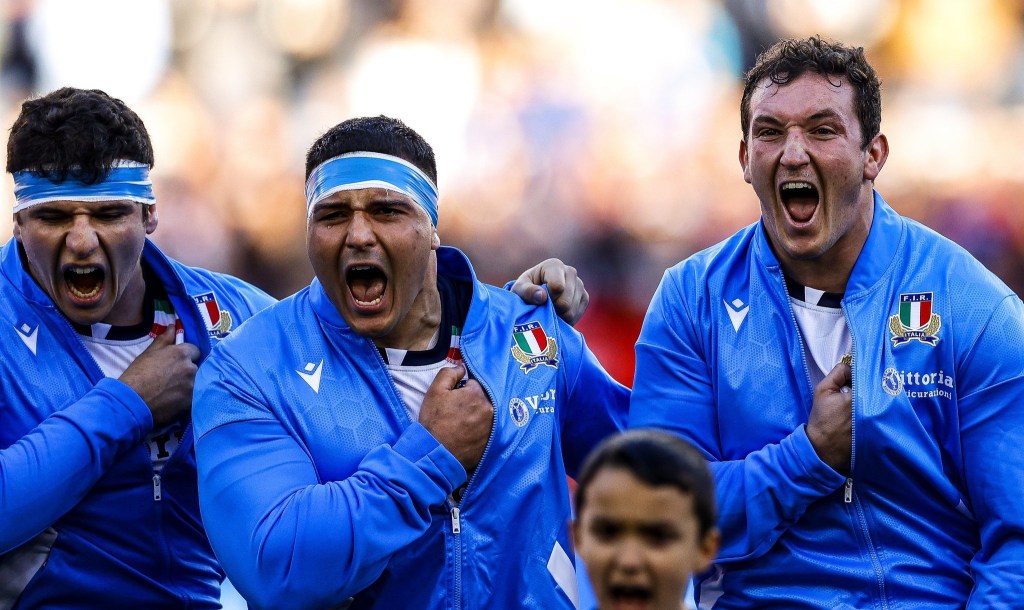
As National Anthems go, the Italian theme tune is as stirring as they come, and one of the best in the Guinness Six Nations.

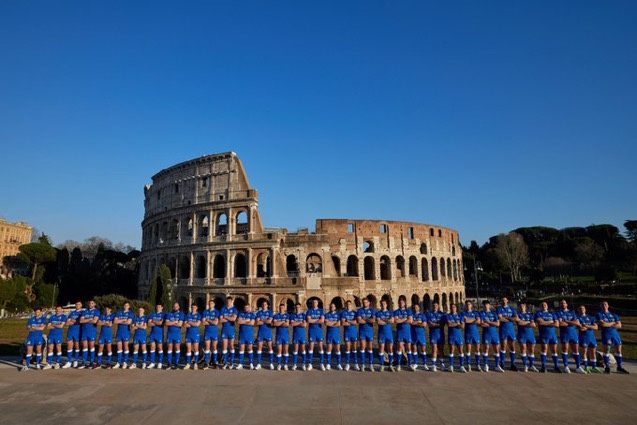
Yesterday at the Stadio Olympic under sun drenched blue skies, Italy were looking to continue their progress as a team finally starting to live up to its musical counterpart.

Italy have always had a good anthem, but their rugby team have lagged behind their bel canto team mate in terms of quality and performance.

The opening lines of Goffredo Mameli’s composition could not be more apt, Fratelli d’Italia, L’Italia s’è desta (Brothers of Italy, Italy has awakened).

At the Stadio Olympic Italy’s awakening stalled as Wales finally dragged themselves from their winter rugby hibernation.

Rio started the carnival after 9 minutes with try following a chip ahead by Rhys Webb that gave the young Dyer the kindest of bounces.

Liam Williams beat four Italians on his way to the try line with 18 minutes on the clock before a 34th minute penalty try gave Wales a confidence boosting 22-3 half time lead.

Despite a 43rd minute Italian try from Sebastian Negri Italy continued to spurn chance after chance which was the theme of their afternoon, and a Taulupe Faletau try on 50 minutes, following a sumptuous break from man of the match Rhys Webb, gave Wales a comforting 29-10 lead with half an hour remaining.

As Wales began to look the more weary of the two sides an Juan Ignacio Brex try with 12 minutes remaining gave Italy hope, but Wales hung on to give earn a bonus point victory.
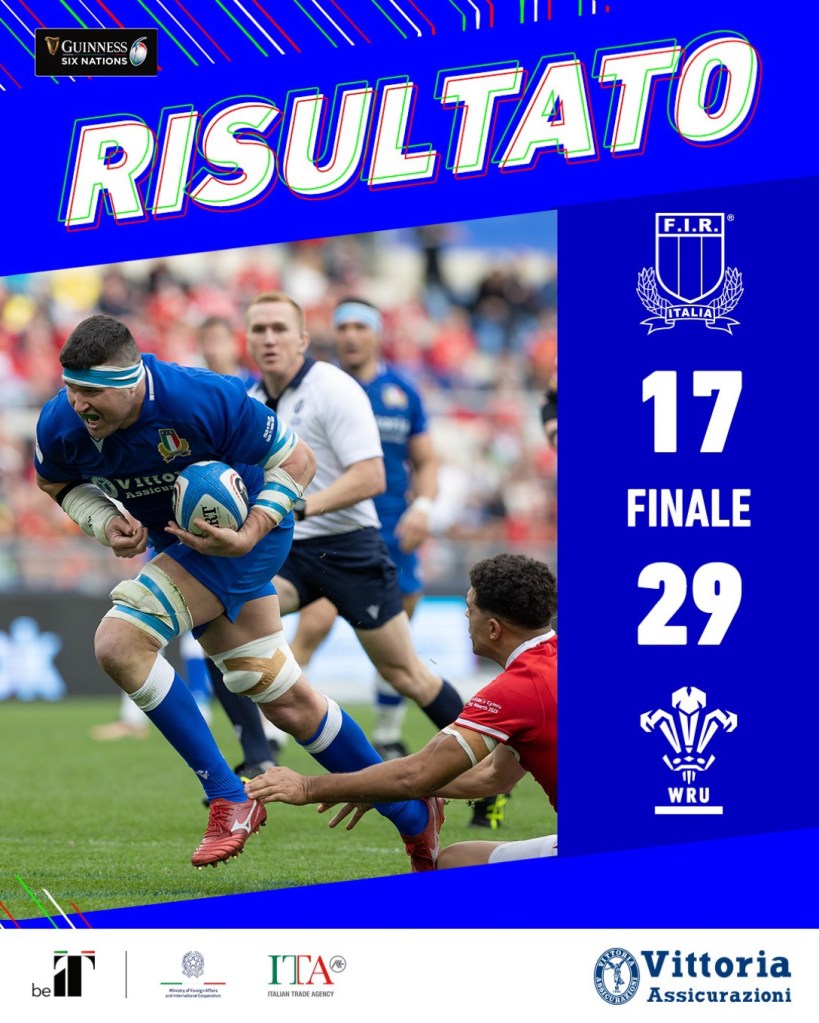
In the current climate this result has come as welcome oasis in a desert of turmoil, unrest, and mistrust back home. The victory will be rightly celebrated before thoughts turn to facing a rampant France on their home patch in a weeks time.

After France’ 53-10 demolition of England at Twickenham facing Les Bleus at Stade de France is a daunting prospect. Wales head to Nice today to start a weeks preparation on the Côte d’Azur, let’s hope they bring that Riviera touch to the capital on Saturday.

RWC 21 ITV’s Nolli Waterman

An established broadcaster, Nolli Waterman will be part of ITV’s 2021 Women’s Rugby World Cup coverage as it offers UK-wide, free to air coverage of the tournament. For the very first time, a UK broadcaster will show all games live in a Women’s Rugby World Cup on free to air television, with matches shown across ITV and ITV4.

Some of you may not know just how good a rugby player Nolli actually was. On the the southern edges of the South-West coast her daring deeds are spoken of in reverential terms.

When the mist rolls in off the Bristol Channel on a cold winters night, the folks that inhabit The Old Ship Aground pub in Minehead tell tales that send shivers down your spine, tales of shipwrecks and smugglers, tales of peril and tragedy in the local waters that have one of the highest tidal ranges in the world.

Inevitably as the night gets darker, and the ale more plentiful, the tales get taller, as indeed do the stories of local heroes who have become legends, largely through many misty ale soaked nights where the thin line between fact and fiction is breached.

One local legend is immune from such treatment, a local Barbarian whose exploits are so incredible in their own right, there is no need for embellishment, even fiction writer Arthur C Clarke, also born in Minehead, would have difficulty making these tales taller, even ale assisted.

Rugby can be a brutal and unforgiving sport but every now and then a player arrives on the scene that can raise the game above the ordinary, a player who amid the bump and grind of top-level sport, manages to make the difficult look easy, a player whose skill and execution provided a sheer beauty, grace and elegance that warmed the soul, set our pulses racing, a player that appeared to have more time and space than those around them, Danielle Waterman was such a player.

A red rose that could always be guaranteed to bloom, whatever the weather, whatever the soil conditions, she graced the white shirt on eighty-two occasions.

It is impossible to calculate how many girls and women have been inspired to take up the game by watching her, but I have witnessed first hand the  “Nolli Effect” around the playing fields of Europe.

She was renowned for her bravery on the field, but perhaps even more noteworthy is her bravery off it, for being part of the RPA “Lift The Weight” campaign and discussing her depression candidly, typically, not for her own benefit, but through a desire to help others who may or have suffered similarly.

Danielle Waterman’s list of achievements make impressive reading, a Rugby World Cup winner in 2014, nomination for World Player of the Year, a member of the first ever Team GB Rugby Sevens squad to compete at the 2016 Olympic Games in Rio.

Nolli captained England A at the tender age of seventeen, and made her full England debut in 2003 whilst revising for her A levels, aged just eighteen.

But in the years to come we will not be discussing the cold statistics, it will be that sidestep, that tackle, or the unique running style, and that joyous smile after scoring a try or making a last ditch tackle.

So if you ever happen to visit “The Ship Aground” on a damp misty moonlit night and you notice the locals huddled together speaking in hushed tones, they may well be telling tales of horticulture, or to be specific their favourite local Red Rose.

Roman Spoons And Kitchen Sinks Italy v Wales

Yes I’m afraid it has come to this, Wales the team that has in recent years been used to preparing for vital matches with Triple Crowns, Grand Slams and Championship deciders at stake, are now having to throw the kitchen sink at an emerging and exciting Italian side in order to avoid rugby’s ultimate booby prize.

In fact Wales at present look like they will need to throw the kitchen sink, the dishwasher and their George Foreman grill at the Azzuri or else another piece of kitchenware will be heading their way, the dreaded “wooden spoon”.

Wales last Wooden Spoon came under the leadership of Steve Hansen back in 2003, their defeat in Rome that year left them doomed to a Six Nations whitewash losing to at home England (26-9) and Ireland (25-24) along with away defeats to Italy, Scotland (30-22) and France (33-5).

The similarities to 2023 are striking, not just the fact that 2003 was also a Rugby World Cup year.

Italy won only their second ever Six Nations game ever when they defeated a dismal Wales side in the Rome sunshine on February 15th 2003. It set Wales on a downward spiral for the rest of the Championship.

The Italians, led by playmaker Diego Dominguez, destroyed the Welsh pack and starved Steve Hansen’s men of any possession.

Tries from Giampiero De Carli, Carlo Festuccia and Matthew Phillips were matched by touchdowns from Tom Shanklin, Steve Williams and Dwayne Peel but Wales were second best in every other area.

The teams that day make interesting reading:

Italy: P Vaccari (Calvisano); Mauro Bergamasco (Treviso), C Stoica (Castres/Fra), G Ranieri (Calvisano), D Dallan (Treviso); D Dominguez (Stade Francais/Fra), A Troncon (Treviso, capt); G De Carli (Calvisano), C Festuccia (Gran Parma), R Martinez (Treviso), C Bezzi (Viadana), M Bortolami (Padova), A De Rossi (Calvisano), A Persico (Viadana), M Phillips (Viadana).

Reps: A Moretti (Calvisano), S Perugini (Calvisano), M Giacheri (Rotherham/Eng), S Palmer (Treviso), J Manuel Queirolo (Dax/Fra), R Pez (Rotherham/Eng), Mirco Bergamasco (Padova).

Wales: R Williams (Cardiff); M Jones (Llanelli), T Shanklin (Saracens), L Davies (Llanelli), G Thomas (Bridgend); I Harris (Cardiff), D Peel (Llanelli); I Thomas (Llanelli), M Davies (Pontypridd), B Evans (Swansea), R Sidoli (Pontypridd), S Williams (Northampton), M Owen (Pontypridd), M Williams (Cardiff), C Charvis (Swansea, capt).

Reps: G Williams (Bridgend), G Jenkins (Pontypridd), D Jones (Llanelli), G Thomas (Bath), G Cooper (Bath), C Sweeney (Pontypridd), M Watkins (Llanelli).

For the record Scotland and Ireland have recorded the most 5/6 Nations wooden spoons with 23 each.

Italy have 17, England 13, Wales 10 and France bringing up the rear with 9.

When it comes to championship whitewashes Scotland and Italy have the most with 11 each. Ireland and France have 7 each.

Then come Wales with 3 and England with 2.

Welsh fans will be hoping their team’s statistics in this department do not alter during the next few weeks.

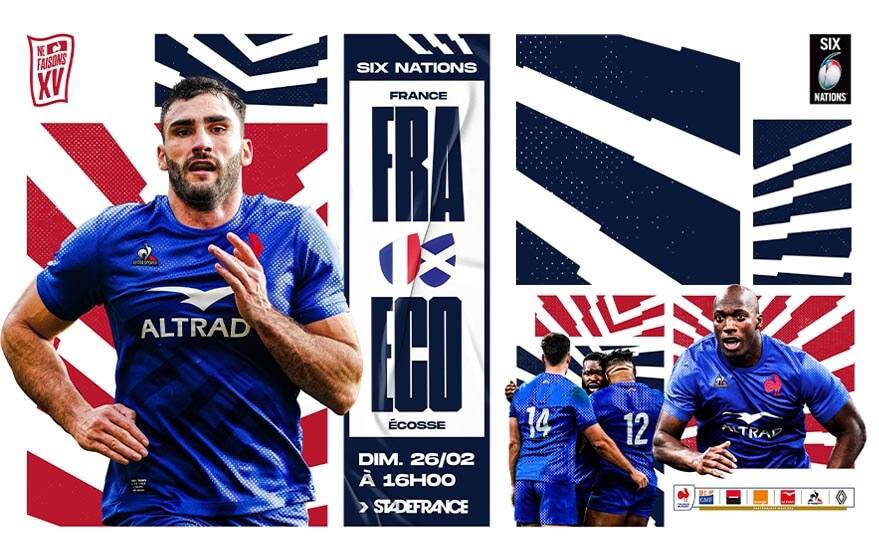
The Auld Alliance France v Scotland

There is a small bakery tucked away down a quiet side street just a stones throw from Stade de France, due to its discreet location it remains relatively uninhabited on international match days.

I discovered it in 2016 when France played Italy in the Six Nations, and it has remained my first port of call on arrival in Saint-Denis ever since.

That Six Nations fixture match in 2016 was the first major sporting event to be held in Paris following the terrorist attacks at the Bataclan, and indeed at the stadium itself.

That day my espresso was delivered to me at my table via a machine gun totting member of the French military, It was the strangest atmosphere I have ever encountered at a rugby international.

Happily eight years later the clientele at Boulangerie Patisserie Lagneb in Rue Jesse Owens were unarmed and looking much more relaxed, and indeed much more kilted.

There is something special about Paris in the winter, the moment you step off the train at Gare du Nord, the aroma of coffee engulfs your senses as you hit the dark misty gloom lit up by the neon lights of the cafes and bars in rue dunkerque. Paris does the cold dark miserable season like no other city, with its inimitable style and class.

Historically France and Scotland have a very special bond. In 1942 Charles DeGaulle described it as the oldest alliance in the world. “In every combat for five centuries when the destiny of France was at stake, there were always men of Scotland to fight by the side of the men of France, and what Frenchmen feel is that no people has ever been more generous with its friendship”.

The auld alliance with France was first agreed in 1295 built on France’ need to curtail English expansion. The canny Scots were given the pick of the best French wines as a result of this accord.

Sunday Guinness Six Nations fixtures can sometimes feel a little bit flat, but yesterday there was a real buzz of expectation and nervous anticipation in the air.

France after 14 successive wins were defeated in Dublin two weeks ago, the public of the republic were expecting a blue backlash and they got one but not quite the one they expected or indeed hoping for.

In fact it turned out to be a “white backlash” as the home team wearing white shirts to avoid a colour clash with the visitors, managed a bonus point win in a pulsating contest.

Both sides received red cards in the first 10 minutes, Gilchrist after just seven minutes and Haouas four minutes later.

Scotland trailed 19-0 after twenty minutes but scored three tries before to trail by only four points with less than a minute remaining.

However, Gael Fickou with 79.34 on the clock glided between Price and Bhatti to dive over and score the try that gave France a bonus point win.

At café du Nord there was a feeling of quiet satisfaction as over a glass of red and a plate of steak frites, the whispers returned about the possibility of World Cup glory in a few months time, a feat rarer than the piece of beef looking up at me from my plate, but this French team with their beauty and power are well and truly capable of grasping their oval Holy Grail.

Bon appetite

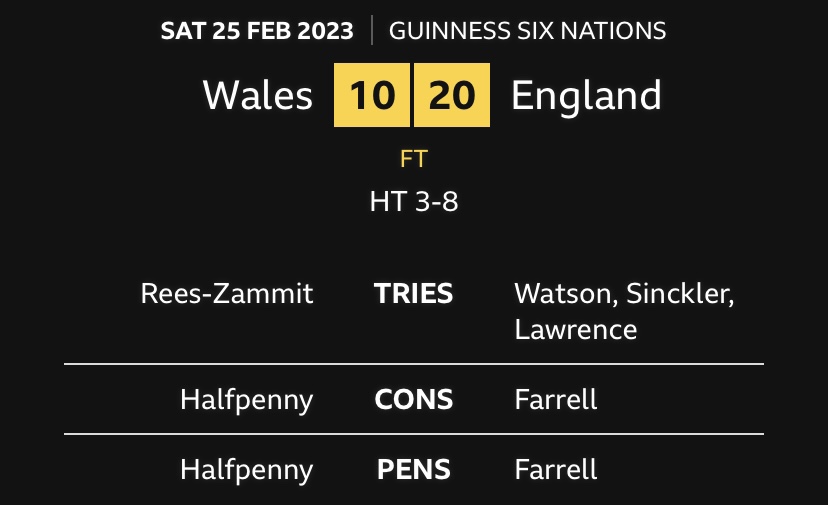
Wales v England Home Thoughts From Abroad

Situated 438 miles away from Cardiff in a bar down the road from Gare du Nord station, it felt very strange watching Wales face England on the multi screens of a Parisian watering-hole, rather than from the press box of the Principality Stadium.

In many ways it was quite a relief to take some distance from the depressing events that occupied the recent weeks news in my homeland.

Yet I felt the Hiraeth, the longing to be with my rugby brothers and sisters in the cauldron of Cardiff, but hey Paris is a pretty good alternative.

The million dollar question was how would the players respond to the overwhelming distractions that must surely have disrupted preparations for this massive game.

Owen Williams finally got the rugby underway after a week of turmoil that put the match in doubt until as late as Thursday evening.

A collective oo la la greeted a Tomos Williams tapped penalty but the very best was reserved for referee Mathieu Raynal, the man from Perpignan, who got a very loud “Merde” and a massive Gallic shoulder shrug at regular whistle blowing intervals.

The bar fell silent as half time approached and thoughts turned to vital rehydration. Trays of beer, bottles of claret and the odd Kir raced passed the television screens in a frantic effort to get everyone prepared for the second half.

Clearing out slower than the Welsh forwards at the rucks the bar staff managed to just about be back on side as Louis Rees-Zammit streaked away for a try that gave Wales hope.

Sadly hope turned into blind faith as Wales toothless attack failed to trouble the English defence, and we were reminded just exactly where Wales are in the pecking order of world rugby.

79 minutes on the clock and an exhausted waiter dropped a profiterole with the table at his mercy it was that kind of day.

Time Is Ticking For Wales Old Guard

Time catches up with us all. I have now reached the age where every bending motion is a challenge and even rising from a seat cannot be achieved without an accompanying groan.

When at your peak it is difficult to imagine life in any other way, but time passes all too quickly and some of Wales wonderful players are now reaching the bending and groaning stage in rugby terms.

Bodies battered by years of brutal attrition are beginning to weaken even minor niggles now take longer to shake off, timing is out by a hundredth of a second, and at the elite international level that split second really matters.

Warren Gatland says Wales are in a hole, well it feels more like the Grand Canyon after the opening two weeks of the 2023 Guinness Six Nations.

Ideally rebuilding a team is a gradual process blending the old and the new in the hope of a seamless transition, but somehow Wales have left it far too late and found themselves caught between two very small stools, and in a Rugby World Cup year.

In Wales the problem goes far deeper, the whole structure and organisation of the game and it’s values have been deeply eroded, and we have finally got to the stage where there is nowhere to hide both on and off the field.

France found themselves in the same situation five years ago and look at them now.

As Welsh Rugby hopefully sorts itself out off the field, Warren Gatland’s unenviable task is to make Wales competitive whilst undertaking a massive changing of the guard.

I fear there will be a lot of bending and groaning over the next few years, but there is some serious young talent in Wales on the field and in the boardroom, who in time can take us out of the current darkness and into rugby daylight.

As Bob Dylan said

Come gather ’round people
Wherever you roam
And admit that the waters
Around you have grown
And accept it that soon
You’ll be drenched to the bone
If your time to you is worth savin’
And you better start swimmin’
Or you’ll sink like a stone
For the times they are a-changin’

Wales are currently in the shallow end of the rugby pool shivering and wearing armbands, in less than two weeks time they face England in Cardiff, barring strike action from the players, it’s time to sink or swim.

The New Italian Renaissance

The Italian Renaissance period was a revival of the ideals and culture lost during previous years of war, as well as a resurgence in the various social and political differences within Europe during the Medieval age. This revival led to a complete shift in perspectives – quite literally and figuratively – in Italian art and culture. Overall, it was a new time for Europe, and it became a period of history that would live on for ages to come.

Italy’s rugby renaissance has been slow in coming, but over the last twelve months the Azzuri artists are beginning to display their considerable talents.

If Michelangelo di Lodovico Buonarroti Simoni known as Michelangelo was the Italian sculptor, painter, architect, and poet of the High Renaissance, then Ange Capuozzo must surely be his rugby equivalent.

In a game obsessed with size and big hits this 5ft 10 inch 12 stone full back/Wing is a wonderful breath of fresh air.

Ange Capuozzo was born on 30 April 1999 in Le Pont-de-Claix on the outskirts of Grenoble to French parents. His father is of Italian descent with paternal grandparents from the Naples area where they settled after the Second World War as Children. Capuozzo’s maternal grandfather is from Madagascar and his maternal grandmother is French. So he had multiple options when it came to representative honours.

With a face as angelic as one of Raphael’s cherubs, Cappuozzo tried to bring his light artistic brushstrokes to Twickenham, but it was a day when the emulsion and heavy roller boys in white took centre stage and his masterpieces were kept under wraps.

England with a new coaching team are starting with a blank canvas and very much went back to basics, Italy were starved of ball and physically dominated by the English pack.

Three first half tries all from England forwards gave them a 19-0 lead which they never looked like relinquishing.

The visitors did supply some bright blue moments under the damp murky grey skies with two second half tries but England’s power kept them at arms length.

This victory will provide the undercoat for England’s tasty visit to the Principality Stadium in a couple of weeks time where Wales will be hoping and praying for a victory, whoever wins that one will certainly paint the town red.

But for now as the Sunday congregation filed out of their sporting cathedral alongside the A316 it was time to cherish a victory, which unless you are Irish or Scottish is something that is extremely hard to come by in this brutal Guinness Six Nations Championship.

When Irish Eyes Are Smiling

When Irish eyes are smiling, Sure it’s like a morn in Spring, In the lilt of Irish laughter, You can hear the angels sing.

When Irish hearts are happy, All the world seems bright and gay, And when Irish eyes are smiling, Sure, they steal your heart away.


“When Irish Eyes Are Smiling” is a lighthearted song in tribute to Ireland. Its lyrics were written by Chauncey Olcott and George Graff, Jr, set to music composed by Ernest Ball. It was first published in 1912, at a time when songs in tribute to a romanticised Ireland were very numerous and popular both in Britain and the United States. During the First World War the famous tenor John McCormack recorded the song. The song continued to be a familiar standard for generations. The song has been recorded on over 200 singles and albums and by many famous singers, including Bing Crosby, Connie Francis, and Roger Whittaker.

Ireland and Wales Celtic neighbours separated by the Irish Sea, So how close exactly are we? well the Llyn Peninsula and the Wicklow mountains are only just over 31 miles apart.

Eryri (Snowdonia) to Howth is some 85 miles so the closeness is very real. With that closeness comes a fierce rivalry that goes back many decades.

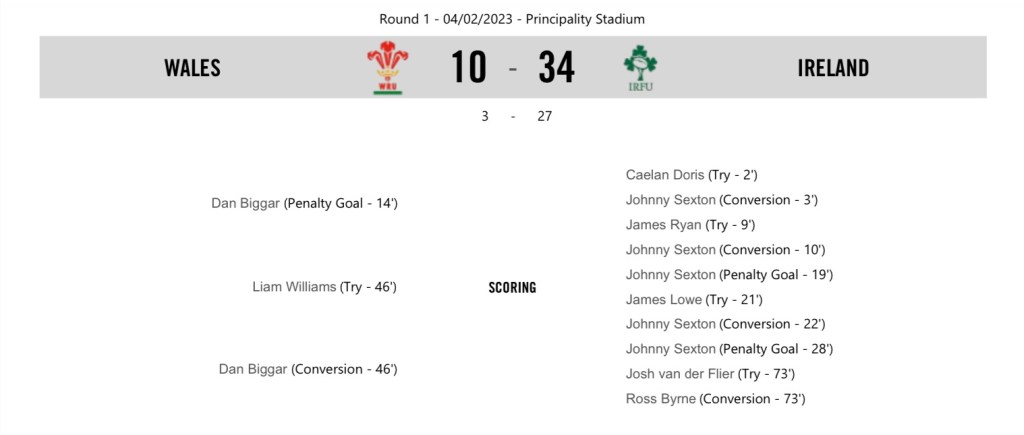
That rivalry was reconvened yesterday in Cardiff in the opening match of the 2023 Guinness Six Nations Championship.

With Warren Gatland back as Wales coach there were hopes for an upset against the Emerald Islanders who are currently number one in the World Rugby rankings.

The hope lasted for just under two minutes before the Irish unleashed a storm that their country’s Wild West coat would have been proud of. Tries for Doris and Ryan and the home side were 14 points adrift after just 10 minutes.

Wales were all at sea, leaking tries and longing for the safe haven of half time. A further James Lowe interception try and the boot of Sexton gave Ireland a 27-3 lead at the interval.

The men in red steadied the ship at the start of the second half with a Liam Williams try 5 minutes after the restart, but their continued indiscipline and line out inaccuracy scuppered the many chances they created.

Ireland had the last word with a Josh Van Der Flier try in the 73rd minute to give all those smiling eyes a bonus point win.

Welsh eyes will be red and baggy this morning as they find their team caught in a generation gap, the old guard are sadly nearing the end and the few bright lights that shone for Wales yesterday were the emerging youngsters. Joe Hawkins, Rio Dyer and Louis Rees Zammit, when fit, are exciting backs to light up the current gloom.

Murrayfield beckons and a Scottish side that will have their tails up. These are difficult days for Welsh rugby on and off the field.

As the audience of 73,931 filtered out of the Principality Stadium there was a eerie quiet in Westgate Street, a stark realisation that there is a lot of rebuilding to be done, and that the prospect of being sent a home tae think again next weekend may well be on the cards.

Price’s Punch And The Prince Of Wales

image Brian Price

The South Wales Echo headlined “A right royal punch up” in its report of the Wales v Ireland match at Cardiff Arms Park, on 8 March 1969, a match attended by HRH the Prince of Wales.

image The Prince Of Newport & The Prince Of Wales

This match was seen as the key to the championship, that year, Ireland and Wales were both unbeaten, and the match was played at a Cardiff Arms Park, resembling a giant airfix kit, as the new North Stand was in the process of being rebuilt, and as a result, the crowd capacity was reduced from 52,000 to 29,000

The pitch appeared to be devoid of even a single blade of grass on it, and was so poor, I think that even the Horse of The Year show organisers would have deemed it unsuitable for their needs.

Ireland had received some criticism from the press as a result of their “robust” play in earlier matches, and Wales were determined to face up to their aggression.

The match began sensationally, within three minutes of introducing his team to the Prince, Brian Price floored Irish flanker, Noel Murphy with a punch that Henry Cooper would have been proud of.

image Noel Murphy takes it on the chin

Brian Price said later that he felt a pair of hands heading towards his eyes, and so he “Let him have it

Later in the first half Irish hooker Ken Kennedy was also floored, resulting in captain Tom Kiernan threatening to take his team off the field, Gareth Edwards spoke to fellow “Lion” Kiernan, but the content of that particular conversation is not suitable for print.

Kiernan then kicked Ireland into an early lead, which Barry John levelled with a drop goal.

The game was brutal, Brian Thomas was led from the field with blood pouring from his face, to be stitched on the touch-line whilst the game went on around him.

In the eighth minute of first half injury time, Wales were awarded a penalty on the Irish 25 yard line, the Irish team turned their backs, expecting an inevitable Keith Jarrett place kick, by the time they looked around, Jarrett had tapped, and fed a trundling Denzil Williams, the Ebbw Vale prop, who ran over unopposed in the corner.

Jarrett converted the try, which gave Wales an 8-6 half time lead.

After the interval Wales stepped up a gear with Newport wing Stuart Watkins, Dai Morris and John Taylor all scoring tries for the men in red.

Mike Gibson scored a consolation late length of the field try for Ireland, but which time the match was well and truly over as a contest.

Wales won 24-11, but the match will always be remembered for Brian Price’s pugalistic efforts in front of HRH.

Ireland v Wales The Legend Of The Terrible Eight

8 The Terrible Eight

IRELAND 3 WALES 11

13 March 1914 Balmoral Showground, Belfast

This match is remembered as ‘The Roughest Ever’ and was the day of ‘The Terrible Eight’,  the Welsh pack that won the battle against eight very strong Irish opponents.

The evening before the game the captain of Wales, The Reverend Alban Davies, decides to take his team for a quiet night out at the theatre

Davies, Alban Rev. Rev Alban Davies

Some versions of the story state that there was brawl in the theatre, and that the police had to be called,  however eye witness accounts state that Doctor William”Billy” Tyrell told Welsh forward Percy Jones: ‘It’s you and me for it tomorrow.’ Jones, a colliery foreman, smiled and answered: ‘I shall be with you, doing the best I can.’

Another Wales forward asked: ‘Can anyone join in?’ And so they did!

Players fought when the ball was not near them and some should have been sent off, but Mr.Tulloch, the referee from Scotland, took little notice.

It was one of the all-time best punch-ups and Jones said: ‘The fun just went on and on.’

But after the match Jones was told by Tyrell that he was the best Welshman he had ever come across, adding: ‘You’re the only Welshman who ever beat me.’

The pair signed each others menu-card and in 1951, the president of the IRU, now Sir William Tyrell, and retired collier and now hotelier, Percy Jones, sat together during the match in Cardiff.

Ireland led with skipper Alex Foster’s try, but Wales clawed back the lead with Bedwelty Jones scoring the equalising try. Two weeks later he signed for Oldham Rugby League club.

Selected Irish captain Dicky Lloyd was photographed before the match with his team, but strained a tendon in the warm-up and Harry Jack was called up for his second cap, playing at scrum half with Victor McNamara switching to outside half. Jack’s third cap came in 1921 and he later became president of the Fiji Rugby Union.

For the first time Wales’s pack had remained unchanged throughout the season, but the First World War now intervened and Wales did not play an official match for five years and one month.

The Rev. Alban Davies died in Los Angeles at the age of 90, while both Tyrell and Jones lived to the age of 82, dying within six months of each other.

Scorers.

Ireland – Try: Alec Foster .

Wales – Tries: Bedwelty Jones, Ivor Davies, Jack Wetter. Con: Clem Lewis.