Alba Capell The Spanish Shark RWC 2025

There are players who score tries, who dazzle with speed and leave a stadium gasping.

And then there are players like Alba Capell — players who do not just win games, but bend the story of a nation’s rugby with their bare hands.

She grew up in the iconic shirt of FC Barcelona, not in the grand round ball light of the Camp Nou, but on muddy fields of the oval Catalonia club where rugby is played in the raw.

As a young player she discovered a simple truth: if someone pushes you down, you get back up. And then you push back harder. It is a lesson she has carried from those first tackles into every shirt she has worn since.

When she first pulled on the red jersey of Spain against South Africa in 2022, there was a fearlessness in her stance, a quiet defiance in her eyes. She was not there to be a debutant. She was there to stay.

Then came heartbreak. The narrow defeat to Ireland in 2023 that shut Spain out of the World Cup and it broke her in a way she admits openly.

Alba cried, she hurt, but she promised herself that she would never feel that helpless again. Out of those wounds came something stronger.

And so, in Dubai at WXV 3 in 2024, with the match locked in a stalemate against Fiji, it was Capell who crashed through over the line to score the only try which proved to be decisive.

It was the moment Spain’s future opened up in front of them. When the whistle blew, she was named Player of the Match, but the award was only a shadow of what had really happened she had helped to redeem a nation’s hope.

It is this duality that defines her: steel and vulnerability, ferocity and tenderness, a warrior who admits the weight of defeat but uses it as a motivation.

Now with Sale Sharks in England’s Premier 15s, she continues to sharpen her skills against some of the best in the world, a young forward learning to thrive in the most unforgiving league. She is not the player you necessarily notice first. She is the one you notice last covered in mud, body bruised and lungs burning — still carrying, still tackling, still refusing to let up.

For Spain, she is more than a flanker. She is a symbol. A reminder that rugby here is not built on privilege or endless depth of talent, but on resilience — the kind that grows when a young girl decides that no defeat will ever define her.

And as the 2025 Rugby World Cup enters its second week, Alba Capell stands at the threshold not as a prodigy anymore, but as a promise kept. A promise to herself. A promise to Spain.

Because when she plays, it is not just rugby. It is poetry written in bruises, a rhythm of collisions, a heartbeat that refuses to quiet.

Vamos Alba.

Red Roses Set Sail In The Stadium Of Light

Sunderland once produced a quarter of all the world’s ships. This proud city was the undisputed king of shipbuilding for over six centuries. By the early 20th century, the River Wear was lined with shipyards that built everything from wooden trading vessels to massive steel ships. Over 400 shipyards were registered here, making Sunderland the largest shipbuilding town in the world. Though the industry has since faded, the city’s maritime legacy is immortal.

So maybe it was appropriate that a launch took place at the Stadium of light as the much anticipated 2025 Women’s Rugby World Cup set sail.

The home of Sunderland FC may have been an unfancied haunt for England defence coach and Newcastle United fan Sarah Hunter, but the result will have warmed the cockles of her black and white heart.

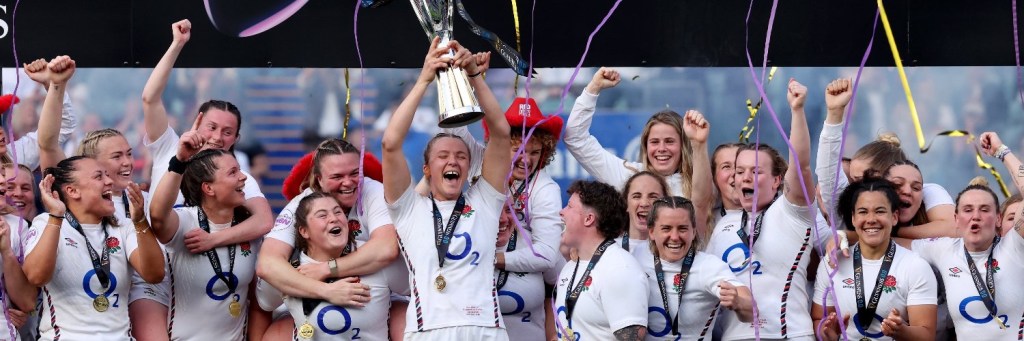
A first half where a dominant England scrum and a USA yellow card were the catalysts for a four try 28-7 England lead, gave way to a final forty minutes where the team and the crowd relaxed and went into full party mode.

Dow’s try two minutes into the second half put the game beyond any lingering doubt and the game was over as a contest. From then on in the Red Roses ran riot.

Appropriately at the home of shipbuilding it was plain sailing for the tournament hosts. It is likely that England will not be properly tested until the semi final stage of this tournament but that is not their fault. They will continue to work hard and improve as they always do with the prospect of any real jeopardy a distant threat.

So in the words of Anne Marie who sang at the opening ceremony we say ‘Ciao Adios’ to Wearside as England head to Northampton to face Samoa. The 2025 Women’s Rugby World Cup is underway god bless her and all who sail in her.

Carla Arbez The Perfect Ten-Women’s Rugby World Cup 2025

Île d’Oléron is an island off the west coast of France. It is joined to the mainland by a bridge and is crisscrossed by cycle paths. It features pine forests, dunes and sandy beaches such as La Brée-les-Bains. Fishing ports fringe the island, such as the busy La Cotinière in the major town of Saint-Pierre d’Oléron. Le Château d’Oléron, a town known for its oysters, is home to La Citadelle, a huge waterfront fortress. 

It is here that Carla Arbez started her rugby journey aged seven. Born in Biarritz, Carla is the daughter of a physiotherapist her boots were too big her at that tender age but it was not too long before she started to fill them both physically and metaphorically.

By 2023, Carla’s trajectory was meteoric — her debut for France in the Women’s Six Nations, a starting shirt against Italy, and a try to announce her arrival. She went on to compete in the WXV tournament that year. Then came the silence. 2024 passed without a call-up. For some, that’s a shadow that lingers; for Carla, it was the space where resilience grew.

She doubled down — on fitness, on skill, and on her greatest weapon: her kicking game. Week after week, she trained with former footballer Benoît Trémoulinas, chasing fluidity, distance, and accuracy. It wasn’t glamorous. It was repetition, frustration, and tiny victories that no crowd would ever see. But by the end of it, she could drive a ball 15 meters further — and carry herself with 10 times the confidence.

In 2025, she pulled the blue jersey back over her shoulders, starting against Ireland and Scotland as if she had never been away. In the final of the French Championship, she joked that she “lost ten years of life expectancy” in the final play — the kind of remark that makes you smile, because you know she lives those moments with every heartbeat.

With Stade Bordelais, she has been at the helm of a dynasty: three consecutive national titles, an unbeaten start to the season, and a brand of leadership that is more compass than command. Her teammates don’t just follow her calls — they trust her vision.

But behind the precision and control she is still the Basque girl from Biarritz who moved from Oléron to La Rochelle to Bayonne, chasing the game and her dreams with the determination of someone who had already decided this sport was not just a pastime, but a language she was born to speak.

When Carla Arbez steps onto a rugby pitch, there’s a certain electricity in the air — the kind that makes you lean forward before the whistle even blows. She is not just a fly-half she is the architect of moments, the conductor of the orchestra and the quiet strong solid heartbeat behind surging attacks and pressure-breaking kicks.

She earned a Master’s degree in Physical and Mental Preparation in 2022, reflecting a keen focus on the holistic aspects of athletic performance and now works as a sports educator at Stade Bordelais Omnisports, combining her intellectual pursuits with her on-field role.

Carla is an extremely private person and prefers to do her talking on the field. Her partner is Sarah-Maude Lachance, a fellow fly half at Stade Borderlaise who has been selected for Canada’s Rugby World Cup squad.

Their paths could cross in the Quarter Finals of the tournament and that could be one of the stories of the tournament.

Brazil Ready For Their First Appearance At Rugby World Cup By Mike Pearce

On the verge of writing a new chapter in Brazilian rugby history, the Yaras have been called up for their unprecedented participation in the Rugby World Cup, which will take place from August 22 to September 27 in England. The squad was announced at an event held at Pacaembu Stadium in São Paulo.

The team’s core is formed by athletes who compete in the sport’s two main formats: rugby XV and rugby sevens. Among the 32 players selected by head coach Emiliano Caffera, 11 have competed in at least one edition of the Olympic Games, which follow the sevens format. Standouts include Luiza Campos and Raquel Kochhann, both three-time Olympians—Kochhann was also the flag bearer for Team Brazil at the Opening Ceremony of Paris 2024.

“It’s hard to put into words what this call-up and World Cup participation mean. Everything we’ve achieved proves that Brazilian rugby deserves more attention. It will be a huge challenge for us. Rugby XV is very different from sevens, and it’s a much more inclusive format. This blend is what makes this squad so special,” explained Raquel Kochhann.

The women’s team has been holding training camps and friendly matches regularly since the beginning of the year. Since May, the Yaras have been training with a group of 46 athletes, giving Emiliano Caffera an opportunity to test combinations before finalizing the squad.

“These 32 players are the best athletes we have in Brazil right now, and I’m confident that this group, beyond doing well at the World Cup, will contribute greatly to the development of rugby in the coming years. This World Cup is another step toward growing the sport in our country,” said the Uruguayan coach, who has led the Brazilian national team since October 2023.

The Yaras will depart for England on August 14 and will make their World Cup debut on August 24 against South Africa, in Northampton. A week later, in Exeter, the team will face France, and their final group stage match is scheduled for September 7, against Italy.

For the tournament, Brazil will wear an exclusive uniform developed by the sportswear brand Oneallsports. While the Olympic jerseys for Paris featured graphic elements inspired by Indigenous art, this time the design was created by Indigenous artist Auá Mendes, who incorporated symbols from Tupi-Guarani cosmology to represent the strength and ancestry of the players.

“Brazil’s participation in this World Cup is a historic milestone for the sport in our country and the culmination of work that has been underway for many years. We’ve developed a project that ranges from grassroots development to high-performance, which allowed us to build a team capable of qualifying for the world’s biggest rugby tournament,” said Alexandre Chiofetti, CEO of Brasil Rugby. This will be the tenth edition of the women’s Rugby World Cup. Held since 1991, the tournament will, for the first time, feature a South American team.

Full squad list:

•Aline Mayumi – Pasteur (SP)

•Ana Carolina Santana – Melina (MT)

•Bianca Silva – Leoas de Paraisópolis (SP) & Nagato Blue Angels (Japan)

•Camilla Ísis – El-Shaddai (RJ)

•Carolyne Pereira – Melina (MT) & Grua (AM)

•Dayana Dakar – Niterói (RJ)

•Edna Santini – São José (SP) & São Miguel (Portugal)

•Eshyllen Coimbra – El-Shaddai (RJ)

•Fernanda Tenório – El-Shaddai (RJ)

•Franciele Barros – Sporting (Portugal)

•Giovana Mamede – Jacareí (SP)

•Giovanna Barth – Maringá (PR)

•Íris Coluna – Poli (SP)

•Isabela Saccomanno – São José (SP)

•Isadora Lopes – Melina (MT)

•Julia Leni – Curitiba (PR)

•Larissa Carvalho – Curitiba (PR)

•Larissa Henwood – Counties Manukau (New Zealand)

•Leila Silva – Leoas de Paraisópolis (SP)

•Letícia Medeiros – Jacareí (SP) & Bond University (Australia)

•Letícia Silva – Melina (MT)

•Luiza Campos – Charrua (RS)

•Marcelle Souza – El-Shaddai (RJ)

•Maria Gabriela Graf – Desterro (SC) & Brothers (Australia)

•Mariana Nicolau – São José (SP)

•Marina Fioravanti – Poli (SP)

•Natalia Jonck – Brothers (Australia)

•Pâmela Santos – Charrua (RS)

•Raquel Kochhann – Charrua (RS) & Desterro (SC)

•Samara Vergara – Pasteur (SP)

•Taís Prioste – Bobigny (France)

•Yasmim Soares – Melina (MT)

Stage Set For The Women’s Rugby World Cup

With the Lions tour over, the sporting world turns its eyes from Australia to England, a storm is brewing not of the rain and thunder experienced in Sydney, but of passion, pride, and pure sporting glory.

The 2025 Women’s Rugby World Cup isn’t just another tournament. It’s a reckoning. A celebration. A powerful reminder that when the rugby women of the globe take the field, they don’t just play the game—they elevate it.

For the first time, sixteen nations will compete for the most coveted prize in women’s rugby. From the lush green grass of Twickenham to the steep historical stands of Sunderland and Manchester, each venue will bear witness to something more than rugby: the pressure, the will to win, the weight of expectation, and the dreams of millions.

This World Cup will be a cornucopia of contrasts. Seasoned big guns like New Zealand, England, and France return with unfinished business and burning ambition.

England’s Red Roses, heartbreakingly close in 2021, will this time have the home crowd behind them, a nation hungry for redemption.

Meanwhile, emerging nations like Colombia, Japan, and Fiji bring their own unique fire and flare eager to upset the hierarchy and etch new names into rugby folklore.

But it’s not just the results that will matter. It’s the stories. The captain who plays for her country just weeks after giving birth. The teenage winger who grew up watching highlights on a cracked mobile phone screen. The coach who turned a grassroots team into global contenders. These women are architects of a new era, and this World Cup is their blueprint for history.

The 2025 Women’s Rugby World Cup promises lifelong memories, hard hits, and breathtaking tries—but more than that, it offers a glimpse into the fierce, unrelenting soul of the game.

The world is watching, and the women are ready to roar.

Nessun Dorma For The Lions In Sydney

Construction began on the Sydney Opera House in 1959, but due to persistent problems its grand opening did not take place until October 20, 1973 at a total cost, way over budget, of 102 million dollars.

The iconic building is situated on Bennelong Point, a promontory on the south side of the harbour just east of the Sydney Harbour Bridge. 

Nessun dorma, translated as “Let no one sleep,” is a celebrated tenor aria from Giacomo Puccini’s Turandot, an opera that has been performed in this iconic arena on many occasions.

It is sung by Calaf, an unknown prince, who expresses his resolve to win the heart of Princess Turandot. The aria is set against the backdrop of Turandot’s cruel decree that everyone in the kingdom must stay awake until she learns Calaf’s name, or they will all be executed. 

Last night in Sydney for the sea of Red that engulfed the capital of New South Wales, it was most definitely a case of Nessun Dorma as sleep was in very short supply as the final whistle didn’t blow until some ungodly hour.

Fortunately, the only executions that took place were of the try scoring variety as the 2025 British & Irish Lions ended their tour with a defeat, the pain of which of which was amply soothed by a 2-1 test series victory.

With the series already in the bag after victory in Melbourne last Saturday, the match might well have lurched into an anti-climactic contest.

But Australia had other ideas and with the masters of niggle Nic White and Will Skelton displaying their full array of shithousery it was a tough and tetchy test match played in appalling conditions which the Wallabies well and truly dominated.

It had rained non stop since Wednesday in Sydney, so much so that the lines on the pitch had to be repainted prior to kick off after being washed away by the pre match torrential downpours.

Australia dominated the first half building up a narrow 8-0 a narrow gap made much more valuable in the monsoon conditions.

The second half had only been underway for two minutes when the players were taken off the field with lightning strikes in the vicinity

The interruption made little difference to the balance of power. Australia looked sharper and hungrier for victory as the Lions line out began to creak.

Jorgensen’s 54th minute converted try took Australia to a 15-0 lead, and the Lions were struggling.

No race is more accustomed to constant rain than the Welsh, and as if to prove the point, Jac Morgan showed his precipitation mastery with a try seven minutes later that brought the Lions back into contention at 15-7.

The disjointed Lions having lost Itoje, Freeman and Ryan to head injuries and with Huw Jones switching to right wing couldn’t get enough accuracy and quality possession to bridge the gap any further. McDermott’s try with ten minutes to go made it 22-7 and sealed the victory.

Stuart consolation try in the 79th made the scoreboard look a little more respectable, but this was a worthy Wallabies win.

To think that Australia were theoretically 51 seconds away from a series win, if you take into account last week’s events, seems hard to comprehend. It emphasises the small margins that make up the difference between success and failure at the top end of elite sport.

It may have been Nessun Dorma last night, although I am sure there will plenty of shut-eye today on the long flight back home.

Victory In Victoria Seals Lions Series Win

The first ever set of traffic lights in Australia were installed in Melbourne in 1928.

As if that wasn’t enough kudos in the claim to fame stakes the iconic Australian spread, Vegemite, was invented and is still produced in Melbourne the state capital of Victoria which is the second most populous city in Australia.

Yesterday, the British & Irish Lions were given the green light to drive all the way to Sydney with a test series win under their seat belts.

At the MCG, that wonderful sporting cathedral, the Wallabies were hit for six in the final minute after producing a performance that puts Lazarus in the shade.

Even that endangered species the Welsh lion made an appearance off the bench in the 54th minute Jac Morgan who should be afforded world wildlife fund protection brought a smile to a desperately depressed rugby nation back home.

With 79:09 on the clock, the Lions were trailing 26-24 and were fifty-one seconds away from defeat and the prospect of having to face a nerve jangling series decider next Saturday in Sydney.

One second later, Hugo Keenan glided through a gap to touchdown for a try that gave the tourists the magical triple treasure trove of the lead for the first time in the match. It was a heart stopping victory, and a test series win.

Chalk and cheese are not diverse enough to describe Australia’s transformation from the first test. Skelton and Valetini were immense and the Wallabies first half performance was powerful and passionate, with accuracy and imagination to match.

It was a case of advance Australia flair right from the kick-off, and the 25-3 lead they built up was thoroughly merited.

Huw Jones 38th minute try and Russell’s conversation made the half-time score 23-17 and brought the Lions right back in contention.

Australia stretched their lead to 26-17 with a 53rd minute penalty from Lynagh before Beirne’s converted try brought the Lions back to within two points (26-24) with twenty minutes remaining.

The Wallabies were clinging on and were just fifty-one seconds away from victory when Lions full back Hugo Keenan applied the coup de grâce.

A 90,307 crowd were entertained and enthralled by a proper pulsating test match with a lovely bit of niggle that went right down to the wire.

The lions showed their true roar in clawing back a record points deficit. But the Wallabies when the gut-wrenching feeling of loss eases will realise they are not as far away from returning to the top table of highly competitive rugby nations as it appeared a week ago.

Those Melbourne traffic lights have witnessed an awful lot since 1928, but last night the red lights appeared to be shining more brightly than the amber ones, perhaps their tribute to a Lions test series victory.

Brisbane A Bridge Too Far For The Wallabies

Brisbane, the capital of Queensland on the southern slopes of the Taylor Mountain range, is Australia’s third-largest city.

If you like bridges, then Brisbane is most definitely the place for you. There are eighteen of them spanning the Brisbane River, with the majority of them situated in the inner city area.

However, yesterday proved to be a bridge too far for the Wallabies as the British & Irish Lions emerged victorious in the first match of their three test series against Australia.

With Finn Russell in sparkling form the Lions bossed the first half building up a 17-5 lead, the only blemish being Australia’s 28th minute try that gave them a lifeline to cling onto at the interval.

The first score of the second half was likely to be pivotal in deciding the outcome of this match, and it was the men in red who in the first minute scored a try through Dan Sheehan. Russell’s conversion made it 24-5 to the tourists.

With all the momentum and a healthy lead, you felt the Lions would pull away and the prospect of a big victory was a very realistic possibility, but they took their foot off the gas.

In fact, they not only took their foot off the gas they parked the car, and turned the engine off.

Tries from Tizzano and McDermott, both converted by Donaldson brought the Wallabies right back in contention as they dominated possession and territory.

Only a Marcus Smith penalty between those two scores kept it beyond a one score game.

The Lions will be delighted with a 27-19 win but the manner in which a clunky and disjointed Australian side came back will cause them a few restless nights, particularly as Nick Skelton and Rob Valetini will be back in the gold Cadbury’s emblazoned shirts next weekend.

Australia will be much improved in the second test, but if the Lions can replicate that first half performance for a full eighty minutes next weekend in Melbourne, they will be hard to live with.

But for now it’s time to savour the sweet taste of victory, and like the Brisbane River, the Lions will cross that bridge when they come to it.

Crouching Lions Hidden Dragons

“It simply isn’t an adventure worth telling if there aren’t any dragons” -J.R.R Tolkien.

For the first time since 1899 there will not be a Welshman present in a British and Irish Lions test team another damning statistic to underline the heart breaking steep decline of Welsh rugby on the world stage.

Since 1899, when Wales were first involved with a tour and the Lions played a Test series, at least one Welshman has been selected to start every Lions Test.

They have stood proudly in rugby history as the only nation to have provided players for every Lions Test for the last century.

Scotland last failed to provide a starter in 2017, Ireland in 1989 and England in 1950.

Wales have supplied a record ten players for a Lions test team on two occasions.

On Saturday August 19, 1950 a fullback from Gorseinon named Lewis Jones made history when he lined-up next to a record nine fellow Welshmen as the British Lions beat Australia in their own back yard.

Lewis Jones, Jack Matthews, Bleddyn Williams (c), Malcolm Thomas, Rex Willis, Dai Davies, John Robins, Rees Stephens, Bob Evans and Roy John stood alone – as members of the most Welsh dominated Lions test team in history.

In 2013 another ten Welshmen lined up against Australia in the third test that produced a rousing 41-16 victory for the Lions to clinch a series win.

Leigh Halfpenny Jonathan Davies Jamie Roberts George North Mike Phillips Richard Hibbard Adam Jones Alun Wyn Jones Dan Lydiate Toby Faletau, and if Sam Warburton had not been injured it would have been eleven players from Wales.

Sadly this time around there isn’t a single Welshman in the matchday 23 an indication of how far a mighty proud rugby nation has fallen.

WARNING: Watching The Lions Can Seriously Damage Your Health

Is it really four years since the Lions left South Africa in face masks with their tails between their legs ?

A pandemic has thankfully come and gone and for those unable to travel to Australia and who cannot afford, or are not allowed to own a Sky sports subscription, the time has come to embark once again on the dreadful early Saturday morning pub experience that for many unfortunates is part and parcel of a Lions tour.

Apart from the out-of-body experience experienced as a result crossing the threshold of your local Ember Inn at such an ungodly hour, there are other serious health implications to consider.

Now, when I was young there were no such dilemmas.

It may seem hard to believe but in 1971 all international rugby matches kicked off in the middle of the afternoon, also television coverage was not available, so it was under the bed covers with a transistor radio the size of a microwave at 4am trying to tune in to a New Zealand radio station commentary via the short wave.

It was tough, but on the plus side we never had to endure three hours of Will Greenwood previewing each test match.

The cumulative effect of more than three consecutive test match Saturday mornings will inevitably increase your exposure to these dangers, and of course the long term repercussions.

But back to the health implications I spoke about earlier, I am of course referring to the dietary minefield that comes with watching early morning rugby in a pub, or wine bar, if you happen to live in Richmond.

Do you start with a cappuccino or a Guinness ? And as the aroma of sausages cooking in the pub kitchen invades the lounge bar, can you be strong enough to stick to your original choice of wholemeal toast and flora ?

 It takes nerves of steel to stick with the courage of your convictions, and a stomach of steel to survive the results of any lack of will power, so there are no real winners here.

Sufferers of high blood pressure, or hypertension as travel insurance providers prefer to call it, are particularly at risk due to several factors.

Firstly there is the almost cast iron certainty that the seat you have carefully selected and occupied since the pub opened, to give you optimum view of the screen, will be totally eclipsed when the largest resident of the town drags his, or her, bar stool in front of your line of vision five minutes before kick off, just breathe deeply and count to ten.

Secondly, as the referee blows his whistle to start the game, the television will mysteriously switch channels. Instead of watching Tommy Freeman steaming down the wing, you will be gazing at James Martin on Saturday morning kitchen, steaming his dumplings. I would suggest counting to twenty for this one.

Finally, there is the post noon exit into bright daylight that has you blinking watery eyed like a pit pony with hay fever. Your befuddled brain reminds you that there are still twelve hours of the day remaining for you to somehow negotiate.

I don’t pretend to know all the answers, and more illustrious scribes than I have wrestled with this problem.

Unsympathetic partners may take advantage of your lethargic state and lure you to the supermarket or other shopping establishments with coffee and pastry enticements, but beware. before you know it, you will be pushing a fully loaded trolley between the dog food and homeware aisles, with your latte and pecan Danish a distant dream.

Good luck my friends, if it’s any consolation you are not alone.